Encelia actoni and E. virginensis
| Encelia actoni | Encelia virginensis | |
| 
| |
| 
| |
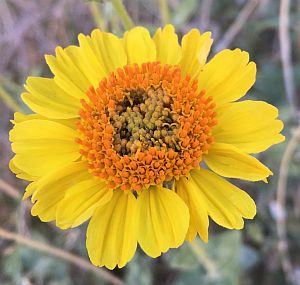
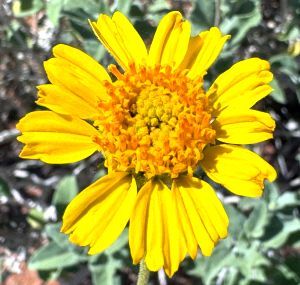
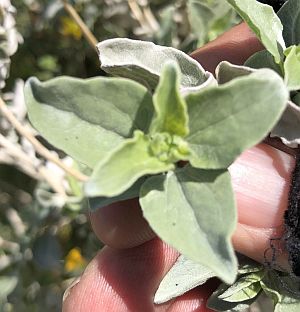
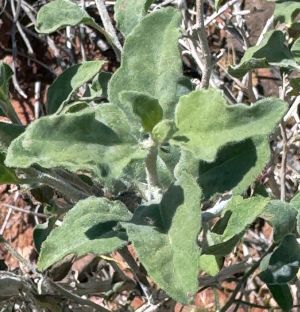
| Fig. 1. Photos of an "average" flower head of Encelia actoni (top row left) and E. virginensis (top row right), and an "average" leaf color of the two species (bottom row).
The "average" flower head in this case means, for each species, one with median values of three different characteristics that I measured in a sample of 21 heads of both species: the width of the disk divided by the width of the entire head; the ray flower width divided by its length; and the ray flower tooth depth divided by the ray flower length. The "average" leaf color in this case is the median color assigned to the leaves by my eye in that same sample of iNat observations, "gray-green to gray" for E. actoni, and "gray-green" for E. virginensis. Even though the leaves in these pix that are closest to the camera might both be described as "gray-green", the leaf of E. actoni is a bit whiter when compared to the leaf of E. virginensis. Since the older leaves for each species turn white-gray, it is important to compare leaves at the same growth stage. The photos of E. actoni were from the north base of San Jacinto Mountain near the community of Snow Creek. The photos of E. virginensis were taken from just north of St. George, Utah. See also more photos of the flower heads of both species side by side. Click on the pictures to go to the original iNat obs, which gives the information as to who took the photos, and the detailed location. | ||
Summary
Encelia actoni and E. virginensis are very similar, but different, species that are often hard to distinguish in photographs without a scale. The presence or not of strigose hairs on the leaves appears to be the most reliable way to separate the species, but it requires a close-up photograph of the leaf to see them. Other characteristics mentioned in the keys to separate them do not reliably determine individual plants, although some are useful to determine populations of plants of a single species.
Plant location works well most of the time to separate the species. The species have quite different geographic ranges and elevations, with most plants of E. actoni found in California, and most plants of E. virginensis found in Nevada, Utah, and Arizona, with overlap only near the California / Nevada border.
Table of Contents
Key Differences Between the Two Species
Leaf Color
Leaf Hairs
Number of Ray Flowers
Length of Ray Flowers
Ray Flower Tooth Depth
Other Differences Between the Two Species
Details of My Initial Analysis of iNat Observations of These Two Species
Is the species spelled Encelia actoni or E. actonii?
History of the names for these two species
Evidence that E. virginensis is an Ancient Hybrid of E. actoni and E. frutescens
Introduction
Encelia actoni and E. virginensis are very similar, but different, species that are often hard to distinguish; see Fig. 1 for representative pix of the flowers and leaves.
There is no doubt that these are distinct species, since it has been shown that E. virginensis is an ancient hybrid between E. actoni and E. frutescens; see Evidence that E. virginensis is an Ancient Hybrid of E. actoni and E. frutescens.
The two species also have quite different geographic ranges and elevations. E. actoni lives almost entirely in California, in the transition zone between the California mountains and the desert edge, and in similar habitat in Desert Mountains. E. virginensis lives almost entirely to the east of E. actoni, from the area near the southern Nevada / California border, to Las Vegas and then St. George, plus the area at elevations above the desert floor in Arizona from Sedona to Phoenix and then Tucson and then the New Mexico border. The species apparently overlap, and potentially intergrade, in the Mojave National Preserve in easternmost California and along the Nevada / California border. See Geographic Distributions.
I was curious as to how well plants of these two species could be distinguished, which is why I started this page. I've just begun to study the differences between these species, on 8 August 2026, so this page is preliminary.
The next section gives the distinctions between the two species given in the floras, as well as the results of my analysis of 21 iNat observations of each of the two species.
Key Differences Between the Two Species
Keys given in floras generally give the most important differences between the two species, sometimes modified by how easy it is to discern those differences. Usually the best distinction is given first.
Curtis Clark is the expert on Encelia species, and gave essentially the same key to separate these species in his 2006 Flora of North America (FNA) key, and in the 2012 and 2023 Jepson eFlora key by Keil and Clark that is reproduced here:
7. Leaves silvery green, canescent, not at all strigose; ray flowers 14-25, ray 10-25 mm, shallowly toothed; sw SnJV and adjacent WTR (Cuyama Valley), W&I, w D and adjacent CA-FP, DMtns ..... E. actoni
7' Leaves sparsely strigose and lightly soft-canescent; ray flowers 11-21, ray 8-15 mm, deeply toothed; e DMoj, DMtns ..... E. virginensis
The next sections discuss each of those characteristics, and include the results of an analysis in which I used iNat observations to measure the flowering head characteristics on 21 plants of each species, along with my estimate of their leaf colors. Details of that analysis are given in a later section.
Leaf Color
The leaves of E. virginensis are given as gray-green in the description.
The "average" leaves shown in Fig. 1 show the somewhat-subtle distinction between the silvery green leaves of E. actoni and the gray-green leaves of E. virginensis.
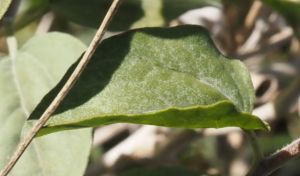
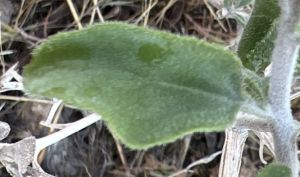
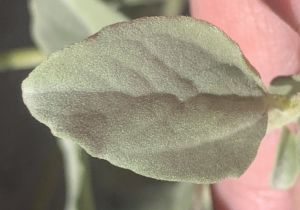
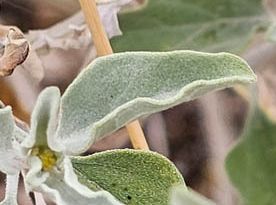
Unfortunately, the leaves of both species are quite variable, so the leaf color does not always work to distinguish them; see the examples in Fig. 2.
See also a more extensive comparison in Encelia actoni and E. virginensis Leaf Variation. A rough estimate is that the color of the leaves only works about half the time to separate the two species, at least in the mostly-random sampling used in that page.
| Encelia actoni | Encelia virginensis | |
| 
| |
| 
| |
| Fig. 2. Some examples of leaf variation in Encelia actoni (left column) and E. virginensis (right column) where the color of the leaf does not work to separate the species.
See also a more extensive comparison in Encelia actoni and E. virginensis Leaf Variation. Click on the pictures to go to the original iNat obs, which gives the information as to who took the photos. | ||
Leaf Hairs
The key mentions "strigose" and "canescent" leaf hairs. Definitions of those terms from Plant ID terminology by Harris and Harris:
"Strigose" means "bearing straight, stiff, sharp, appressed hairs".
"Canescent" means "gray or white in color due to a covering of short, fine gray or white hairs".
Most photographs of leaves are not close-up enough to show the strigose hairs, which are also described as scabrous (="rough to the touch") hairs, since that is what short stiff hairs often feel like. The canescent hairs are often visible as whiter patches on the leaves, even in pix that are not so close-up.
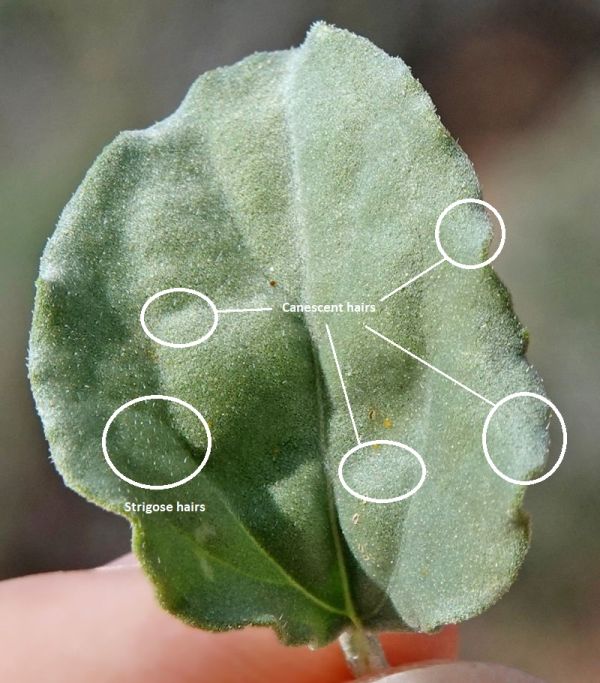
Fortunately, Jim Boone has taken good close-ups of the leaves of E. virginensis which show both kinds of hairs. Fig. 3 shows some excerpts from his pix with the hairs labeled by me, that beautifully illustrate the key element 7' for the hairs.
| |
| 
|
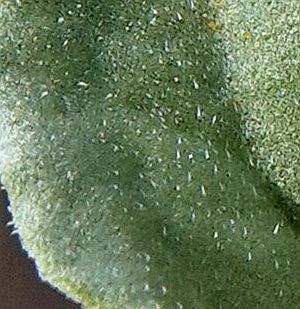
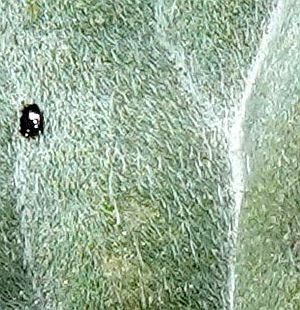
| Fig. 3. Photos of the strigose hairs and soft-canescent hairs of E. virginensis, taken by Jim Boone. The top photo shows a leaf which has one patch of strigose hairs circled, and four patches of canescent hairs circled. The canescent hairs show up as whitish patches on the otherwise gray-green leaf.
A blow-up of those strigose hairs from the leaf pix shown at top is shown at bottom left. The canescent hairs from a leaf of a different plant are shown at bottom right. Those hairs from a different plant were shown at a more close-up scale, and were in better focus, than a blow-up from the leaf shown at top. Click on the pictures to go to the original iNat obs. | |
For a side view of the strigose hairs, see this photo showing the hairs on a stem of Encelia resinifera. These hairs are a bit different from the usual strigose hairs that I am familiar with. I always thought that strigose hairs were strictly appressed to a surface starting at their base. The Encelia strigose hairs initially spread from the stem and then curve to be parallel to the stem. In fact, they are identical to the strigose hairs illustrated here in the illustration labeled "M" in the bottom row.
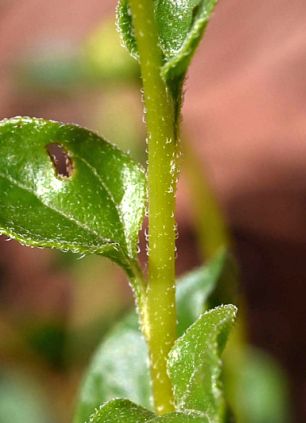
A rough estimate of the relative size of the hairs, from the leaf in Fig. 3, is that the canescent hairs are something like two to three times longer than the strigose hairs.
The presence or not of strigose hairs appears to be the most reliable way to separate the species, but it requires a close-up photograph of the leaf to see them.
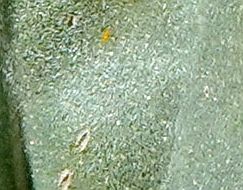
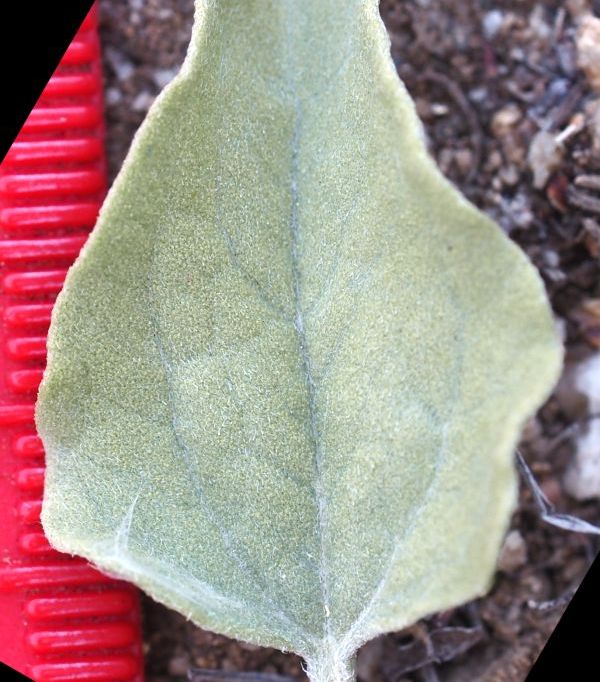
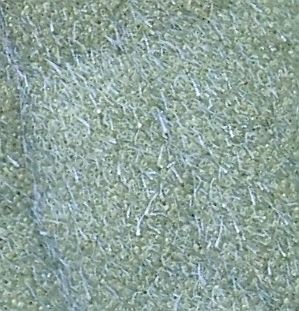
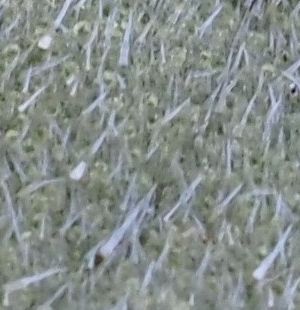
Fig. 4 shows the canescent hairs of a leaf of E. actoni in one of the very few photos of that species I could find that show the hairs close-up, taken by Kyle Brine.
| |
| 
|
| Fig. 4. Photos of the soft-canescent hairs of E. actoni, taken by Kyle Brine from Thomas Mountain, above Garner Valley at San Jacinto Mountain in Riverside County, California. The top photo shows the leaf. The bottom left photo shows a crop from that original photo. The bottom right photo shows a photo of the hairs taken at higher resolution.
Click on the pictures to go to the original iNat obs. | |
Number of Ray Flowers
The Jepson eFlora key gives a range of 14 to 25 ray flowers for E. actoni, and 11 to 21 for E. virginensis. The broad ~70% overlap range in the number of ray flowers between each species makes this key indeterminate for a large number of specimens. Furthermore, it is not clear how trustworthy the key is for heads that fall outside the overlap range, since it is not clear whether those numbers include less common counts or not.
The accuracy of those ranges is called into question by my ray flower counts of 21 heads of E. actoni from a fairly wide geographic area. That gave a range of 11 to 21 ray flowers, which is exactly the range in the key given for the other species, E. virginensis!
Fig. 5 gives a histogram of the ray flower counts for both species.
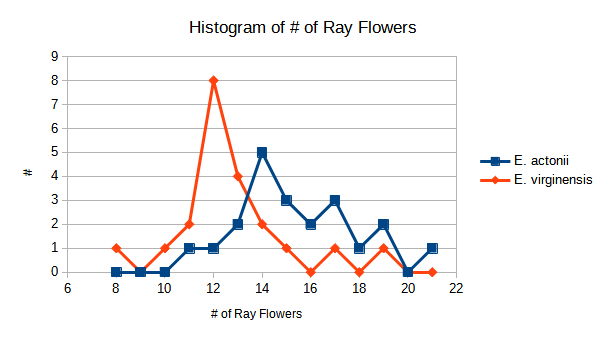
Fig. 5. Histogram of the number of ray flowers for Encelia actoni and E. virginensis.
Although the numbers in the Jepson eFlora key seem incorrect, the histogram does support the sense of the key, in that E. actoni tends to have more ray flowers than does E. virginensis:
- Out of 21 flower heads, 17 flower heads of E. actoni have 14 or more ray flowers, compared to only 5 flower heads of E. virginensis with 14 or more ray flowers.
- Correspondingly, 16 flower heads of E. virginensis have 13 or fewer ray flowers, compared to only 4 flower heads of E. actoni with 13 or fewer ray flowers. A surprising two-thirds of E. virginensis heads, 14 out of 21, had 11, 12 or 13 ray flowers.
This difference is probably useful in determining populations of each species, but is not very dependable in determining a single plant.
Length of Ray Flowers
The Jepson eFlora key gives a range in ray flower lengths of 10 to 25 mm for E. actoni, and 8 to 15 mm for E. virginensis. Since 70% of the range for E. virginensis is included in the range for E. actoni, and since we don't know whether less common lengths were included in those ranges, the ray flower length is also not useful in distinguishing individual flower heads. However, this could well be a good discriminant for populations, since one wouldn't have to measure very many heads to find out whether they are all less than ~15 mm in length, or whether a number are longer.
In any case, this characteristic is impossible to use for almost all iNat observations, since it is extremely rare to have a ruler in a photograph so that the ray flower length can be deduced.
Ray Flower Tooth Depth
The Jepson eFlora keys says that the ray flower tips of E. actoni are "shallowly toothed", and those of E. virginensis are "deeply toothed".
The FNA key had the comparison in parentheses: "(relatively shallowly toothed)" and "(relatively deeply toothed)". I don't know what was meant by the parentheses. When numeric values are given in parentheses in floras, it means the values are rare. If the parentheses here mean something similar, it might mean that this discriminant is only rarely useful.
It is not clear in the key whether the tooth depth refers to the actual size of the tooth, or whether it refers to the relative size of the tooth, compared to the ray length. That can make a significant difference, since the ray flower lengths for E. actoni can be 1.7 times longer than the lengths for E. virginensis.
In either case, it is odd that no numeric values were given for the tooth depth.
In pictures without a scale one can only measure the relative tooth depth. My analysis of iNat photos for 19 heads for each species shows essentially no difference in the ray tooth depth divided by the ray length; see Fig. 6. However, this likely means that the actual tooth depth could be ~70% deeper in E. actoni, since it has larger leaves, which would be opposite to the sense of the key!
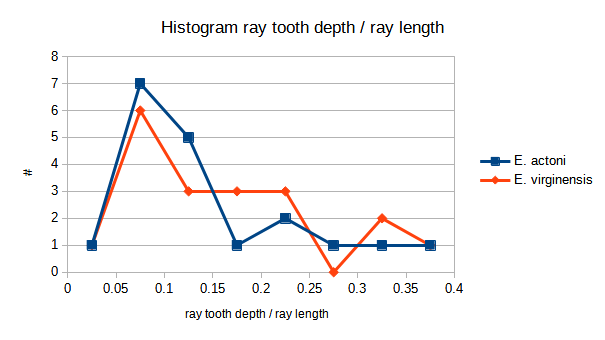
Fig. 6. Histogram of the ratio of the ray tooth depth divided by the ray length for Encelia actoni and E. virginensis. There is no significant difference between the two species in this histogram.
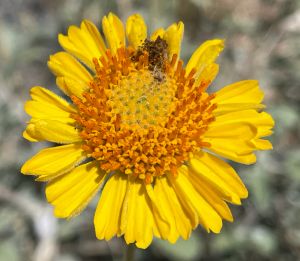
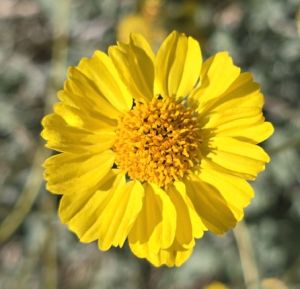
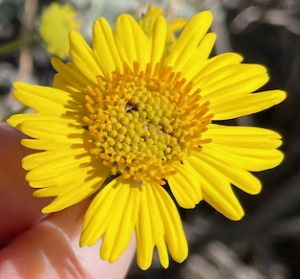
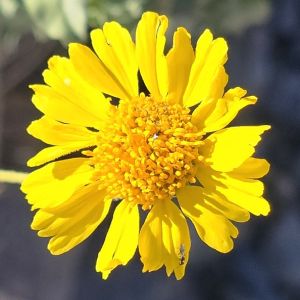
Fig. 7 shows the flower heads for each species with the shallowest teeth and the deepest teeth of the 19 heads measured for each species.
| Encelia actoni | Encelia virginensis | |
| 
| |
| 
| |
| Fig. 7. Some examples of the variation in the depth of the teeth at the tip of the ray flowers in Encelia actoni (left column) and E. virginensis (right column). The top row shows the head with the shallowest teeth for each species among the 19 heads measured. The bottom row shows the head with the deepest teeth for each species.
I only measured the teeth on a single ray flower in each head, the one I could see the best without part of the ray flower being hidden by overlap with other ray flowers. In the top row, I measured a ratio of the tooth depth to the ray flower length of 0.06 for one ray on the left flower head, and 0.03 for one ray for the right flower head. In the bottom row, I measured a ratio of 0.37 for one ray for the left flower head, and 0.38 for one ray for the right flower head. Click on the pictures to go to the original iNat obs, which gives the information as to who took the photos. | ||
Other Differences Between the Two Species
The only other differences between the two species given in the floral descriptions in the FNA and the Jepson eFlora are the size of the leaves, the shape of the tips of the leaves, and the shape of the phyllaries.
- E. actoni is said to have bigger leaves, petioles of 6-12 mm compared to 2-7 mm for E. virginensis, and blades of 25-40 mm, compared to 12-25 mm for E. virginensis.
Unfortunately, most iNat observations don't have a scale in the pix, so this can't be verified using those observations.
- The leaf tips of E. actoni are said to be acute, whereas the leaf tips of E. virginensis are said to be acute or obtuse.
However, a quick scan of the leaves of E. actoni on this page showing the leaf variation of the two species quickly shows that the leaves of E. actoni can also have obtuse tips.
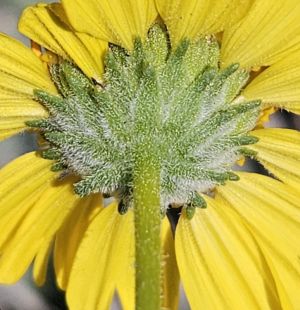
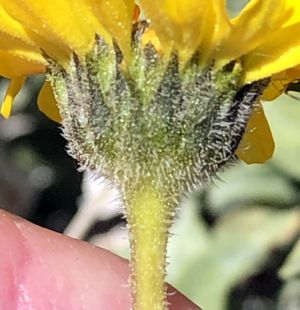
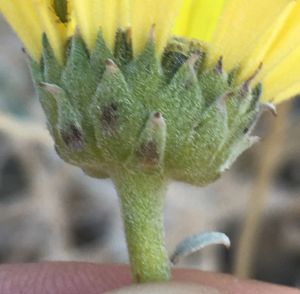
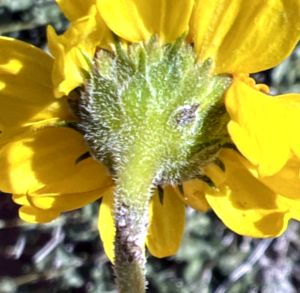
- The phyllaries of E. actoni are said to be "ovate", and the phyllaries of E. virginensis are said to be "narrowly ovate". A quick scan of iNat photos shows that the phyllaries of both species range from lanceolate to narrowly ovate to ovate. See Fig. 8.
- I put all 21 flowering heads of each species on a page showing the flower heads of both species side by side, in hopes of discovering some other difference I could pick up by eye. But I was not able to see any characteristic other than the ones mentioned above that would help me determine a pix of a flower head alone. Take a look and see if you can!
| Encelia actoni | Encelia virginensis | |
| 
| |
| 
| |
| Fig. 8. The phyllary shape variation in Encelia actoni (left column) and E. virginensis (right column). The phyllaries in the top row have a lanceolate or narrowly ovate shape. The phyllaries in the bottom row have an ovate shape.
The phyllary and peduncle hairs are also similar in the two species. Click on the pictures to go to the original iNat obs, which gives the information as to who took the photos. | ||
Other differences I investigated:
- I measured 20 flower heads of each species for the ratio of the disk width to the total head width, and there were no significant differences between the two species. I also measured the ray flower width divided by the ray flower length, and again found no significant differences.
- There appear to be no differences in the peduncle or phyllary hairs between the two species; see Fig. 8.
Details of My Initial Analysis of iNat Observations of These Two Species
To begin my first study, I used iNat observations to measure the flowering head characteristics on 21 plants of each species. The observations were selected from diverse areas in which only one of these two species was found, according to vouchers.
I selected areas at iNat that each had ~25 to ~50 observations, and used only observations that showed a straight-on view of the flower head, with the flower head in focus, with fresh ray petals that had their tips visible. At first I was only going to select observations that showed both a flower head and a good view of the leaves, but such observations were almost non-existent. Even observations with just a straight-on view of the flower head were surprisingly uncommon. If there were more than three to five such observations in a given area, I only measured the first three to five observations, making no selection other than the criteria in the first sentence of this paragraph.
For each flower head observation, I counted the number of rays, measured the disk width and the full head width, a ray flower length, width and tooth depth, selecting the ray flower I could see best, regardless of its tooth depth.
For each observation I recorded my estimate of the leaf color, using categories of "green to gray-green", "gray-green", "gray-green to gray", and "gray".
For E. actoni, I started in the Banner area in San Diego County, and worked my way north, measuring observations in Banner and Culp Valley in San Diego County; the Cactus Spring Trailhead area, and Snow Creek on the north side of San Jacinto Mountain, both in Riverside County; southeast of Yucca Valley in Joshua Tree National Park, San Bernardino County; Littlerock in the Mojave Desert in Los Angeles County near the type locality for E. actoni; and west of the town of Mojave in the Mojave Desert in Kern County. I stopped at that point since I had measured 21 heads.
For E. virginensis, I measured observations near its type locality in the area south of Virgin Peak, Nevada; the Las Vegas, Nevada area; the St. George, Utah area; the Zion National Park, Utah area (taking care to avoid any intermediates there with E. resinifera); the Sedona, AZ and south area; and in the McDowell Sonoran Preserve north of Phoenix, AZ.
Geographic Distributions
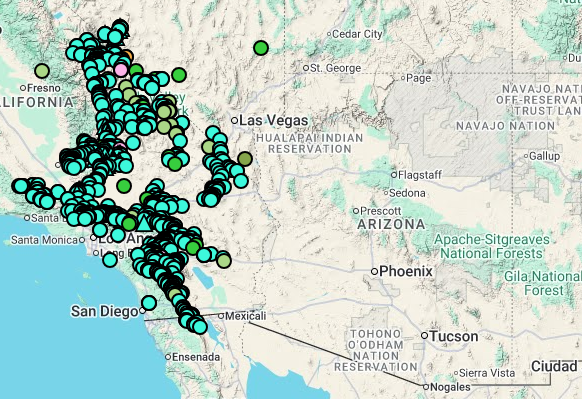
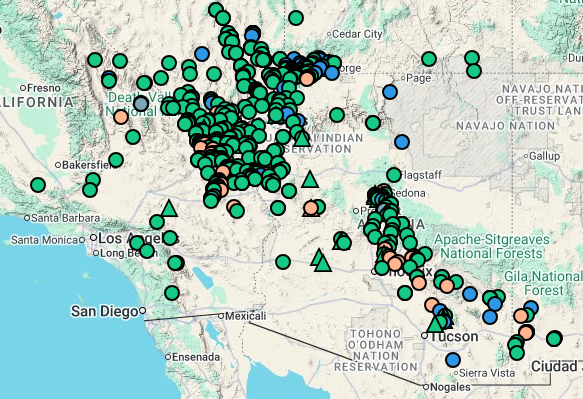
The geographic distribution of the two species from vouchers is shown in Fig. 9.
| Encelia actoni | Encelia virginensis | |
| 
| |
| Fig. 9. Map of Encelia actoni (left) from vouchers from CCH2, and E. virginensis (right) locations from vouchers from SEINet, retrieved in August 2026. The color differences denote different names which are synonyms or subtaxa of the species name.
Unfortunately, a number of vouchers were only determined to the species back when E. actoni was a subspecies or variety of E. virginensis. Hence all of the vouchers on the western edge of the E. virginensis distribution are actually plants of E. actoni. This is a general problem in vouchers when a subspecies was changed to its own species, since voucher determinations are often not updated for decades. Also, vouchers of "E. virginensis" in the Grand Canyon and eastern Utah area are actually E. resinifera, which was only defined in 1998 from plants formerly called E. virginensis. See Encelia resinifera and E. virginensis. The distributions are mostly disjunct, with apparent overlap only in the Mojave National Preserve in easternmost California and along the Nevada / California border. For the full interactive voucher map from CCH2 and SEINet, see E. actoni and E. virginensis. Click on the maps here for larger static versions. | ||
Is the species spelled Encelia actoni or E. actonii?
Encelia actoni was named for a place, Acton, Los Angeles County, California. The esoteric rules of botanical nomenclature thus require it to have only a single "i" added to the place name, making the name "actoni". If it had been named for a person called "Acton", it would have required "ii", and been actonii. For additional information, see Nomenclature by Michael Charters.
History of the names for these two species
Both of these two species for many years were considered varieties of E. frutescens, even though E. virginensis was described as its own species in 1904, and E. actoni in 1905. Keck in 1958 wrote that E. virginensis should be its own species, and it was restored to species status in the Munz and Keck 1959 California Flora, albeit with the inclusion of E. actoni as a subspecies under E. virginensis. That inclusion was maintained in the 1974 Munz Flora of Southern California.
Curtis Clark restored both as species in his 1993 Jepson Manual First Edition treatment, and maintained them as such in his 2006 Flora of North America treatment.
In the following, the names are linked to the original online references.
E. actoni:
1905: E. actoni
1907: E. frutescens f. actoni
1913: E. frutescens var. actoni
1958: E. virginensis ssp. actoni
1990: E. virginensis var. actoni
E. virginensis:
1904: E. virginensis
1907: E. frutescens f. virginensis
1913: E. frutescens var. virginensis
Evidence that E. virginensis is an Ancient Hybrid of E. actoni and E. frutescens
Curtis Clark measured eight characteristics of 119 plants of E. actoni, E. frutescens, E. virginensis, and F1 hybrids of the first two species. He found that E. virginensis came out intermediate between the two parents in a PCA using those characteristics, and that it was indistinguishable from the F1 hybrid. A plot of the mean achene length and width also found intermediacy. Internal transcribed spacers of nuclear rDNA found that the parent species differed by nine bases, and every sampled E. virginensis had "either the E. actoni base, the E. frutescens base, or a polymorphism consisting of both bases." See Phylogeny and Adaptation in the Encelia Alliance.
See also the discussion in Diversification, disparification and hybridization in the desert shrubs Encelia by Singhai et al 2021.