Encelia resinifera and E. virginensis
| Encelia resinifera | Encelia virginensis | |
| 
| |
| 
| |
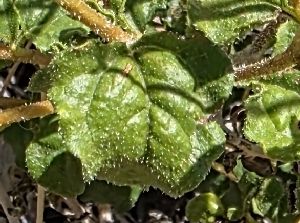
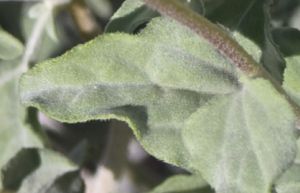
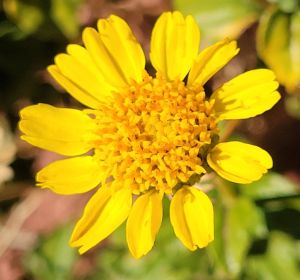
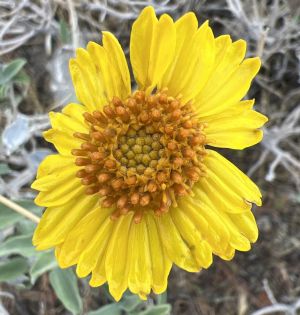
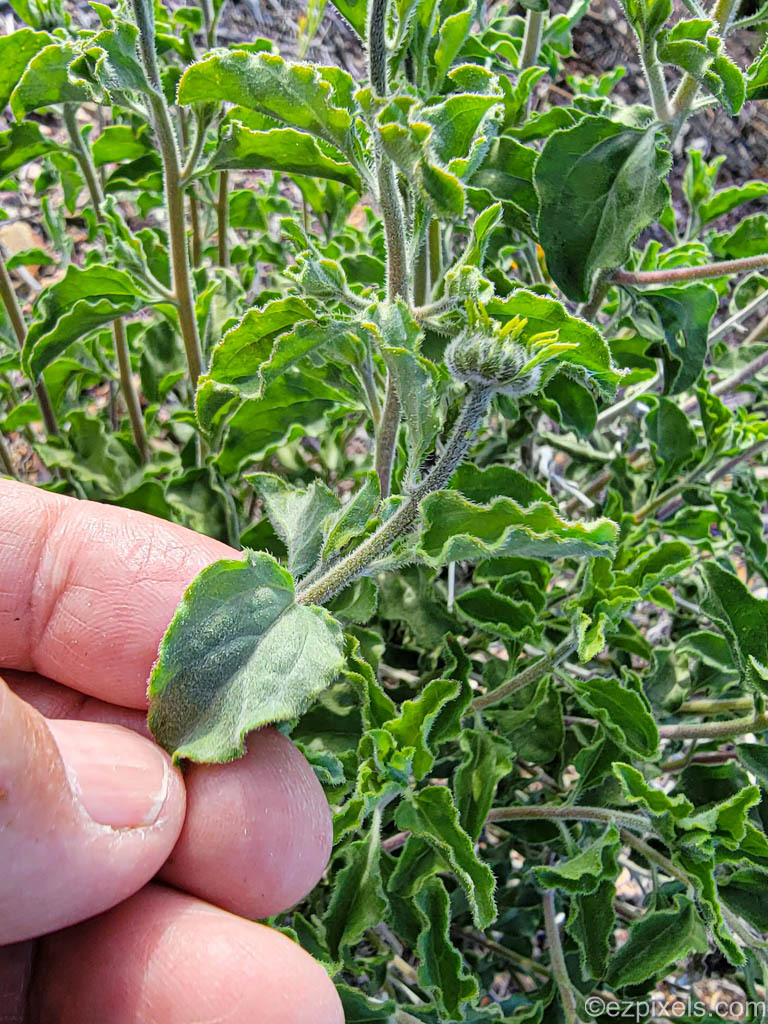
| Fig. 1. Photos of the leaves and flowers of Encelia resinifera var. resinifera (left) and those of Encelia virginensis (right). The color and hairiness of the leaves is the main separator of the species. The leaf of E. resinifera is green in color, and it has mostly rough scabrous hairs and sometimes strigose hairs. The leaf of E. virginensis is gray or gray-green in color with sparsely canescent and strigose hairs.
About half of the flowers of E. resinifera have a wider disk compared to the width of the flower as a whole, than any flower of E. virginensis. The other half of the flowers of E. resinifera are similar in that ratio to the flowers of E. virginensis. Click on the pictures to go to the original iNat obs, which gives the information as to who took the photos. | ||
Introduction, including How To Distinguish These Species
History of the names for these two species
Intergradation of the Species at Zion National Park
Keys Used to Distinguish the Species
Introduction, including How To Distinguish These Species
Encelia resinifera and E. virginensis are very similar, but different, species which are both thought to be ancient hybrids between E. actoni and E. frutescens; see Diversification, disparification and hybridization in the desert shrubs Encelia by Singhai et al 2021! Their DNA results (using only a small part of the entire genome) nestle both species together.
That's worth saying again. Hybridization of the same two species at two separate times resulted in two closely-related, but different, species!
This is not as surprising as it seems. For one thing, one species may have resulted from pollen from E. actoni on the ovary of E. frutescens, and the other species may have resulted from pollen from E. frutescens on the ovary of E. actoni.
Also, hybrids go through a process of change to their genome with successive generations until the genome stabilizes; see Eukaryote hybrid genomes by Runemark et al 2019. This process may result in different end points, even when the hybrid starts in the same way. The two hybrids therefore might have differed significantly almost immediately, and then their separate evolution would increase their differences.
As expected of species of ancient hybrid origin, both species occur in disjunct habitats from their parent species. I.e., the combination of the genes from the two parents allowed them to adapt to different environments, with the result that the ranges of the two species are different from the ranges of the parents. For example, E. actoni does not occur in the range of E. resinifera, showing that E. resinifera is its own species now, having spread far from its origin within the range of E. actoni.
It is striking that the main difference between these two species is that E. resinifera has a green leaf with scabrous hairs like one of its parents, E. frutescens, and E. virginensis has a gray or gray-green leaf with sparsely canescent and strigose hairs like the other parent, E. actoni; see Fig. 1.
While there is considerable variation in the leaf of each species, the color and hair difference almost always distinguish the two species. However, in reviewing iNat posts of these two species, I came across two posts of E. virginensis from central Arizona that had green fresh leaves, but gray-green older leaves, so that can apparently happen. Interestingly, some of the leaves on those plants had toothed / corrugated edges, which is also different from the entire leaves that this species has in almost all other plants. See this pix which beautifully shows that transition from green new leaves to gray leaves, from this post, as well as this post.
Color can be tricky, since people often see colors differently, and colors can look different due to the lighting conditions and how photos are processed. In order to help judge whether a leaf is green or gray-green, I've made two pages showing the variation in the leaves of each species. The pages can be used as a comparison to a photo of a leaf of a plant, to help see whether the leaf is green, gray-green, or gray. The pages can also be opened side by side on a computer to show the differences.
Other differences between the species
There are four other characteristics that can at least sometimes distinguish the species.
- The stems of E. resinifera are glabrate, almost always with only a few short hairs, which are curved upward, as in the left photos in Fig. 2. I've seen only two plants with denser hairs, both from Marble Canyon / Little Colorado River in the Grand Canyon area: the lower stem hairs in this pix from this observation, and this photo, from this observation.
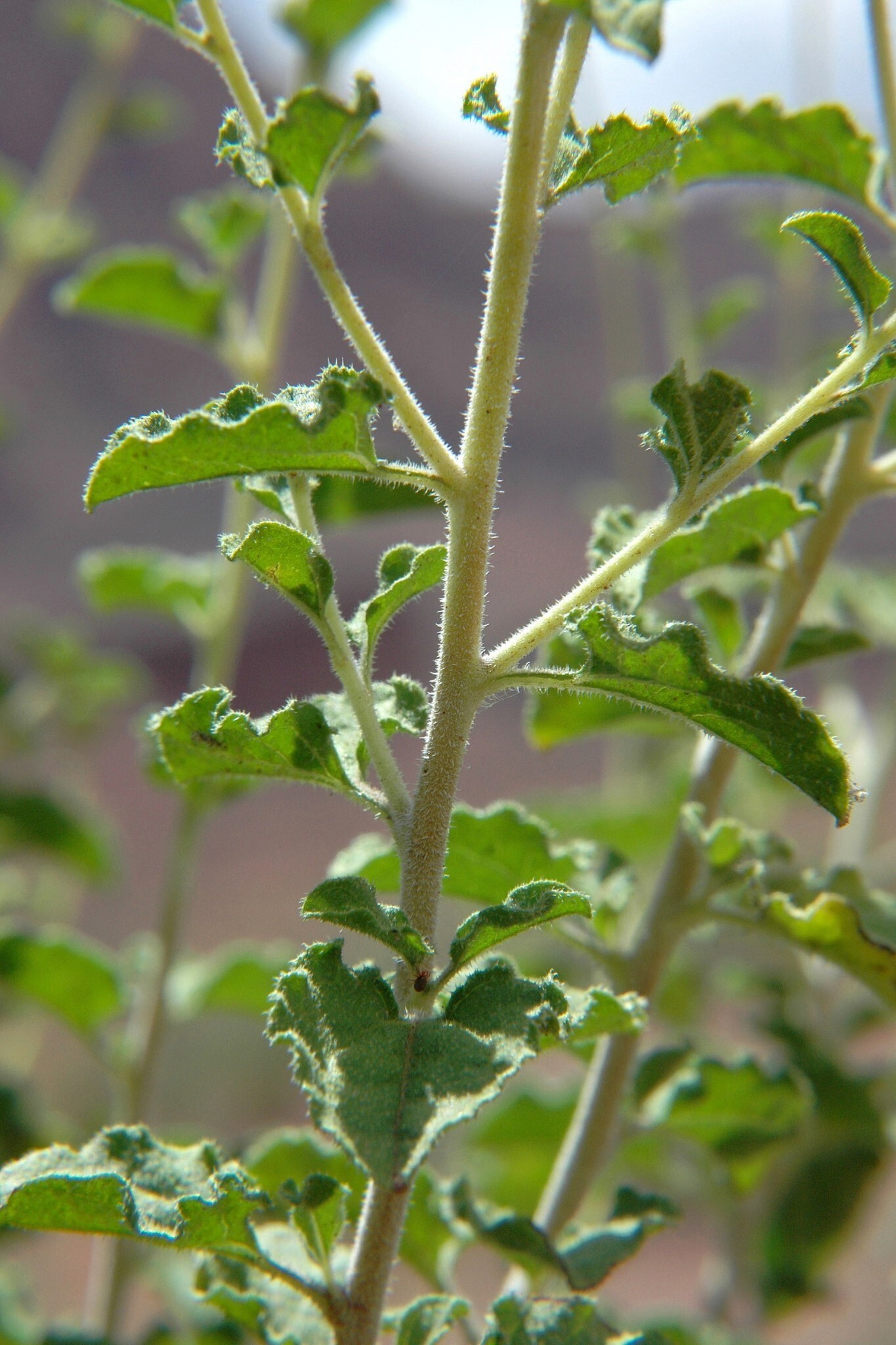
In contrast, the stems of E. virginensis are almost always hairier, with longer white hairs, but ranging from fairly sparse hairs (top right photo in Fig. 2) to abundant white hairs that often make the stem appear white (bottom right photo in Fig. 2).
Encelia resinifera Encelia virginensis 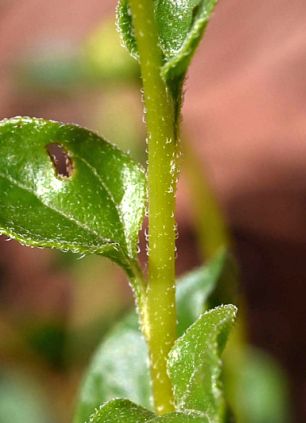
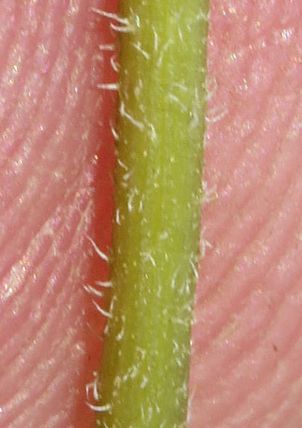
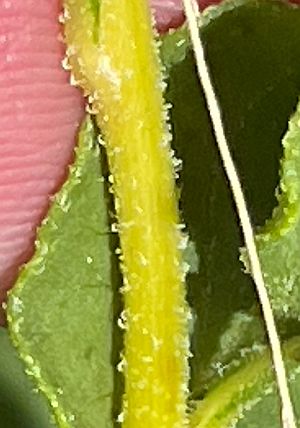
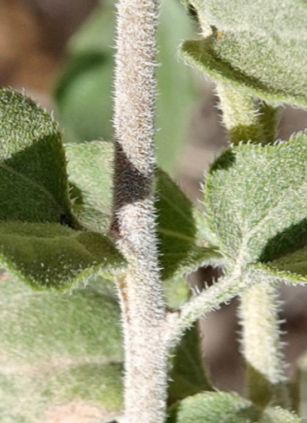
Fig. 2. Photos of the stem hairs (not the peduncle hairs) of Encelia resinifera var. resinifera (left) and those of Encelia virginensis (right). The left photos show the very typical sparse hairs of E. resinifera, that almost always curve upward. The photos on the right shows the considerable variation in the stem hairs of E. virginensis. The stem hairs are almost always longer than the stem hairs of E. resinifera, but can be fairly sparse (upper right photo) to very dense (lower right photo).
The hairs on the stem of E. virginensis change when the stem produces a flower and becomes a peduncle, becoming much less dense; see the photos in Fig. 3.
Click on the pictures to go to the original iNat obs, which gives the information as to who took the photos.
- The flowers of E. resinifera generally have a wider disk compared to the width of the flower as a whole, although there is much overlap in the ratio. E. resinifera has a ratio of disk to head width of 0.35 to 0.63, with half of the measured heads having a ratio of 0.45 or greater. E. virginensis has a ratio of 0.34 to 0.44. Thus flowers with a ratio definitely larger than 0.45 are highly likely to be E. resinifera. Flowers with a ratio of 0.45 or below could be either species. In Fig. 1, the ratio of the head of E. resinifera is 0.44, the median value for measured heads of that species, and the ratio of the head of E. virginensis is 0.38, the median value for measured heads of that species.
- The peduncle and phyllary hairs can also distinguish the two species at times, but the difference can be more subtle at times.
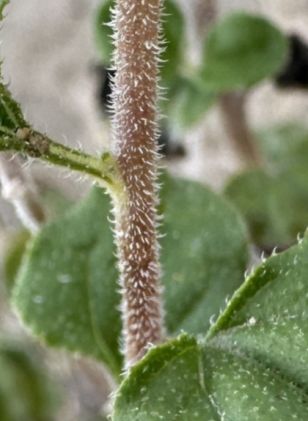
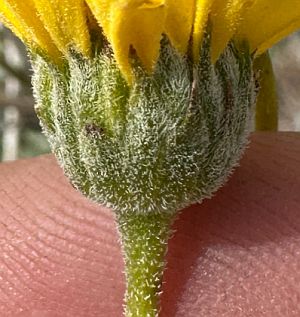
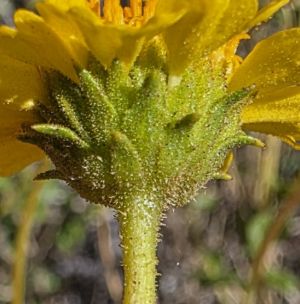
The peduncle of E. resinifera ranges from being nearly glabrous, with sparse hairs that are curved upward (top left photo in Fig. 3), to having mostly glandular hairs (bottom left photo in Fig. 3).
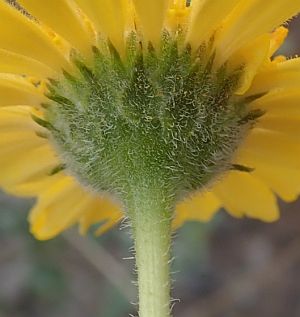
The peduncle of E. virginensis is almost always hairier, with white spreading hairs that can be short (top right photo in Fig. 3) or long.
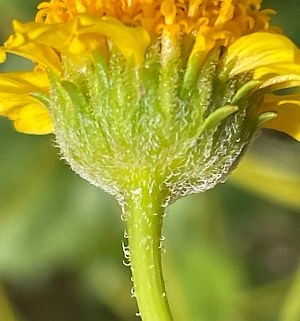
The phyllaries of E. virginensis are moderately to densely covered with long white hairs (top and bottom right photos in Fig. 3).
The phyllaries of E. resinifera can have dense glandular hairs (bottom left photo in Fig. 3), or can have sparse to moderate long white hairs that sometimes include dense patches on some, but not all, phyllaries (top left photo in Fig. 3).
- The Utah Flora mentions that the phyllary tips can distinguish the two species, with the very tip of the phyllaries of E. virginensis having a little tail-like appendage that is absent in the phyllary tips of E. resinifera. Those tail-like tips are most visible in the top right photo in Fig. 3. They are also seen in the bottom right photo in Fig. 3, but are much less visible.
| Encelia resinifera | Encelia virginensis | |
| 
| |
| 
| |
| Fig. 3. Photos of the phyllaries of Encelia resinifera var. resinifera (left) and those of Encelia virginensis (right). See text for a description of these pix.
Click on the pictures to go to the original iNat obs, which gives the information as to who took the photos. | ||
History of the names for these two species
Both of these two species for many years were considered varieties of E. frutescens, even though E. virginensis was described as its own species in 1904. Keck in 1958 wrote that E. virginensis should be its own species, and it was restored to species status in the Munz and Keck 1959 California Flora, albeit with the inclusion of E. actoni as a subspecies under E. virginensis. E. resinifera was not described at the species level until 1998!
Curtis Clark restored both E. actoni and E. virginensis as species in his 1993 Jepson Manual First Edition treatment, and maintained them as such in his 2006 Flora of North America treatment, along with E. resinifera.
In the following, the names are linked to the original online references.
E. resinifera:
1907: E. frutescens f. radiata
1913: E. frutescens var. resinosa
1998: E. resinifera var. resinifera; E. resinifera var. tenuifolia
In 1906, Brandegee described a species he called E. resinosa from Hidalgo, Mexico, but that apparently was a different taxon from E. resinifera.
E. virginensis:
1904: E. virginensis
1907: E. frutescens f. virginensis
1913: E. frutescens var. virginensis
Geographic Distributions
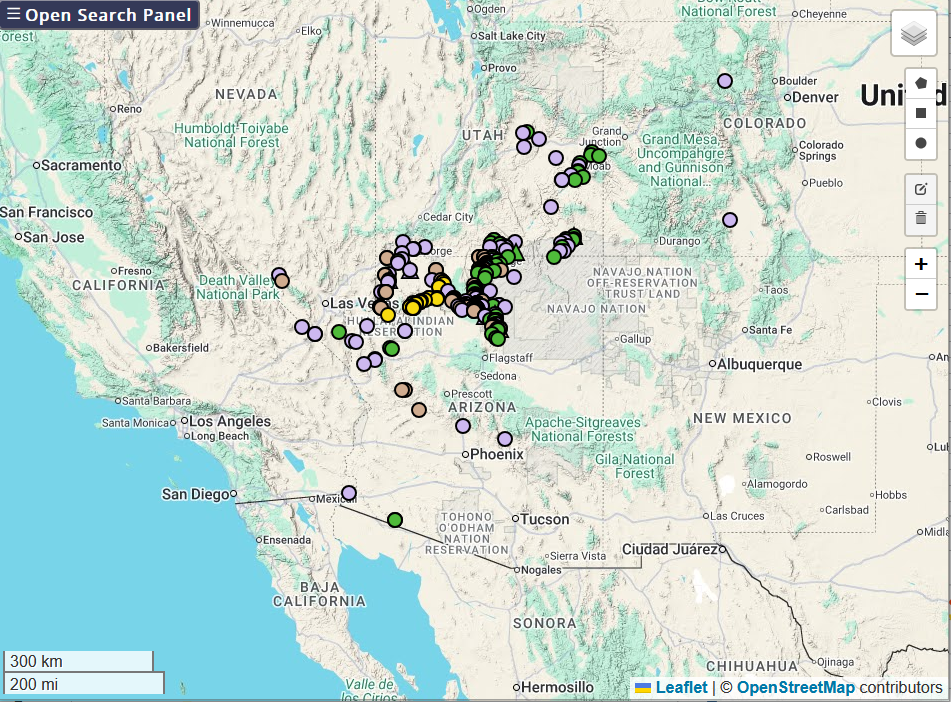
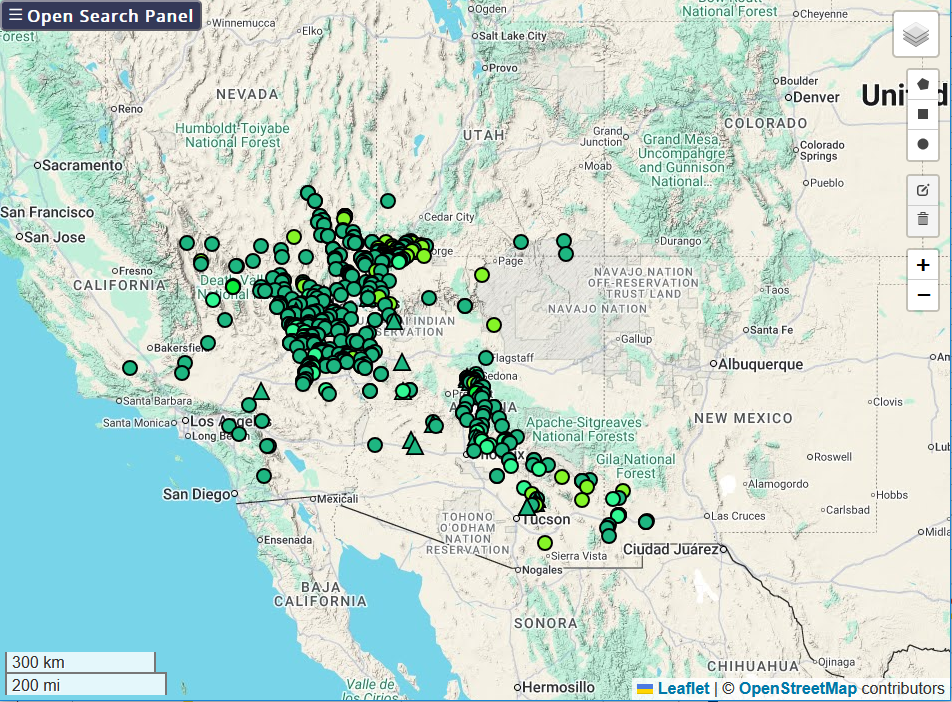
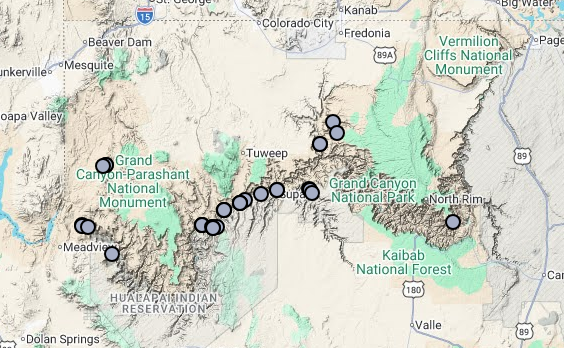
The geographic distribution of the two species from vouchers is shown in Figs. 4 and 5. Fig. 5 also maps my determinations of some iNat observations east of E. longitude of -113°.
| Encelia resinifera | Encelia virginensis | |
| 
| |
| Fig. 4. Map of Encelia resinifera (left) and E. virginensis (right) from vouchers from SEINet retrieved in June 2026. The color differences denote different names which are synonyms or subtaxa of the species name. The distributions are somewhat disjunct, with only E. resinifera found in Utah and Arizona east of the longitude of St. George, Utah, and with mostly only E. virginensis found west of Las Vegas and south of Flagstaff. However, both species are found together in a significant area.
It is likely that some vouchers are misdetermined, such as the ones of "E. virginensis" in southeastern Utah, since the Utah flora gives only E. resinifera in that location. In fact, examination of the two vouchers with photos shows that the leaves are green, not gray, indicating they are indeed E. resinifera, not E. virginensis. For the full interactive voucher map from SEINet, see E. resinifera and E. virginensis. See Fig. 5 for a map with both species together. Click on the maps here for larger versions. | ||
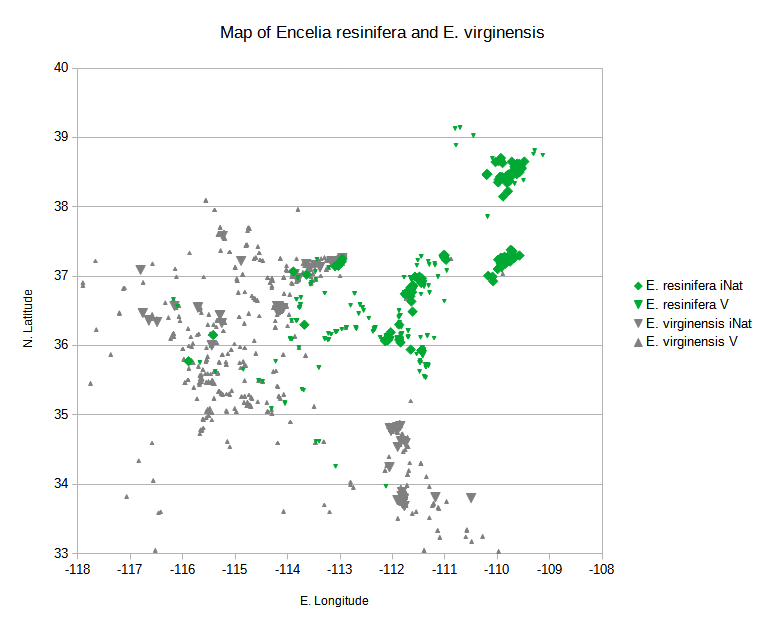
Fig. 5. Map of Encelia resinifera (green symbols) and E. virginensis (gray symbols) from vouchers from SEINet retrieved in June 2026 (small symbols with label "V") and from iNat observations of the two species reviewed by the author (large symbols with label "iNat"). The area shown is the same as the areas shown in Fig. 4; refer to those maps to see landmarks near a given location.
Intergradation of the Species at Zion National Park
Something weird happened when I started working on identifying the iNat observations from Zion National Park - I had trouble confidently identifying them!
Prior to that, I had identified ~200 iNat observations of both species. Those observations consisted first of about 50 observations taken from throughout the range of the two species, as I was learning how to discriminate the two species. I then systematically identified iNat observations from east to west in Utah and Arizona.
I had no trouble identifying those ~200 observations. The species in each observation was generally clear at a glance, primarily from the color of the leaves, as detailed above.
But the first several iNat observations at Zion were not so clear to me. I then abandoned my usual practice of identifying each iNat observation at the time I reviewed it, since I wasn't confident about my determinations at Zion. I decided instead to go through all the ~53 iNat observations at Zion first before posting my determinations.
Surprisingly, at the end of that exercise, I still wasn't happy with my determinations. I then went through all the observations again, looking at all the characteristics that separate them when they were present in the photographs, and recording them in a spreadsheet. To my chagrin, I changed my mind about at least a few of the obs.
I then plotted the locations of my determinations of the two species, hoping to see some geographic separation between them. There was a bit of geographic separation for some observations, but a number of the two species were intermixed in close proximity.
Wondering if I had simply underestimated the range in characteristics of E. virginensis, I then went through the 73 iNat obs from what is probably the type locality for E. virginensis, south of Virgin Peak in Nevada, 80 miles to the southeast of Zion. To my relief, I had no trouble identifying those observations.
That left only one possibility, that at least some of the Zion plants were intergrades between the two species, explaining my difficulties in trying to shoehorn some of the plants into just one of the two species.
In retrospect, it shouldn't have been surprising to find intergrades at this location, since Encelia species readily hybridize with each other, and Zion National Park is one of the areas where the range of both species overlaps; see Fig. 4. Zion National Park is in the extreme southeast corner of Utah, 30 miles northeast of St. George.
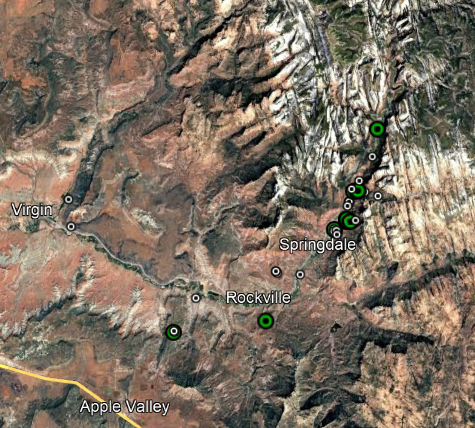
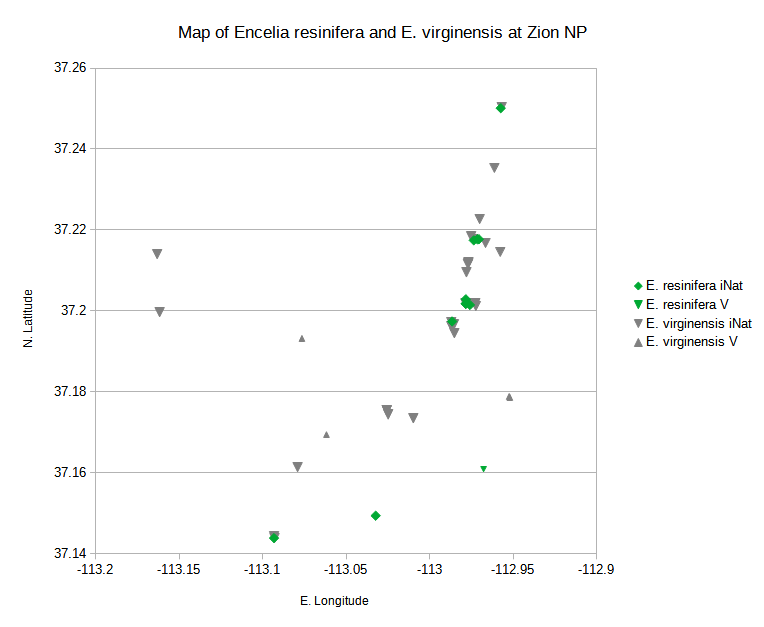
Fig. 6 shows two maps of my determinations of the iNat observations in the Zion National Park area, as well as voucher determinations in that area. Those maps show that the E. resinifera locations are all on the east or southeast, and are the edge of the main distribution of that species. The E. virginensis locations are also on the edge of the main distribution of that species, which is found to the west and southwest of Zion.
| 
| |
| Fig. 6. Maps of E. resinifera (green symbols) and E. virginensis (gray symbols) from my determinations of iNat observations in Zion National Park, on a Google Earth map (left) and on a plot that also includes vouchers (right).
The E. resinifera locations are all on the east or southeast in these maps, and represent the edge of the main distribution of that species; see Fig. 5. Click on the map or plot to see larger versions. | ||
Here are some examples of intergrades at Zion National Park:
- 362601743. Leaves are green, with scabrous hairs, typical of E. resinifera, but the stem is canescent, typical of E. virginensis.
- 217684988. Some leaves are bright green and appear non-canescent, typical of E. resinifera, but some leaves are gray-green and canescent, typical of E. virginensis. The stems appear canescent in parts, and glabrescent in other parts, combining the characteristics of each species.
- 148808122. Some leaves are green, with scabrous hairs, typical of E. resinifera, but other leaves are gray-green with canescent hairs, typical of E. virginensis. The stems have strigose hairs in places, typical of E. resinifera, but canescent hairs in other places, typical of E. virginensis.
There are at least four other iNat obs from Zion that similarly mix-up the characteristics of the two species. You can see why I was confused in trying to identify these observations as a single species!
Compare those with:
- these three iNat observations of perfect E. resinifera from Zion, with green leaves, scabrous hairs on the leaves, sparse hairs that are curved upward on the stem and on the peduncle, and glandular hairs on the phyllaries with only partial coverage by canescent hairs: 170513023; 170514415; and 374425648.
- this observation of perfect E. virginensis from Zion, with gray-green leaves, and the longer straight hairs on the peduncle and phyllaries, as well as this observation showing gray-green canescent leaves, with longer straight white hairs on the stem.
Table 1 gives the number of iNat obs of each species from the various areas I've reviewed, showing how unique the Zion area is so far in having both species present. Each area in the header is linked to iNat obs of all Encelia species for that area so you can quickly review just an individual area. You can then select the "species" view, and then select only the species of your interest, to only see observations determined as a single species. Note that many obs of E. resinifera are called Encelia species at iNat if an obs had a previous determination of E. virginensis, which I then annotated as E. resinifera, and there were no further updates. Hence selecting a single species will not include such observations.
Table 1. Number of iNat posts of each Taxon in Different Areas Ordered From East to West
| Taxon | Moab, UT^ | se UT | Sedona to Phoenix, AZ | Marble Canyon AZ | Grand Canyon AZ | Zion, UT | South of Virgin Peak, NV |
|---|---|---|---|---|---|---|---|
| E. resinifera | 67 | 28 | 0 | 43 | 30 | 13 | 0 |
| Intergrades | 0 | 0 | 0 | 0 | 0 | 7* | 0 |
| E. virginensis | 0 | 0 | 54 | 0 | 0 | 29* | 61 |
*The number of intergrades could be significantly higher, and the number of E. virginensis observations significantly lower, since most of the observations called E. virginensis, solely from the color of the leaves, do not show the stem, peduncle, or phyllary hairs.
I discovered something interesting when I went through all the iNat obs of Encelia in the Moab area to determine them. In this area, of these two species, only E. resinifera exists. For observations posted prior to September 2024, most of the iNat obs were correctly determined as E. resinifera, with no iNat obs determined as E. virginensis, almost always by identifiers who knew the species there. But for observations posted after that time, there were 51 obs determined as E. virginensis, and only 37 obs determined as E. resinifera. The reason is almost surely that during that later period, the iNat Computer Vision Model suggested only E. virginensis for those observations, with no mention of E. resinifera, probably because E. resinifera was not in the Computer Vision Model (and still wasn't as of August 2026), and hence doesn't appear in the "expected nearby" species.
E. resinifera Subspecies
There are two subspecies of E. resinifera. Ssp. tenuifolia has lengths of leaf blades and ray flowers at least three times their widths, as shown in Fig. 7. Ssp. resinifera has leaf blades that range from having roughly the same width as length, up to a length ~2.5 times their widths, and ray flowers with lengths ~1 to ~2 times their widths.
Ssp. tenuifolia has a very narrow distribution only in the Grand Canyon "following the 1200 m (4000 foot) contour". It is said to intergrade with ssp. resinifera at the east end of the Canyon. All other locations have only ssp. resinifera.
There are only three iNat obs of plants that have the narrow leaves of ssp. tenuifolia, but the ray flowers of those plants are not narrow. That may indicate that they are intergrades, or may just mean that ssp. tenuifolia doesn't always have narrow ray flowers. There is also fourth observation of ssp. tenuifolia which didn't have flowers.
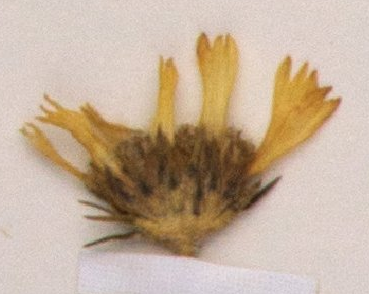
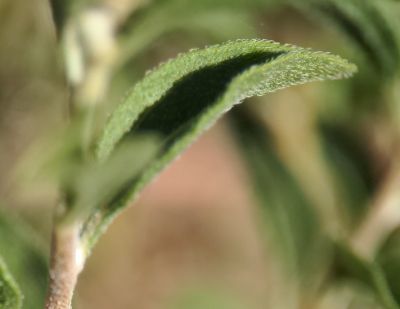
Fig. 7. Ray flowers and leaves of Encelia resinifera ssp. tenuifolia. Click on the photos to go to the type specimen or the iNat observation.
Keys Used to Distinguish the Species
This section gives keys that have been published to separate the two species, plus some additional information about them.
The key to separate these species in the Curtis Clark paper defining E. resinifera is:
1. Leaves silvery pubescent, broad2. Rays numerous, well-developed, leaf pubescence of long, soft hairs and occasional glands ... E. actoni
2'. Rays fewer, short, leaf pubescence of long, soft hairs; short, broad, coarse hairs; and glands .... E. virginensis
1'. Leaves green with sparse, coarse hairs
3'. Rays present
6. Leaves broadly ovate, rays broad .... E. resinifera ssp. resinifera
6. Leaves lanceolate or linear, rays narrow .... E. resinifera ssp. tenuifolia
The Flora of North America key to separate these species is:
7 Leaves scabrous to strigose (not canescent) .... E. resinifera7' Leaves canescent, sometimes strigose as well
8. Leaves sparsely canescent and strigose; rays 11-21, laminae 8-15 mm (relatively deeply toothed) ... E. virginensis
8'. Leaves ± silvery-canescent (not strigose); rays 14-25, laminae 10-25 mm (relatively shallowly toothed) .. E. actoni
The Utah Flora key to separate the species is:
1. Herbage strigose, also with some pustular-based hairs; involucral bracts abruptly caudate-acuminate, strigose; plants of Washington County ... E. virginensis1' Herbage hispid with pustular-based hairs; involucral bracts gradually attenuate, more or less glandular (sometimes strigose); plants of the Colorado Basin ...E. resinifera
The Utah flora also says for E. resinifera:
There is a cline of glandularity in leaves from definitely glandular in the southern portion of the range in Utah to no glands at all in the northern material.
Type of E. resinifera from Little Colorado River "near Winslow, Arizona".
Type of E. virginensis from "Valley of the Virgin, Nevada".
Analysis showing that E. virginensis is consistent with a hybrid between E. actoni and E. frutescens:
Curtis Clark measured eight characteristics of 119 plants of the E. actoni, E. frutescens, E. virginensis, and F1 hybrids of the first two species. He found that E. virginensis came out intermediate between the two parents in a PCA using those characteristics, and that it was indistinguishable from the F1 hybrid. A plot of the mean achene length and width also found intermediacy. Internal transcribed spacers of nuclear rDNA found that the parent species differed by nine bases, and every sampled E. virginensis had "either the E. actoni base, the E. frutescens base, or a polymorphism consisting of both bases." See Phylogeny and Adaptation in the Encelia Alliance.