Small-Flowered Plants of Lupinus arizonicus, Arizona Lupine
| 
| |
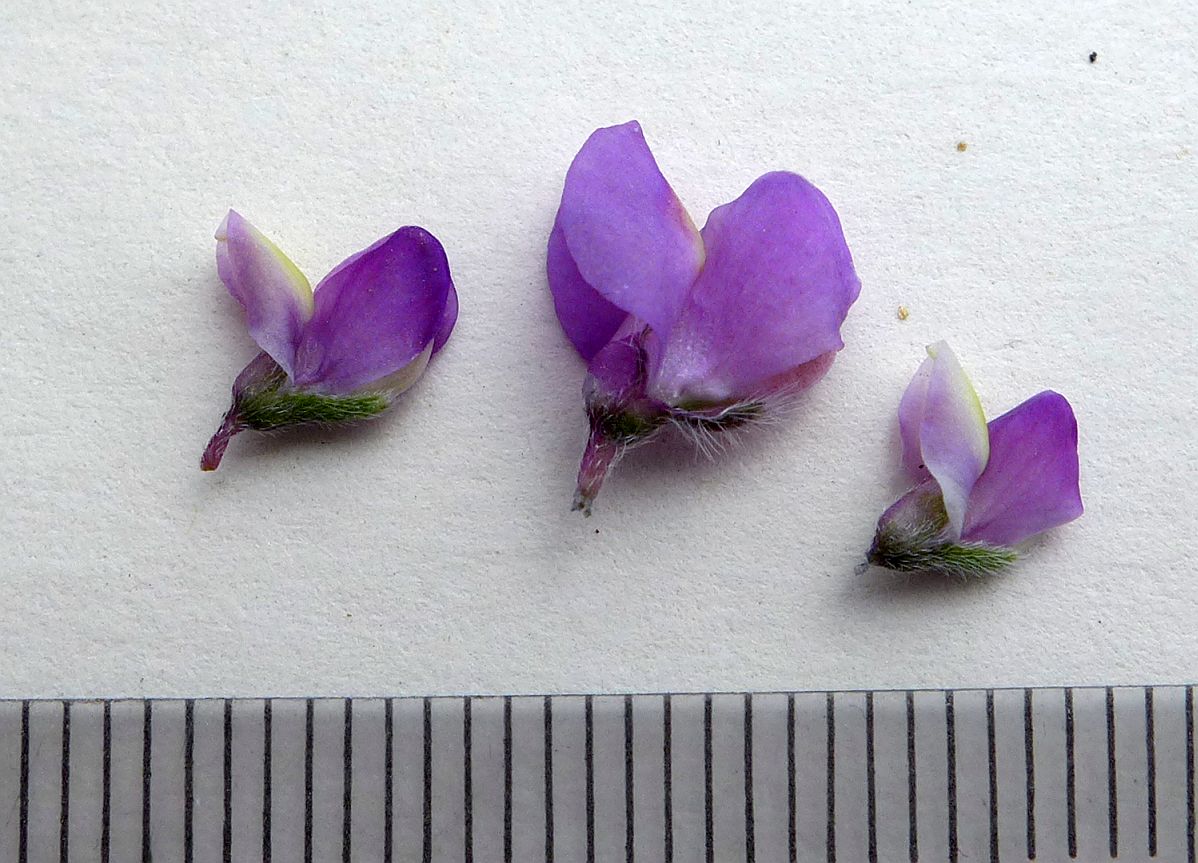
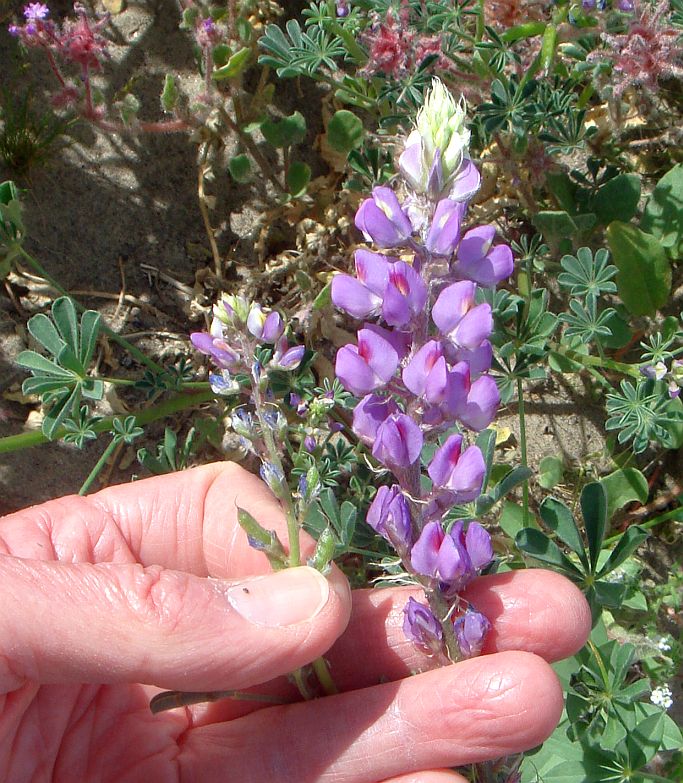
| Fig. 1. Two forms of Lupinus arizonicus. In each pix, the small-flowered form is on the left.
The small-flowered form in the left photo is from plants along Coyote Creek Road just south of Di Giorgio Road on 13 March 2016. The large-flowered form is from plants about a mile farther along the road. See additional pix of those plants. The right photo is from a field north of Henderson Canyon Road, just west of the Pegleg Monument, where both forms were growing together on 18 February 2011. There was no discernable difference between the forms in the field except for the size of the flower. See additional pix of those plants. Photos taken by Tom Chester. Click on the pictures to see larger versions. | ||
In 2010, I thought I knew all the lupine species found in the Borrego Desert. But on 15 March 2010, when my wife and I stopped at Coyote Canyon Road just past the end of the pavement of Di Giorgio road, there was a carpet of a small-flowered lupine with pink-purple flowers that I didn't recognize! These lupines were extremely abundant there.
In the field, I was sure that these lupines had to be a species different from L. arizonicus since they were smaller plants with much-smaller flowers.
When we then visited the flower field on the north side of Henderson Canyon Road, I became even more perplexed. Plants of the same small-flowered species with pink-purple flowers from Coyote Canyon Road were growing abundantly there, and one patch was right next to a taller, larger flowered, very clear L. arizonicus. I looked at two of the plants side by side, and shook my head, asking my wife if she could see any difference in these plants except for size. She couldn't either.
So now I was really puzzled. How could there be two seemingly-different species that looked identical except for size?
Because I was sure that these were two different species, I took samples home to examine closely, to find out what the small-flowered species was.
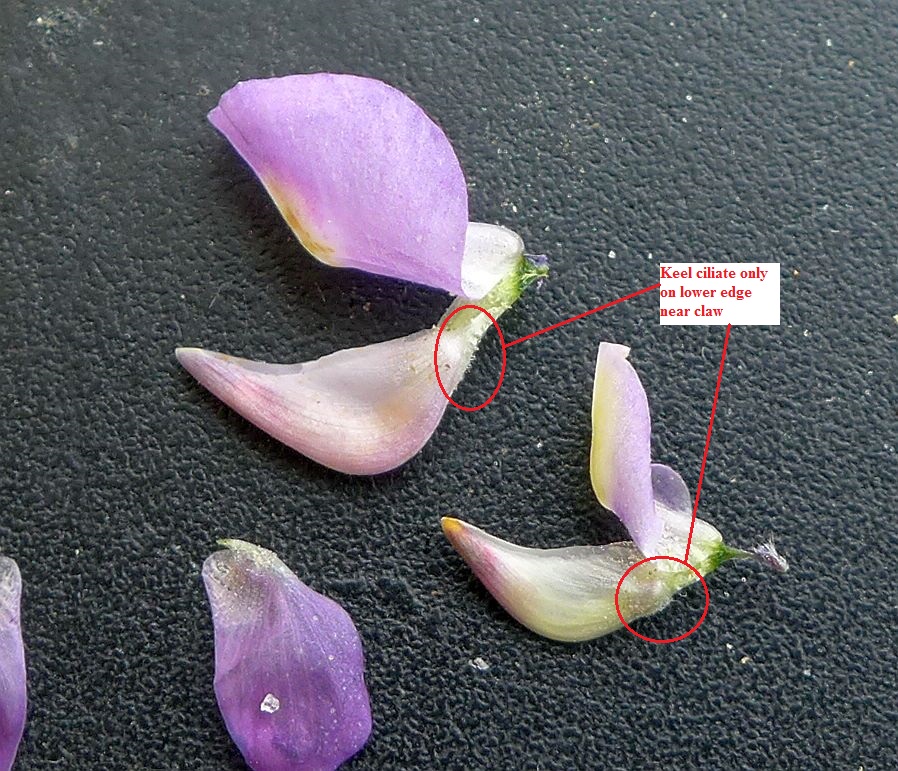
I spent almost a half day measuring and analyzing my samples, and reached the conclusion that the small-flowered plants were indeed L. arizonicus. There was not a single characteristic of the small-flowered plants that differed significantly from values for that species. As only one example, the small and large flowers have identical hairs on the keel, which are key to separating many lupine species. Both flower sizes have no hairs on the upper edge of the keel, and identical hairs on the lower edge only near the base of the keel; see photo from 13 March 2016.
I later learned that a flower-size difference had been previously noted. Smaller-flowered plants were originally described as L. arizonicus, with corolla lengths of 7 to 10 mm, and larger-flowered plants were later described as L. arizonicus var. barbatulus, with corolla lengths of 10 to 11 mm.
Most floras ignore the varieties, probably because it seems very arbitrary to split two varieties out of a range in flower size of 7 to 11 mm.
Our plants don't clearly fit either of those varieties! Fig. 2 shows my measured corolla lengths for fresh flowers, as well as the Jepson eFlora range for the corolla lengths of L. arizonicus (7 to 10 mm; which possibly failed to include the 10 to 11 mm range for var. barbatulus). Those Jepson numbers might be values for fresh flowers, but it is more likely that they are values of dried, pressed corollas in herbarium vouchers, which might be something like 10% smaller than fresh corollas. If so, the corresponding fresh values would be 8 to 11 mm. Very few of the fresh measurements fall within either range.
So far, there is a clear difference in corolla sizes between the small-flowered form and the large-flowered form. I'll continue to measure samples from elsewhere to see what the range is for the large-flowered form.
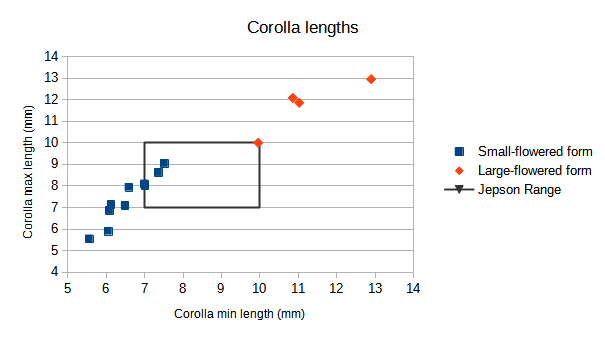
Fig. 2. The corolla lengths for both forms of L. arizonicus, with each point representing measurements from different times and/or places. Most measurements were of the minimum and maximum length measured in the field; sometimes the min and max were the same value. Some measurements were only of a single corolla. The plotted values have been dithered by a random number in order to show individual measurements that otherwise would have plotted on top of each other. The original measurements are made only to the nearest 0.5 mm.
Also shown is the Jepson eFlora range for the corolla lengths of L. arizonicus, from 7 to 10 mm. See the text for comments on those lengths.
One factor that complicates comparison of these two forms is that growing conditions can be different from different cohorts in the same year. That is, we often have a first cohort of annual plants that germinate from a first rainfall in December, and a second cohort that germinates from later rainfall in February or March. Usually, plants in the second cohort are uniformly smaller than the plants in the first cohort, with smaller flowers. For example, on 13 March 2016, I measured larger plants to have flower lengths of 7.5 to 9 mm, and smaller plants to have flower lengths of 6 to 7 mm. At the time, I took the larger plants to be the larger-flowered form, but looking at Fig. 2 it appears that both were the small-flowered form. I found the same variation between plants on 27 February 2023 in one location where there were no large-flowered forms.
The small-flowered form appears so far to be restricted to a small area north of Borrego Springs; see Fig. 3. This is a tiny fraction of the range of L. arizonicus in the Borrego Desert; compare to the iNat map for it for our area.
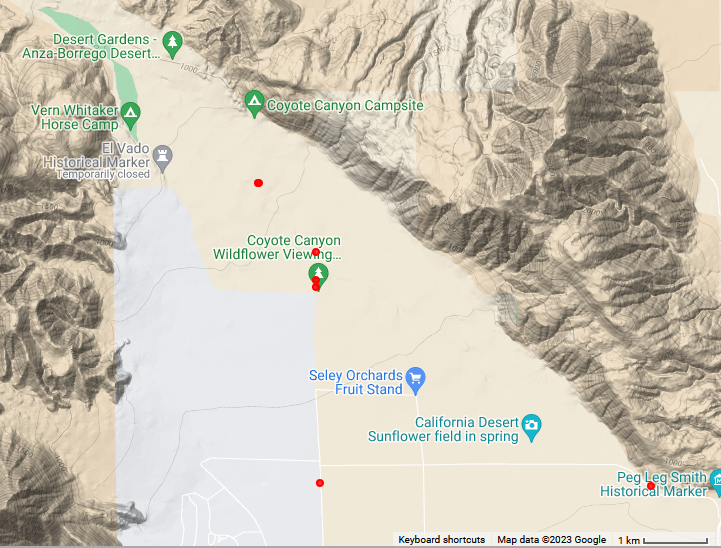
Fig. 3. Map showing locations of the small-flowered form of L. arizonicus by the red filled circles.
Additional observations of our small-flowered plants at iNat, sorted by date, sometimes along with observations of nearby large-flowered plants:
- 15 March 2010, Coyote Canyon Road, small-flowered form
- 18 February 2011, Henderson Canyon Road, pix of both species growing together
- 13 March 2016, Coyote Canyon Road, pix of samples of both forms
- 17 February 2023, Coyote Canyon Road, small-flowered form
- 17 February 2023, Coyote Canyon Road, small-flowered form
- 17 February 2023, Coyote Canyon Road, large-flowered form
- 17 February 2023, Coyote Canyon Road, large-flowered form
- 27 February 2023, Coyote Creek Wash, small-flowered form
- 27 February 2023, Coyote Creek Wash, large-flowered form
- 27 February 2023, Di Giorgio Road near Henderson Canyon Road, small-flowered form