Bighorn Sheep Herbivory Creates Multiple Heads on Barrel Cacti
| 
|
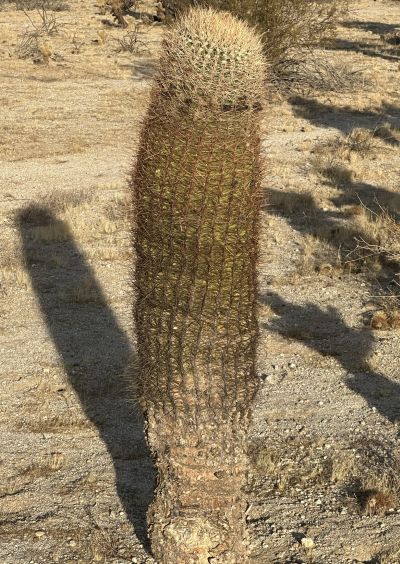
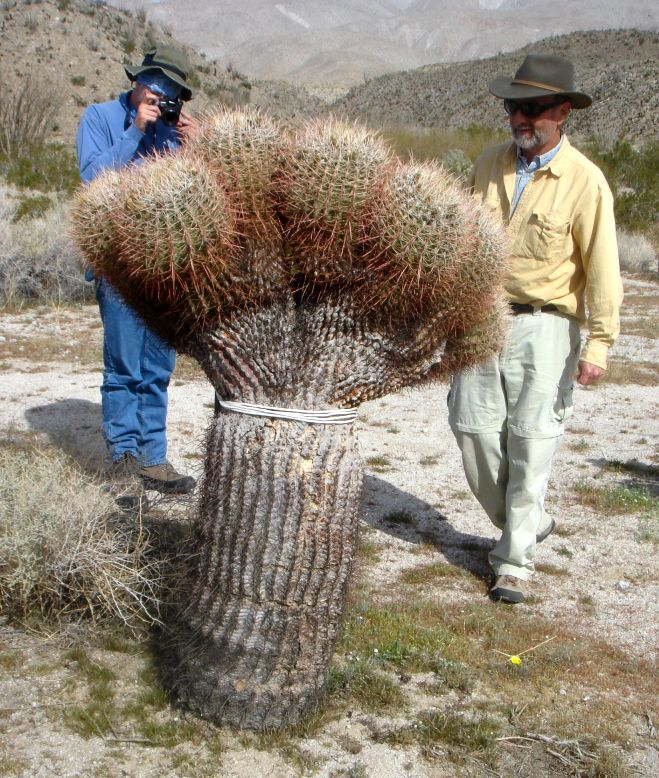
| Fig. 1. Left: A normal cylindric specimen of barrel cactus, Ferocactus cylindraceus. Pix by @planetaverde, taken on 4 January 2025 in the Vallecito Valley. Right: a famous nine-headed barrel cactus, that had fallen over in ~2008 but which was then righted and securely staked. Pix by Tom Chester, taken on 13 February 2011, also from the Vallecito Valley. Click on the pictures to go to the original iNat post or for a larger version. | |
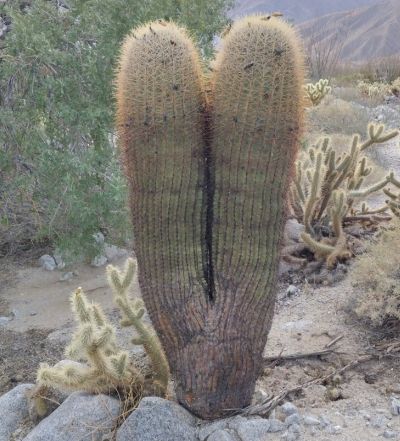
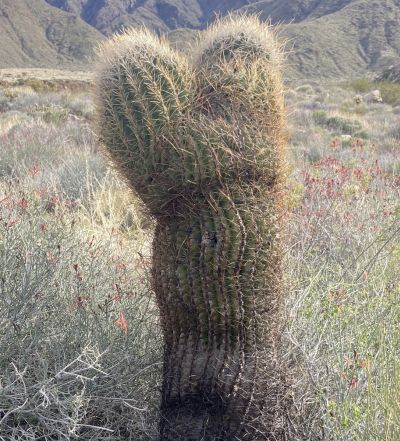
Barrel cacti with multiple heads are quite noticeable, and always a pleasure to see. Normal cylindrical barrel cacti are fairly uniform, differing primarily by the length of their stem, and by the angle the stem makes from vertical. But barrel cacti with multiple heads have a plethora of forms, with a variable number of heads, and variable patterns in those heads. Figs. 1 and 2 show some of that variation.
| 
|
| Fig. 2. Two barrel cactus specimens with multiple heads. Left pix by Don Rideout, taken on 18 December 2023, from a wash to the west of Ironwood Canyon. Right pix by Steven Clinton, taken on 10 March 2024 in Indian Canyon near Collins Valley. Click on the pictures to go to the original iNat posts. | |
Everyone wonders what causes the multiple heads. The floras say that undamaged plants have a single stem, with no branches (i.e., additional stems / heads), and that branches only occur if there is damage to the single stem. So what can damage the top of a barrel cactus, armed as it is with fierce, long, stout spines?
It turns out the answer is mostly, and perhaps almost entirely, bighorn sheep.
Tom Chester, Keir Morse, Don Rideout and Tom Robinson were lucky enough to recently witness a bighorn sheep bashing in the top of a barrel cactus in order to eat its inner flesh. Tom Robinson was on the sun side of the ridge with the sheep and the barrel; the rest of us were on the shaded side of that ridge. We all were absolutely enthralled watching one bighorn sheep working on that barrel, while three other sheep were trying to "horn in" on the action. This was the first time any of us had seen bighorn sheep eating a barrel cactus.
We first noticed the sheep at 3:45 p.m., and watched intently until about 4:20 p.m. when we had to move on, even though the same sheep was still eating at the time.
The bighorn first smashed the barrel repeatedly, checking with his nose and/or mouth between some bashes, and occasionally pawing the opening to remove some of the loose spines.
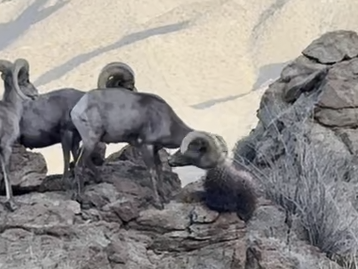
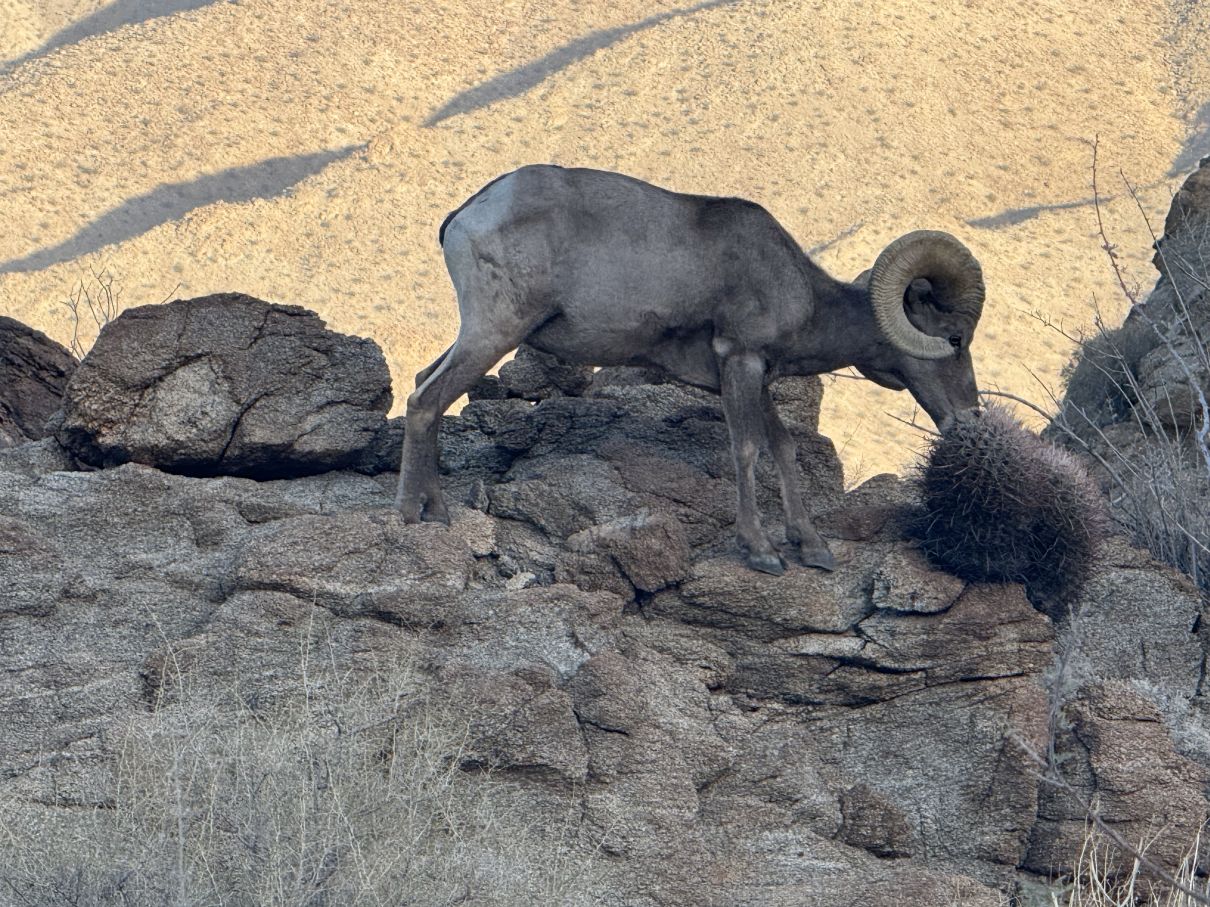
Fig. 3 shows the sheep opening the cactus by bashing the cactus top with its horn, and then eating it.
| 
|
| Fig. 3. Left: Frame grab from a video made by Tom Robinson of the sheep breaking open the top of a barrel cactus and then eating it. Video made on 20 January 2025 from the Art Smith Trail just above Palm Desert. See text for links to his videos. Right: crop of a photograph taken by Tom Robinson of a bighorn eating the barrel cactus. See also Keir's iNat post from a different angle. | |
Tom Robinson recorded three absolutely fantastic videos, and kindly gave permission for Don to post them at his YouTube channel:
- Part 1: when the bighorn gingerly smashes the top, and keeps checking to see when he can start eating
- Part 2: when the bighorn starts eating it
- Part 3: when a second sheep gets tired of waiting for some juicy food and starts to "horn in"; you can also hear the wind blowing.
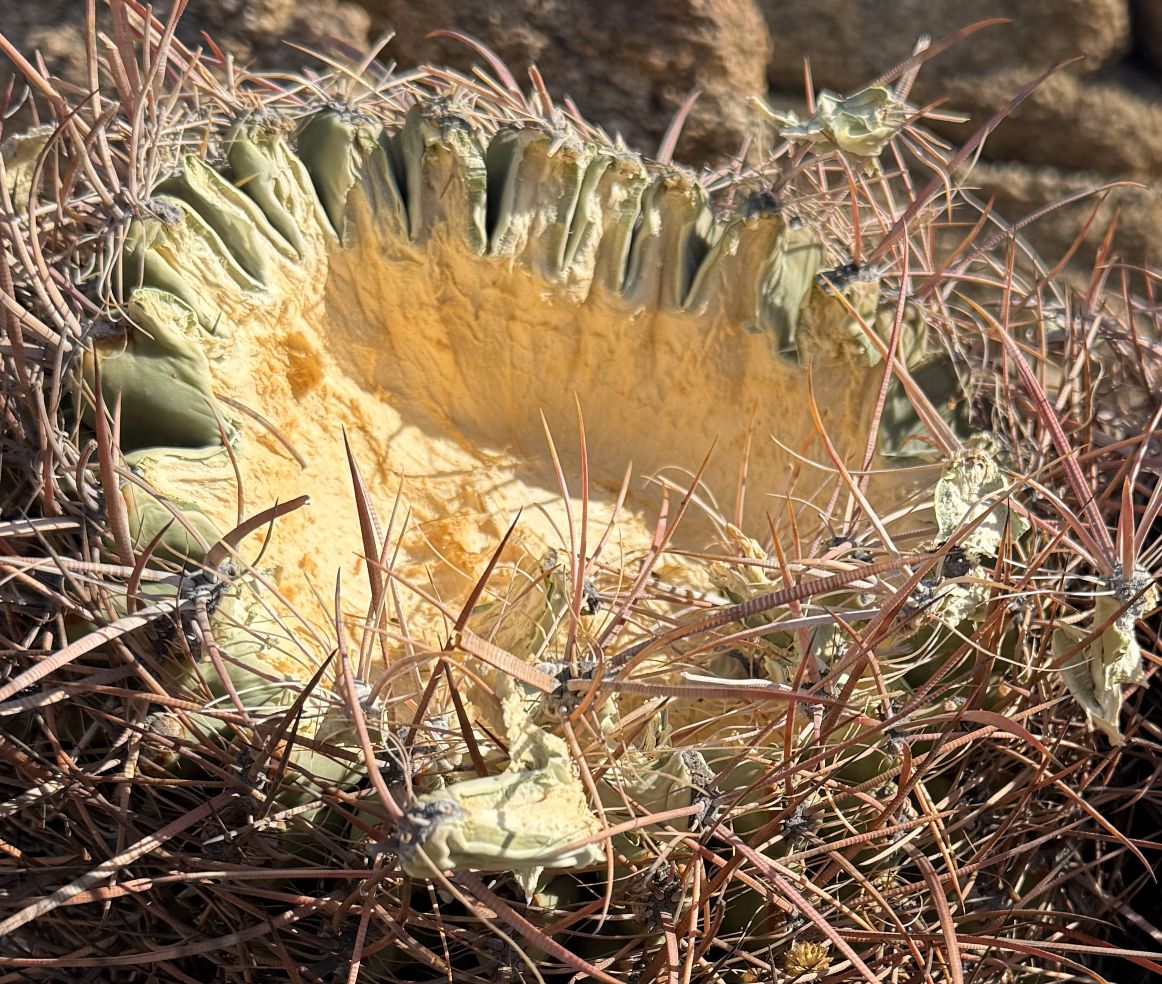
Tom Robinson was back on the trail five days later, and took a pix showing the barrel cactus now missing its top, given in Fig. 4.
|
| Fig. 4. Close-up view of the damage to the top of the barrel made by the bighorn sheep seen in Fig. 3, taken by Tom Robinson five days later on 25 January 2025. Click on the picture for a larger version. See also a larger-scale pix show the entire barrel and its neighbor. |
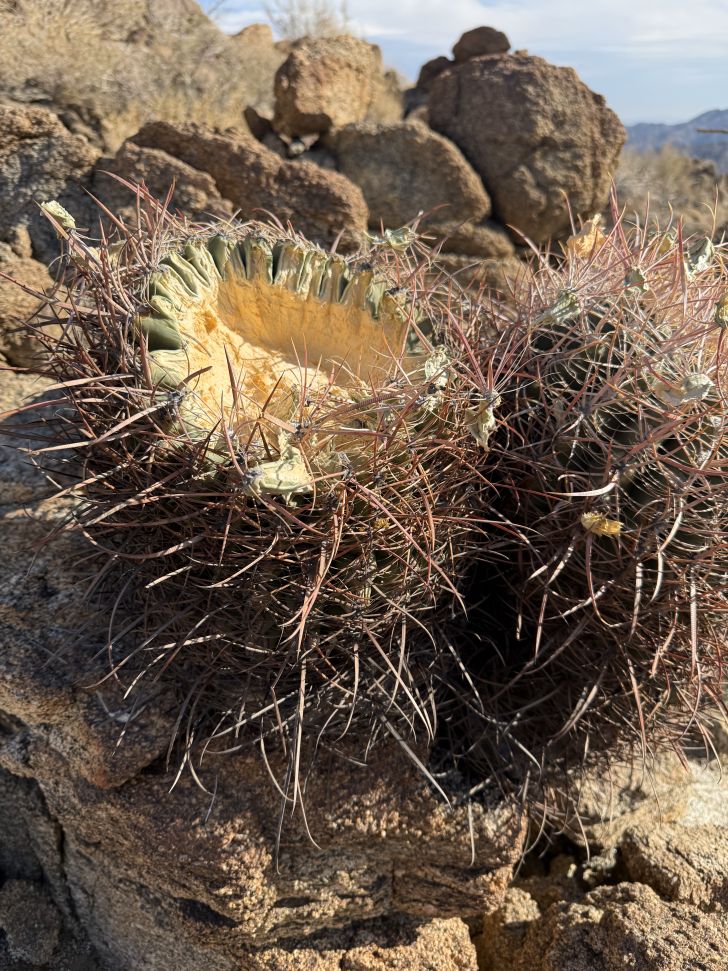
We also observed two other nearby barrel cacti with similar damage, one to the west, that had probably been damaged some time earlier, and one to the east, which had been recently damaged since spines were still strewn around that plant.
Herbivory of F. cylindraceus by bighorn sheep has been studied by Warrick and Krausman 1989 (The Southwestern Naturalist, Vol. 34, pp. 483-486) in Arizona, where they found that 29 barrel cacti were consumed during 217 observed "feeding bouts", a rate of 13%, where they followed a single sheep for the entire "feeding bout" of up to 8 hours. If bighorn sheep have two "feeding bouts" per day, one barrel cactus would be eaten every four days per each sheep. If there are 1,000 bighorn sheep in all of Anza Borrego Desert State Park, they would damage ~90,000 barrel cacti per year. This is clearly not an insignificant number of damaged barrels!
So what happens next to these eaten and bashed cacti?
Some probably die, either from being knocked over or separated from their roots in the process, or from infections that decay their moist spongy tissue. There is another fabulous online video by someone else ("Road"), which shows a bighorn killing another barrel cactus when it falls downhill before he could open it up.
But some grow new stems (new heads), from the edge of the spongy tissue left at the top. Tom Chester, Don Rideout, Mark Stevens, and Rebecca Stevens were lucky enough to run across a "Rosetta Stone" barrel on our next trip, on 24 January 2025, that showed the bighorn damage, along with the new head growth. See Fig. 5.
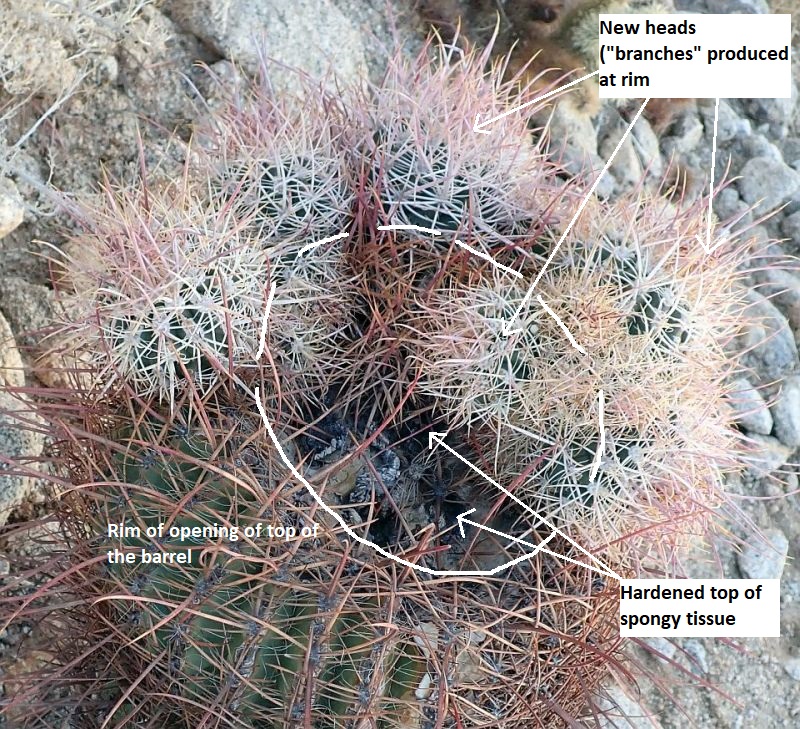
Fig. 5. New head growth around a bit more than half of the rim of the opening at the top of the barrel cactus produced by bighorn sheep herbivory. The formerly-white spongy tissue in the opening has turned black. Click on the pix to go to the iNat obs of this plant.
A very nearby plant had been eaten some years earlier, and its new growth now dwarfs what is left of the original plant. See Fig. 6.
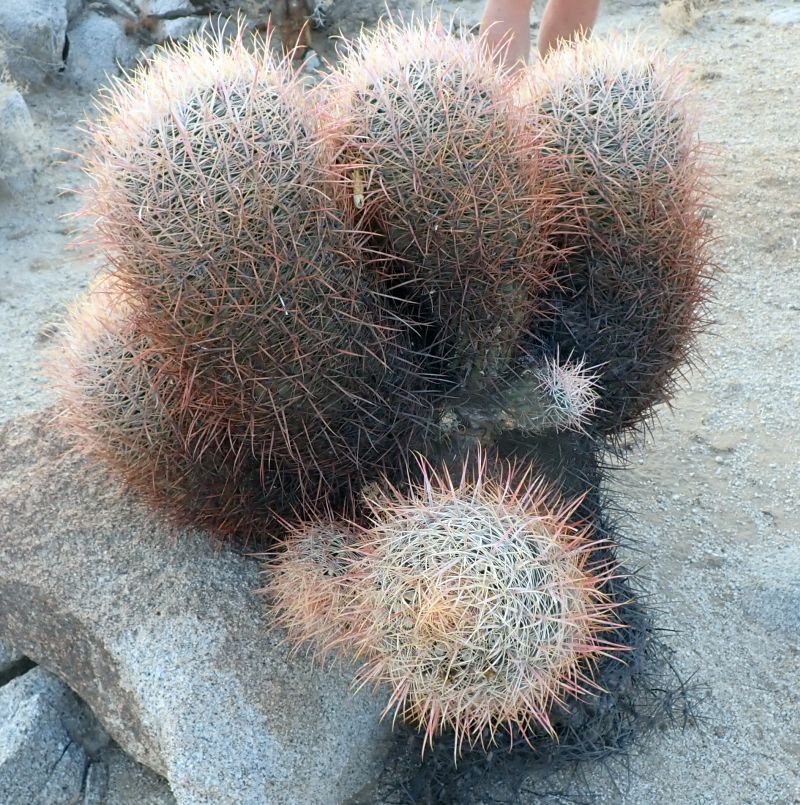
Fig. 6. The new head growth now dominates this plant, which still retains evidence of the cavity created by bighorn sheep herbivory. Click on the pix to go to the iNat obs of this plant, which shows the remaining cavity.
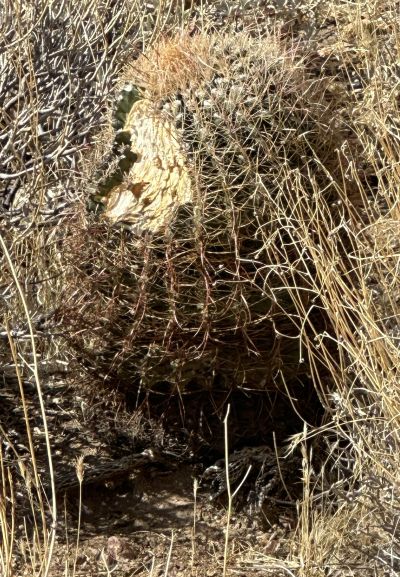
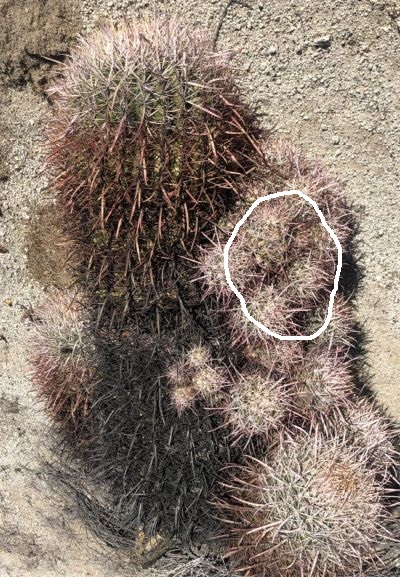
It is also plausible that bighorn sheep can attack the side of the plant, which eventually creates new heads arising from the middle of the stem. @planetaverde303 at iNat has found good evidence of this occurring; see Fig. 7.
| 
|
| Fig. 7. Probable bighorn sheep herbivory on the side of two barrel cacti, both photographed by @planetaverde303 at iNat. Left: A recently-eaten barrel cactus, observed on 4 January 2025 in Hornblende Canyon. Right: A barrel that was eaten sometime in the past, and produced a ring of new heads ("branches") from one spot. There may have been bighorn damage to a few other spots lower on the main stem, which produced the other nearby heads. The lowermost heads are probably due to herbivory from a small mammal like a rabbit at the base of this plant. This specimen had fallen over, and was observed two times previously when it was alive. The best picture showing the ring of new heads on the side of the barrel was the one shown here of the downed specimen, observed on 9 November 2024 along S2 just south of Canebrake. Click on the pix to go to the original iNat obs. | |
We thank Tom Robinson for allowing us to post his wonderful pix and videos from the Art Smith Trail; Keir Morse for originally alerting us to the sheep on that trail; Rebecca Stevens for spotting the specimen that turned out to have the recently-produced small heads; and @planetaverde303 for their pix posted at iNat.