Phacelia crenulata, heliotrope phacelia, var. ambigua and var. minutiflora

| ||

| 
| |

| 
| |
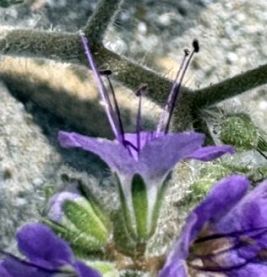
| Fig. 1. Phacelia crenulata, heliotrope phacelia. Top row: Inflorescence branch of var. ambigua on the left; var. minutiflora on the right.
Middle and bottom rows. Left: var. ambigua. Right: var. minutiflora. The difference in flower size is very apparent when these two varieties are seen side by side, or in photographs that show the entire plant. However, the flowers look very similar is close-ups that have no scale. In the middle row, note how showy var. ambigua is compared to var. minutiflora, even though both plants are in full bloom. In the bottom row, note that both varieties have a white throat. Click on the bottom four pictures for larger versions. The pollen for var. ambigua can be purple, as shown in this figure, or yellow. The pollen for var. minutiflora seems to always be yellow, as shown in this figure. (What appears to be filaments without anther sacs is usually the two-lobed style.) Note that the flower color depends strongly on lighting and how one processes the picture. The top photograph was taken inside by flash on white paper; the other photographs were taken in the field. See another version of the top photograph taken inside without using flash on manila paper, for dramatically-different colors! (Note that the varieties are on different sides in the linked photograph.) | ||

Table of Contents
Introduction
Flower Size Measurements
Geographic Distribution
Analysis of how well the two varieties separate using photos of the flowers from the side
Summary of how to recognize the two varieties from photos
Introduction
Phacelia crenulata is the most common phacelia species of the Borrego Desert Floor (P. distans is the most common phacelia species west of the Borrego Desert Floor). It has a number of common names: heliotrope phacelia, cleftleaf wildheliotrope, and notch-leaved phacelia. In addition to these common names, its large-flowered variety ambigua is sometimes called purplestem phacelia, and its small-flowered variety minutiflora is sometimes called little-flowered heliotrope phacelia.
There has been considerable confusion about how to distinguish these two varieties since the keys in floras to distinguish them have problems; see Comments on the 1993 Jepson Manual First Edition.
As an example of the difficulties in determining vouchers, in Beauchamp's 1986 Flora of San Diego County, var. minutiflora was considered to be scarce in San Diego County, with only two locations given, with var. ambigua considered to be occasional, with 13 locations given. In contrast, we have more records of var. minutiflora in our database compared to var. ambigua, 25 vs. 16, and there are now more vouchers of var. minutiflora from San Diego County compared to var. ambigua, 45 vs. 39. It appears that at least some of the vouchers examined by Beauchamp have had their determinations changed after 1986 from var. ambigua to var. minutiflora, since some of the locations listed by Beauchamp for var. ambigua now have only vouchers determined as var. minutiflora.
Part of the difficulty in making a key is having to include var. crenulata, which we don't have in the Borrego Desert, which makes even the current Jepson eflora key misleading in how to separate the species based on corolla size and corolla throat color.
The Jepson eFlora Phacelia treatment was updated in 2023, and the key is now much improved. The best distinction in the new treatment is "stamens, style exserted < 2 mm" for var. minutiflora, and stamens, style exserted ≥ 9 mm" for var. ambigua.
Fortunately, as shown in Fig. 1, in the field there is no difficulty at all discriminating the two varieties. Our two varieties are easy to distinguish almost at a glance based on how showy the flowers are, since the flowers of var. minutiflora are much smaller than those of var. ambigua. There is also no difficulty in discriminating the two varieties if a picture is taken of the whole plant; see the middle row of Fig. 1.
There is also good geographic separation of the varieties for the most part, although there are areas where both varieties occur together; see the next section.
However, a photo of just the flower alone is often difficult to identify, since without a scale in the photo, the flowers of each species can look very similar. Tom analyzed how well one can separate the two varieties using photographs of the flowers taken from the side, with the results reported below, followed by a summary of how to recognize the two varieties from photos.
Flower Size Measurements
Table 1 gives flower size measurements Tom has made on fresh flowers from two plants growing within 10 feet of each other in the Arroyo Salado Campground. The corollas are shown side by side in Fig. 2. Many more pictures are at the iNat obs for each taxon: var. ambigua and var. minutiflora.
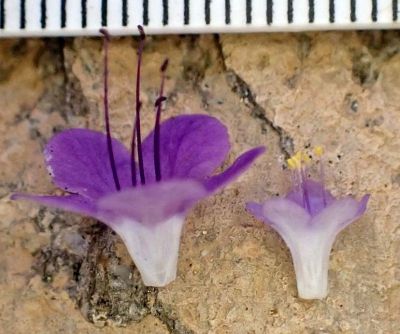
Fig. 2. Fresh corollas from two plants growing within 10 feet of each other in the Arroyo Salado Campground. Left: var. ambigua. Right: var. minutiflora. More photos from each plant are posted at iNat: var. ambigua and var. minutiflora.
Table 1. Flower Size Measurements (mm)
| Characteristic | var. ambigua | var. minutiflora |
|---|---|---|
| Calyx length | - | 4.0 |
| Calyx width | - | 1.2 |
| Corolla tube+throat | 4.9 | 3.1 |
| Corolla lobes | 4.0 | 2.8 |
| Corolla total length | 8.9 | 5.9 |
| Corolla width | 12.0 | 6.0 |
| Length of stamens above mouth of corolla throat | 9.0 | 4.0 |
| Difference in length between shortest stamen and longest stamen, measured above mouth of corolla throat | 3.8 | 0.5 |
| Distance spanned by stamens at the pollen sacs (perpendicular to their length) | 3.1 | 2.1 |
Geographic Distribution
The known geographic distribution of the two varieties of Phacelia crenulata, from accurate GPS observations in the field and from vouchers with localities that are accurate to less than a half mile, is shown in Fig. 3.

| 
|
| Fig. 3. The geographic distribution of Phacelia crenulata in the Borrego Desert area, from our GPS records and from vouchers with well-defined localities. Left: var. ambigua. Right: var minutiflora. Click on the maps for larger versions. | |
Fig. 4 shows the two species on the same map.

Fig. 4. The geographic distribution of both varieties of P. crenulata, both from our digitized GPS records and from vouchers with well-defined localities. This map corresponds in area closely to the area shown in Fig. 3; see those maps for landmarks. Note the nearly-complete, but not absolute, geographic separation of the varieties.
These two varieties have an almost completely-disjunct distribution in the Borrego Desert, even though both varieties are found together in a number of other areas of California (see southern California voucher maps for var. ambigua and for var. minutiflora).


The western and southern portion of the Borrego Desert contains almost entirely var. minutiflora, except for a single voucher of var. ambigua, SDSU6085. We've asked Mike Simpson to recheck the determination of that voucher.
The northeastern portion of the Borrego Desert contains almost entirely var. ambigua, except for a very small number of records for var. minutiflora. One of those records is the plant shown in Fig. 1, that was found at the parking area for Palm Wash. There are hundreds of plants of var. ambigua that we've seen in the general area, so it is possible that this single record of var. minutiflora was a waif. Our other two records in that area were of a single plant, and of three plants, so even if these plants are not waifs, var. minutiflora is clearly not very abundant in this area that is dominated heavily by var. ambigua.
Our records give an elevation range from 530 to 1060 feet for var. ambigua, and from 430 to 1730 feet for var. minutiflora. Voucher elevations range from zero to 1000 feet for var. ambigua, and from 60 to 2020 feet for var. minutiflora. (Vouchers with stated elevations above 1000 feet for var. ambigua either have elevations inconsistent with their localities, or are almost certainly misdetermined.)
Combining our records with vouchers, var. ambigua ranges from zero to 1060 feet elevation in our area, and var. minutiflora ranges from 60 to 2020 feet.
Analysis of how well the two varieties separate using photos of the flowers from the side
This section describes Tom's analysis of how well one can determine the variety by using photos of the flowers from the side that have no scale. A summary of the results for how to recognize the two varieties from photos is given in the next section.
A priori, trying to distinguish the two varieties using photos without a scale is difficult since the flowers are basically similar in morphology, and differ primarily on size. But since these are different taxa, we would expect that careful measurements could discriminate them.
After looking at a number of iNat posts, and spending a day measuring some characteristics seen in photographs, it looks like one can indeed almost always separate the varieties from photographs of the flowers from the side.
After looking at a number of iNat posts, including every post that was determined as var. minutiflora, Tom found one discriminant that easily identified some plants of var. ambigua. It appears that purple pollen sacs are only found on var. ambigua, so a flower with purple pollen sacs is immediately determined as var. ambigua. However, var. ambigua can also have yellow pollen sacs. Var. minutiflora always has yellow pollen sacs. So observing yellow pollen sacs doesn't help in the discrimination, since either variety can have yellow pollen sacs, but it is an important confirming character for a determination of var. minutiflora. Although the pollen sacs often are not present on some stamens, leaving only the purple filament for each variety, there are almost always some pollen sacs still present.
Tom analyzed 11 photographs from iNat observations, six that were clearly ambigua, and five that were clearly minutiflora, all from size comparisons visible in the iNat posts. Tom measured the calyx lobe length for the lobe nearest the camera, and used that to scale measurements of the following characteristics: the calyx lobe width; the corolla tube length; the corolla lobe length; the corolla width; the length of the longest stamen measured from the base of the flower; the length of the longest stamen above the corolla throat; and the distance between the ends of the stamens. Tom also measured the angle of the tip of the calyx lobe and the angle of the corolla lobes from vertical.
A PCA on those measurements gave fairly good separation of the two varieties; see Fig. 5.
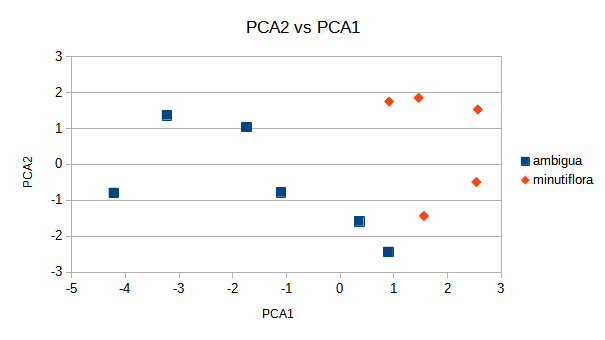
Fig. 5. Principal Components 2 vs. 1 for the two varieties using the measurements described in the text.
Four of the photographs for var. ambigua were well separated from the five photographs of var. minutiflora, with the mean for each variety differing by over four standard deviations in PCA1, with the mean of those four photographs of var. ambigua of -2.5, and the mean for var. minutiflora of +2. This is a very significant difference.
However, two of the var. ambigua have values of PCA1 that are in, or close to, the range of PCA1 for var. minutiflora. Those two photographs are the last two photographs in Fig. 7 below, which has the PC values below each photograph. More photographs need to be measured to try to understand what is going on.
All of the measured characteristics turned out to contribute to distinguishing the two varieties.
Principal Component 1 was most heavily loaded on the corolla lobe length, the corolla width, the longest stamen length from the base of the calyx, the longest stamen length measured from the corolla throat, and the separation of the stamens at their tip, all contributing with negative coefficients.
Principal Component 2 was most heavily loaded on the four other measurements, the calyx lobe tip angle; the angle of the corolla lobes from the vertical; the calyx lobe width, and the corolla tube length, in addition to the corolla lobe length. All coefficients were positive except for the corolla lobe angle from vertical.
Fig. 6 plots two of the characteristics that went into the PCA, the stamen length vs. corolla length, both normalized by the calyx lobe length. The corolla length used here is the corolla throat length plus the corolla lobe length. Those two characteristics alone provide good separation for all but the smallest flowers.
Figs. 7 and 8 show all the flowers used for this analysis, with each flower linked to its iNat observation. The values for the stamen and corolla lengths, normalized by the calyx length, are also given.
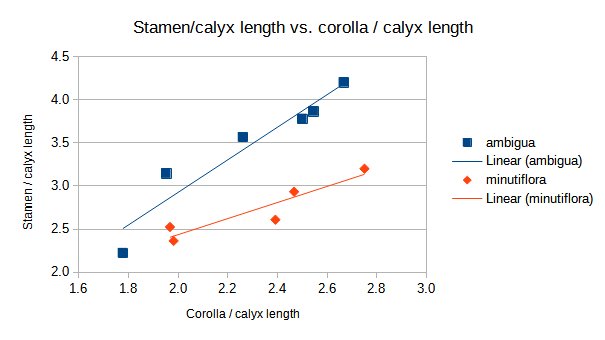
Fig. 6. Stamen length vs. corolla length, both normalized by the calyx lobe length, for the two varieties. The best fit line is shown for each variety. The varieties separate well in pictures from the side without scale except for the smallest flowers.
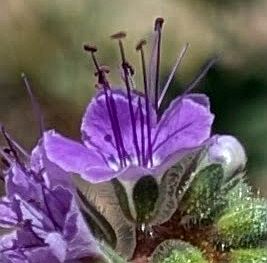
Stamen / calyx = 4.2, corolla / calyx = 2.7 PC1 = -3.2, PC2 = 1.4 | 
Stamen / calyx = 3.9, corolla / calyx = 2.5 PC1 = -4.2, PC2 = -0.8 | 
Stamen / calyx = 3.8, corolla / calyx = 2.5 PC1 = -1.7, PC2 = 1.0 |
Stamen / calyx = 3.6, corolla / calyx = 2.3 PC1 = -1.1, PC2 = -0.8 | 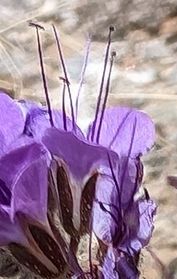
Stamen / calyx = 3.1, corolla / calyx = 2.0 PC1 = 0.4, PC2 = -1.6 | 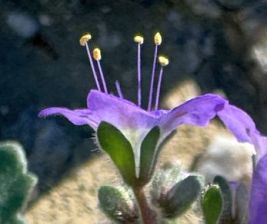
Stamen / calyx = 2.2, corolla / calyx = 1.8 PC1 = 0.9, PC2 = -2.4 |
| Fig. 7. Photographs of var. ambigua, arranged in order (left to right in top row, and then continuing left to right in bottom row) of decreasing ratio of the stamen length to the calyx length. The stamens extend well past the corolla throat. Note also how dispersed the stamens are, and how open some of the flowers are, with spreading petals. Some anther sacs are yellow; some are purple. Click on the pictures to go to the original iNat obs. | ||

Stamen / calyx = 3.2, corolla / calyx = 2.8 PC1 = 0.9, PC2 = 1.8 | 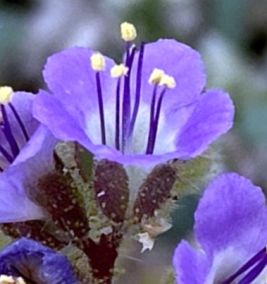
Stamen / calyx = 2.9, corolla / calyx = 2.5 PC1 = 1.5, PC2 = 1.8 | 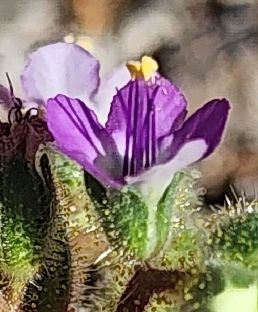
Stamen / calyx = 2.6, corolla / calyx = 2.4 PC1 = 2.6, PC2 = 1.5 |

Stamen / calyx = 2.5, corolla / calyx = 2.0 PC1 = 1.6, PC2 = -1.4 | 
Stamen / calyx = 2.4, corolla / calyx = 2.0 PC1 = 2.5, PC2 = -0.5 | (intentionally blank) |
| Fig. 8. Photographs of var. minutiflora, arranged in order (left to right in top row, and then continuing left to right in bottom row) of decreasing ratio of the stamen length to the calyx length. The stamens extend past the corolla throat, but not nearly as much as for var. ambigua. Note also how tightly the stamens cluster, and that many of the flowers have cupped petals. All the anther sacs are yellow. Click on the pictures to go to the original iNat obs. | ||
Summary of how to recognize the two varieties from photos
First, if there is anything in a photograph that can be used as scale, such as a photo of the entire plant, or fingers next to the flowers, the size of the flowers is the best discriminant of all. The middle row of Fig. 1 above shows the difference at a glance, with var. ambigua flowers being showy and easily visible, whereas var. minutiflora flowers are almost invisible in a photo of the entire plant from a distance.
Second, if you see purple pollen sacs, your plant is var. ambigua. If you see white pollen sacs, it could be either variety.
Lacking the above, more subtle characteristics need to be considered to differentiate the two varieties, most of which are shown in Figs. 6 and 7 above.
Variety ambigua typically has stamens that stick out of the flower to a farther distance, relative to the flower. Its stamens spread out to a greater degree at their tips, due to their longer length and the room in their larger flower throat. The corolla lobes are typically more spreading and not as cupped.
Voucher data provided by the participants of the Consortium of California Herbaria (ucjeps.berkeley.edu/consortium/) on 12 February 2016.