Pectis papposa, golden chinch-flower (chinch-weed)
| 
|
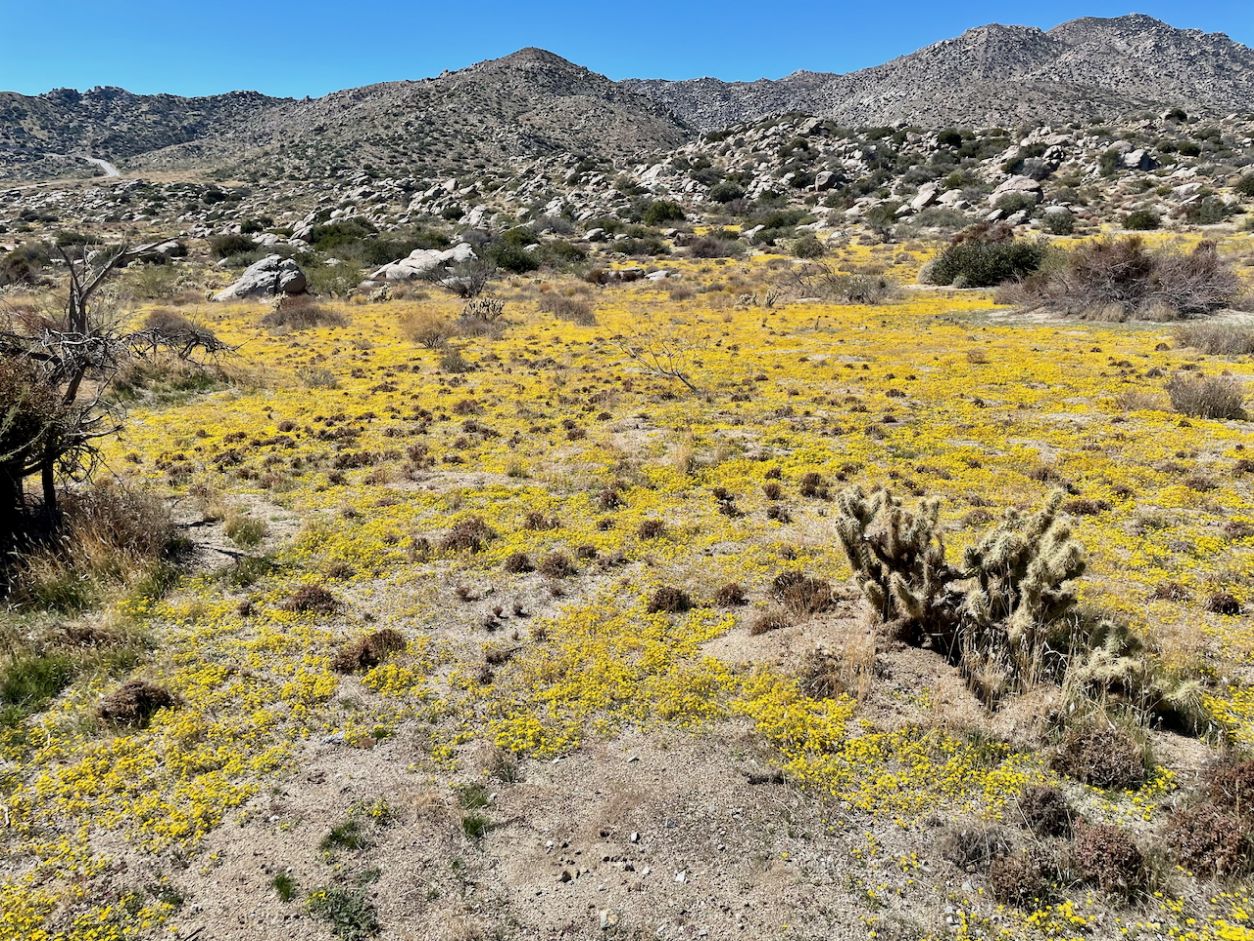
| Fig. 1. Left: a field of chinchweed, Pectis papposa, in full bloom just north of the Culp Valley Campground. Picture taken by Jim Roberts on 17 October 2025.
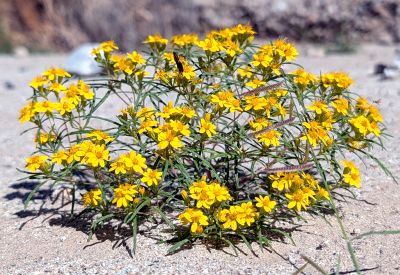
Right: A beautiful individual plant of chinchweed in full bloom in the North Fork of the Arroyo Salada just south of S22, photographed by Fred Melgert on 15 October 2025. Click on the pix to see a larger version or to go to the original iNat observation. Also see view of the Pectis fields in Borrego Valley seen from the pullout on the Montezuma Grade, taken by Don Rideout on 4 October 2025! | |
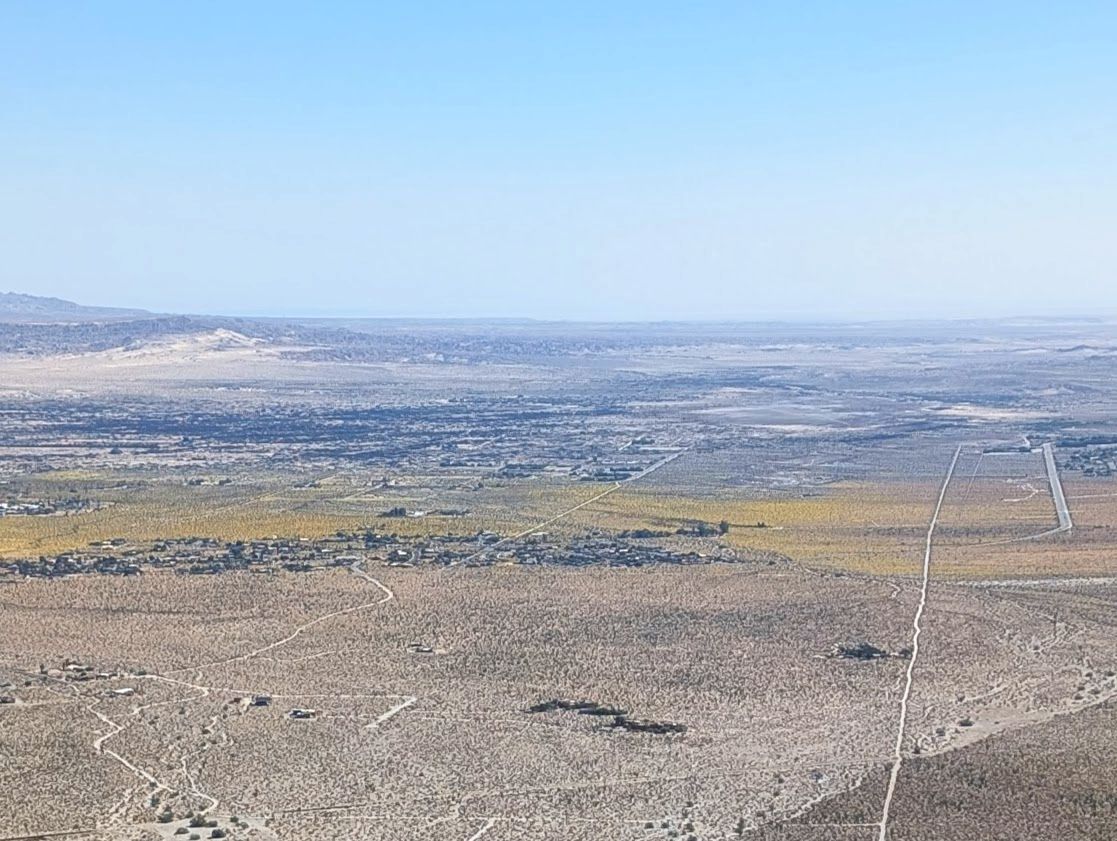
Table of Contents
Introduction
Geographic Distribution for ABDSP
Identification Characteristics
Fragrance
Growth Rate
Human Uses
Origin of Common and Scientific Names
Taxonomy and Phylogeny
Introduction
Pectis papposa, chinch-weed, is the star of the show of monsoonal annuals in the Borrego Desert. After an inch of warm rain or so, typical of monsoonal thunderstorm precipitation that occurs in July, August, or September, Pectis can form amazing carpets of yellow on the desert floor and other flattish sandy areas just one month later; see Fig. 1.
It can appear as scattered plants in nearly every part of the Borrego Desert. It ranges from below sea level to 5,335 feet! As of 21 October 2025, there are 1,456 iNat observations of Pectis within the extended Anza Borrego Desert State Park area, from nearly every part of that area which people usually explore.
Pectis is also one of the strongest-scented plants in the Borrego Desert. A field of Pectis can produce a potent, at-times-overwhelming, odor in the field, which can last on one's boots for over a day. See the section on Fragrance below.
Pectis is perfectly suited for its niche as a dominant monsoonal annual for the Borrego Desert since it grows quickly in hot weather, and can flower and set seed before the water from a single monsoonal rain event is used up. Its "secret" is that it has a type of photosynthesis ("C4") that is more efficient than the older C3 photosynthesis at high temperatures, high light intensities, and in water-limited conditions. That essentially perfectly describes summer in the Borrego Desert!
C4 photosynthesis first evolved ~30 million years ago in grasses in response to lowering carbon dioxide levels worldwide, and in portions of North America that became hottier and drier in that time period. Dicots were slower to evolve it, mostly in the last 5 to 10 million years. C4 photosynthesis has evolved independently over 45 times in 19 families of angiosperms (Sage 2004).
Other C4 monsoonal annuals found in the Borrego Desert are Boerhavia and Allionia.
Geographic Distribution for ABDSP
As of 21 November 2025, the number of Pectis iNat posts in the Borrego Desert project at iNat was 1,687. The top observer by far was @efmer, Fred Melgert and Carla Hoegen, with 785 posts, 47% of the total. I was a distant #2, with 98 observations, and Larry Hendrickson was #3, with 64 posts.
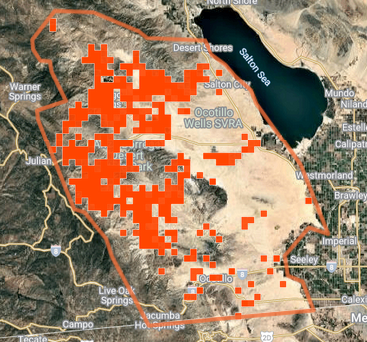
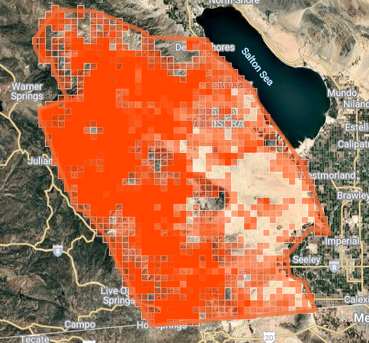
Fig. 2 shows the map for Pectis compared to the map for all iNat unobscured plant observations in the same area. The Pectis distribution looks like a less-sampled subset of the map for all plants, with the exception of Pectis being apparently absent from the higher mountains on the north, northwest, and southwest. The sampling for Pectis is severely restricted since it takes a very heat-tolerant person to go to the desert in September and October to observe it when it is at its peak.
| 
|
| Fig. 2. Left: iNat geographic distribution for Pectis papposa as of 21 October 2025. Right: iNat geographic distribution for all unobscured plant observations as of 21 October 2025.
See text for comments on these distributions. Click on the pictures to go to the current interactive iNat maps. | |
The northernmost iNat post in our area is by @efmer at the Turkey Track in middle Coyote Creek.
The westernmost iNat post in the Borrego Desert iNat project is by @efmer in the San Felipe Wildlife area. There is one post of Pectis even farther west, by @u_phantasticus, from near the junction of SR76 and SR79. There are also vouchers of Pectis from near the Inaja picnic area by Jerilyn Hirshberg.
The highest elevation iNat post is from 4670 feet, on the trail to Whale Peak, by @peterj29. I have GPS'd a higher occurrence on that trail, at 5,335 feet elevation (33.02949, -116.31659), but I didn't photograph it.
Fig. 3 shows a histogram of the elevations for the iNat observations as of 21 November 2025. The histogram shows the preponderance of observations from the desert floor at 600 to 1000 feet elevation.
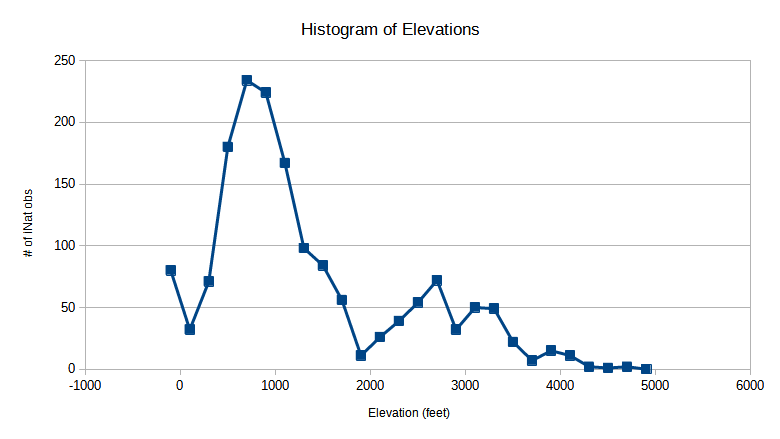
Fig. 3. Histogram of the elevations for iNat observations of Pectis as of 21 November 2025.
Fig. 4 shows a plot of the elevation of iNat posts vs. Longitude, with some locations labeled.
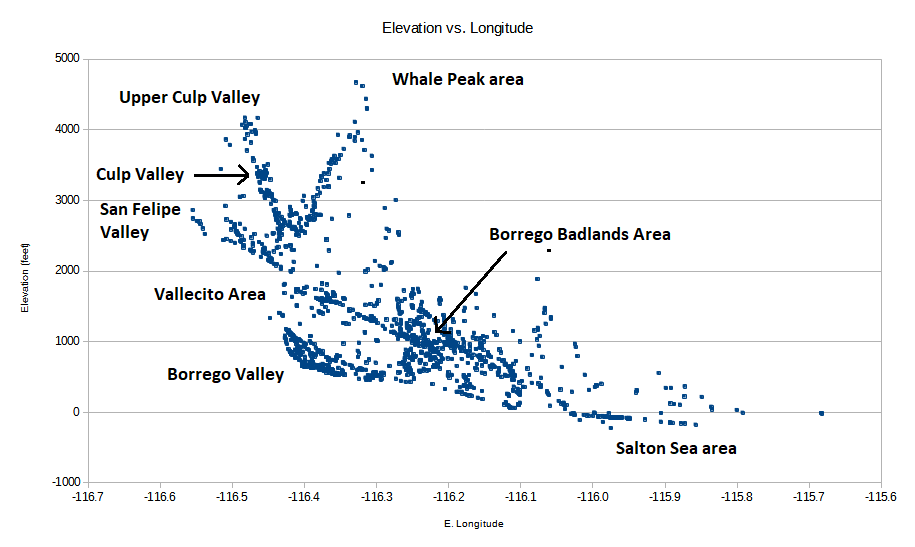
Fig. 4. Plot of elevation of iNat posts vs. Longitude as of 21 November 2025. Some locations in the plot are labeled.
Identification Characteristics
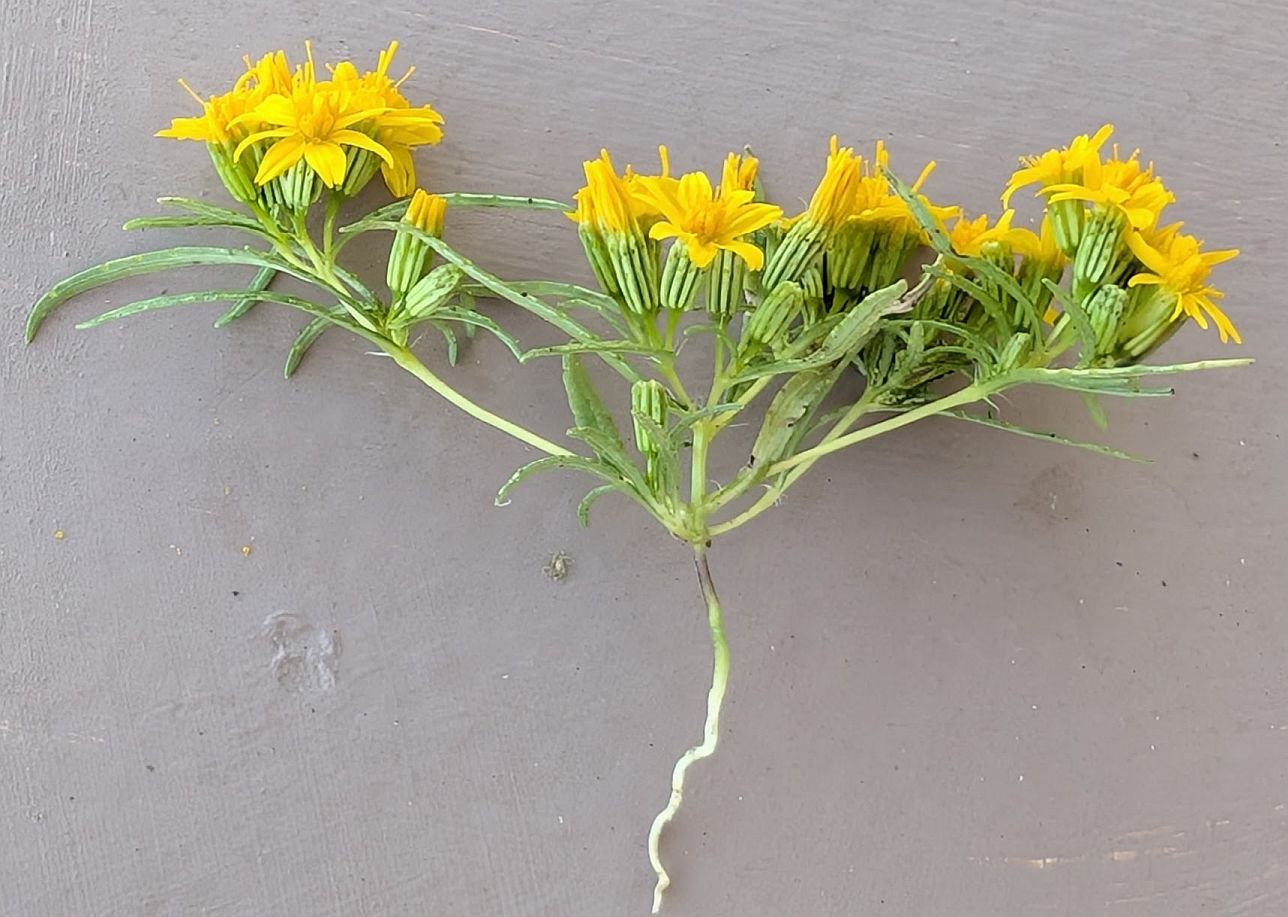
Pectis papposa is easy to identify when it forms fields of yellow flowers in September and October, and you smell its potent fragrance. But if you aren't certain, or have only a photograph of it, here are some characteristics to check to confirm the identification:
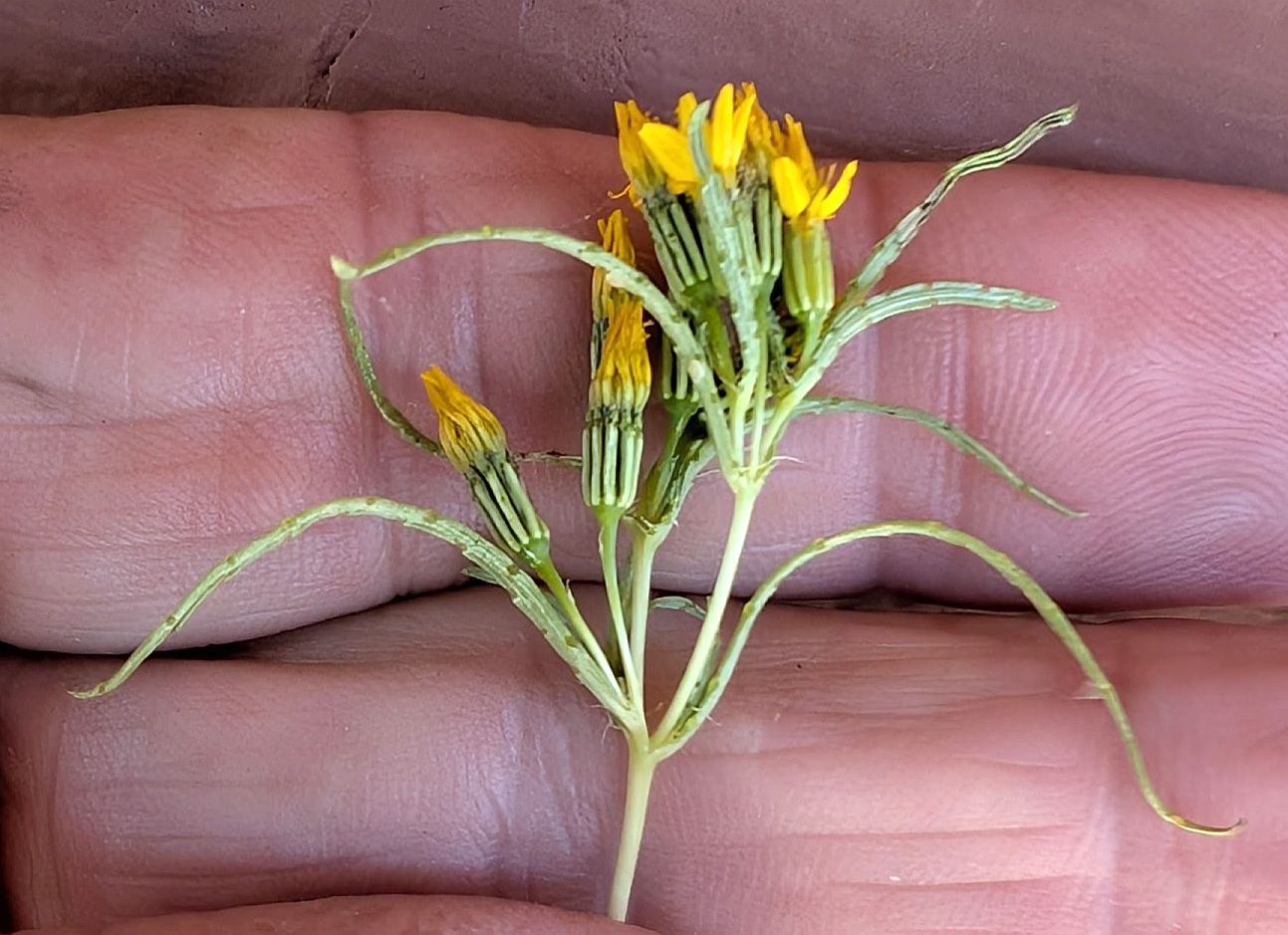
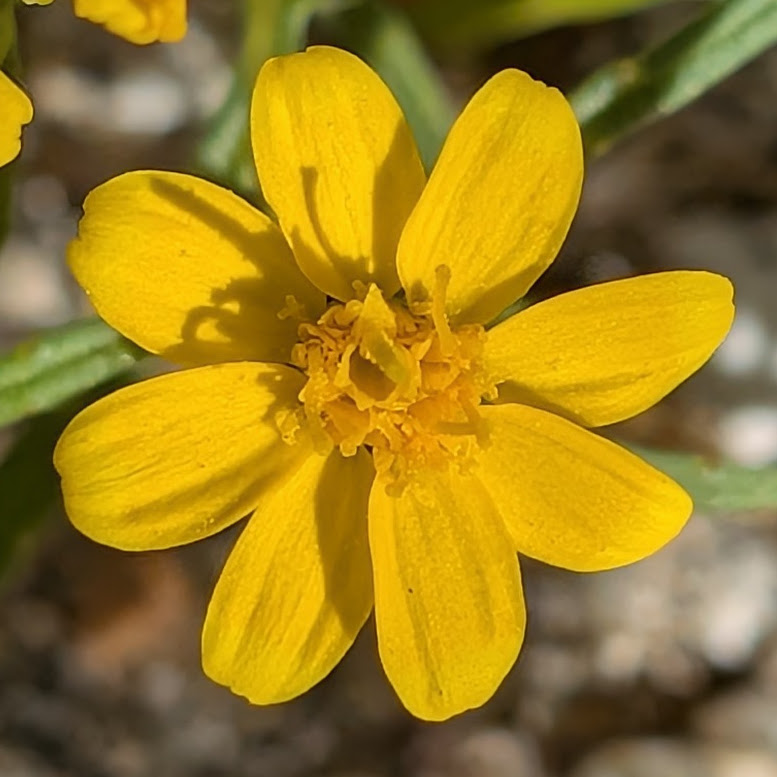
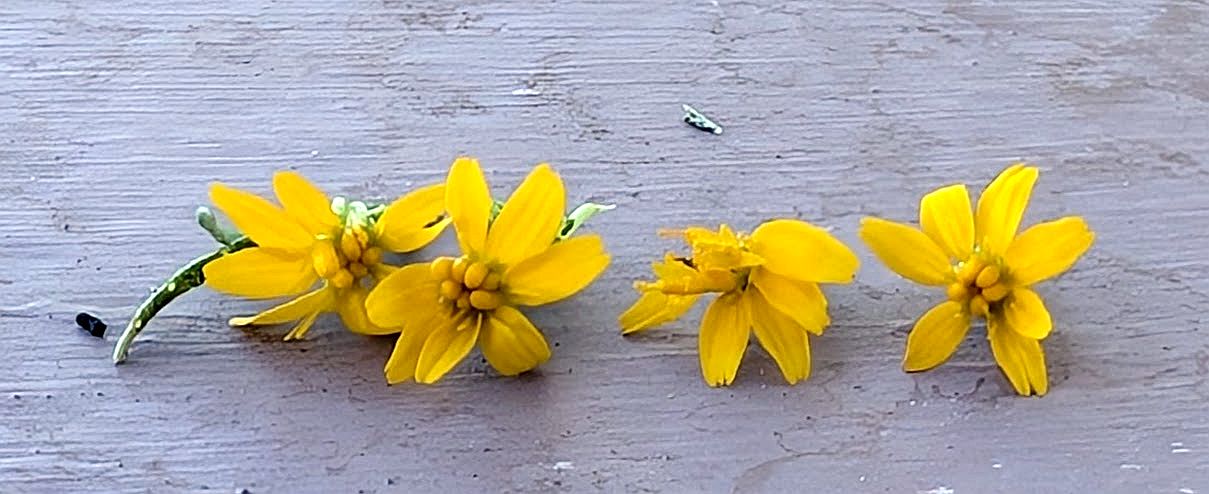
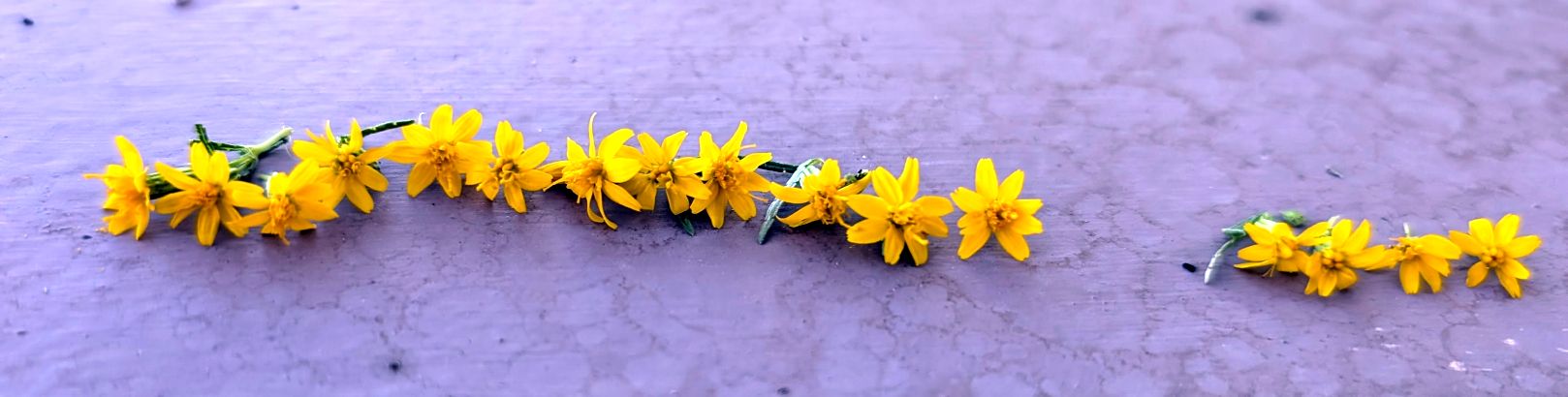
- Pectis is an annual sunflower family member with both disk and ray flowers that are yellow, usually with eight ray flowers, but occasionally with seven or nine ray flowers. The stems are either simple, or usually repeatedly forked.
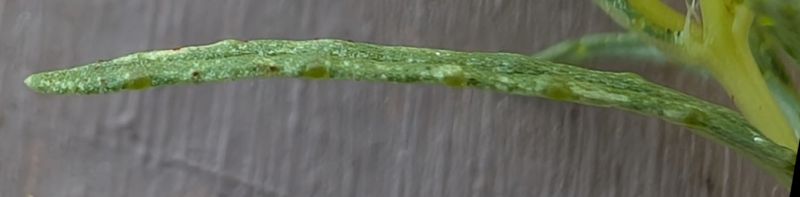
- Pectis has (sub)opposite linear leaves that are dotted with glands on their margins.
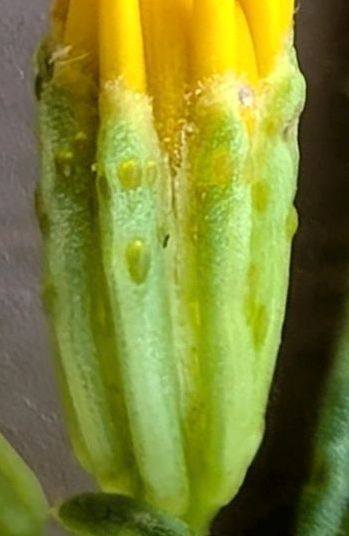
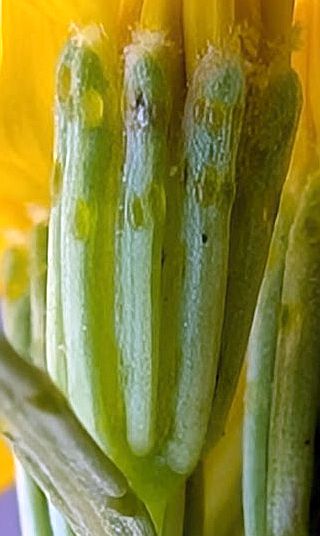
- There are usually eight phyllaries (bracts on the outside of the flower), each surrounding the seed of an individual ray flower, with glands mostly scattered in the top half of the phyllaries. Since each ray flower has its own phyllary, heads with fewer ray flowers also have fewer phyllaries.
These characteristics are shown in Figs. 5 through 7.
Interestingly, the disk corollas are said to be "2 lipped", which means the five tiny lobes of the disk flowers are not spread evenly around the edge of the flower, but instead are bunched into two groups. This appears to be very hard to see in photographs. This observation shows two disk corollas that each have four lobes on one side of the flower, and a single lobe on the other.
|
|
| Fig. 5. Top: Photo of one entire plant. Note the annual nature of the plant, as shown by it being an herbaceous plant with a single taproot with no indication of any parts that might last longer than one season.
Bottom: Photo of another plant that shows the subopposite linear leaves. The floras say just that the leaves are "opposite", but the bottom pair of leaves looks subopposite, being displaced slightly along the stem from exact opposition. It is possible the leaves below the inflorescence are strictly opposite. The deeply-indented phyllaries, forming columns, are striking in these pix. Each phyllary subtends one ray flower, and it wraps around the seed and pappus. Photos taken by Don Rideout on 22 October 2025 from Borrego Springs. Click on the pix to see larger versions. |
| |
| |
| |
| Fig. 6. Top row: Close-up of a single flower, showing its normal eight ray flowers. Second row: Four flowers that have fewer than eight ray flowers. Third row: 12 flowers that all have eight ray flowers.
Photos taken by Don Rideout on 22 October 2025 from Borrego Springs. |
| 
|

| |
| |
| Fig. 7. Top row: photographs of the gland-dotted phyllaries. Second and third rows: photographs of the leaves from above (second row) and from the side (third row) showing the glands along the edges of the leaves.
Photos taken by Don Rideout on 22 October 2025 from Borrego Springs. | |
Fragrance
In addition to producing showy flowers, Pectis produces a heck of a fragrance that can even persist after the plant has died and dried up. It is in the elite group of the strongest-smelling plants in the Borrego Desert. Anyone who has spent any time walking in a field of Pectis will have smelled this plant. In November 2013, after I walked through a large field of dead Pectis to get to Big Spring in Culp Valley, I detected a strong turpentine odor in my garage the next day, and I couldn't figure out what was causing it. I finally tracked it down to my hiking boots that were inside my car!
As with many smells, few people agree on what it smells like, although most people agree the smell is potent and can be overwhelming at times. Here are some descriptions of the odor. Note the quite different opinions in the first four, as well as the difficulty in describing the fragrance in the next two.
- Jaeger wrote "heavy but agreeably scented".
- Willis Lynn Jepson wrote "herbage with a strong disagreeable odor".
- Morhardt and Morhardt wrote "with strong odors, though not necessarily unpleasant in small doses".
- One person said "it smells like a dangerous relative of curry seasoning. Not my favorite!"
- A trip report posted at Sweet Adversity nicely summarizes the difficulty of assigning a name to the fragrance:
"Marzipan...," I concluded confidently.
I'd rattled off several other possible general aroma classes, including hand lotion, sunscreen, citrus, and candy before finally settling on the smell of the almond confection.
- One person said:
I've tried figuring out what else I'm smelling besides the citrus smell. When it's a large field and all over my shoes it seems to be less refreshingly lemony and more pungent. I just grabbed another stem and it has some fennel scent as well to me.
- Spellenberg, in Sonoran Desert Wildflowers, wrote "an odor reminiscent of lemon-scented furniture polish".
- To me, Pectis smells like a box of Crayola crayons. A small number of people have agreed with that interpretation. As mentioned above, later the fragrance changes to turpentine.
- One person said it smells like "spicy melted crayons".
- Some people said it smells like turpentine in the field.
- Some of my companions have said it smells like the herb cumin. The fragrance of cumin is described as a "spicy, woody, and aniseed scent", or a bold and aromatic profile characterized by its warm and earthy notes with a hint of spice.
- One person said it smells like a mix of vanilla and almond.
- The Jepson eFlora says "herbage spicy-scented", as does the Flora of North America.
- Yavapai County Native & Naturalized Plants says it is "spicy- or lemon-scented".
- Munz write "heavy-scented".
One of the major problems in describing smells is that our vocabulary of fragrances is so limited. So even though humans can distinguish one trillion odors, when asked to describe a smell we have to shoehorn that smell into a much smaller number of categories. One study used just 16 descriptive terms for people to score different smells. The same study found that the rankings were highly individual, varying from person to person, just as seen in the different descriptions above.
A paper was published in 1949 on "The essential oil of pectis papposa", saying:
This oil, produced by a heavily scented herbaceous plant of the American Southwest and northern Mexico, is rich in cumaldehyde and carvone, and is therefore a potential commercial source of these fragrant aldehydes, now obtained from cumin, caraway and dill seed oils and used in Savoring food and beverages.
Chinchweed is notable as a fragrant summer annual because it contains a healthy dose of cuminaldehyde, an organic compound that is found in cumin, eucalyptus, myrrh, and dill. If you are walking through the desert in the summer and things are smelling spicy, it's the Chinchweed.
Growth Rate
Pectis is one of the fastest-growing annual species in the Borrego Desert. Monsoonal rain fell on 25 August 2025 in the area along Split Mountain Road, and 16 days later we observed Pectis plants that were within a day or two of opening their first blooms! See obs 1 and obs 2; note the color showing on one bud. Boerhavia triquetra intermedia also was about to bloom 18 days after that rain in the Blair Valley Area.
Exactly one month after that rain, there were carpets of Pectis in bloom.
Kearney and Peebles, in their Arizona Flora, write:
With remarkable promptitude after summer rains have fallen, especially in the southern part of the state, the ground is carpeted with the small yellow heads of the strong-smelling chinchweed (P. papposa).
As mentioned above, one "secret" for the rapid growth of both of these species is their C4 photosynthesis.
Another "secret" is that the seeds are programmed to germinate quickly. Hayashi et al 1994 showed that in the lab, the root emerged from the seed just one day after being soaked in 30° C water for 24 hours with continuous lighting. Half of their seedlings opened their cotyledons two days later, with almost all the seeds having open cotyledons five days after sowing. The first true leaves were visible four to nine days after sowing. The first flower bud was visible nine to 10 days later for 20% of the population, which is when their experiment stopped.
Pectis seedlings in Nature did not appear as quickly in our 2025 observations. We surveyed a number of areas that later had carpets of Pectis in bloom, but we saw no baby Pectis plants at all seven days after the rain. The only seedlings we saw to emerge so quickly were a small number of Datura discolor and a somewhat larger number of Boerhavia triquetra intermedia, both of which had started showing their first true leaves.
In Summer 2026, I grew some Pectis plants in my Fallbrook, California yard, and they followed the fast timeline observed by Hayashi et al. Just 5.7 days after I planted and watered the seeds, the plants had fully developed cotyledons and half-developed first true leaves! I posted daily, and sometimes semidaily, observations of those plants at iNat.
Other developmental milestones for those plants:
- The first bud showed color on day 18.0.
- The first flower started opening on day 18.7, with just some of its ray flowers open.
- The first flower that had all its ray flowers open appeared on day 19.7. It therefore took a full 24 hours for that flower to finish opening! That flower was still blooming three days later, although perhaps not looking as fresh as they had been.
- On day 22.7, one plant had 4 flowers open, and another set of two plants growing close together had 10 flowers open.
Human Uses
Jaeger wrote "The Hopi Indians of Arizona sometimes used the ashes to mix with corn flour in making peki, while the Zunis used it as a seasoning for meat stew or rubbed it on the body as a perfume" (Desert Wildflowers, p. 303)
Origin of Common and Scientific Names
The genus name of Pectis was defined by Linnaeus in Syst. Nat., ed. 10. 2: 1189 (1221, 1376) in 1759.
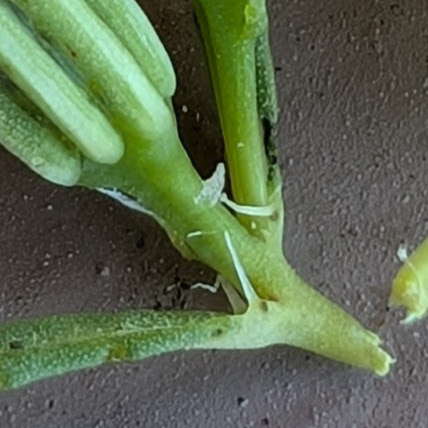
The name Pectis is from the Greek "pecteo", "to comb", from its ciliate leaves (Michael Charters; Keil, Jepson eFlora, 2022). However, the leaves of P. papposa are not very ciliate, having only a few hairs near the leaf bases; see Don Rideout's pix.
The species name of "papposa" derives from the ~20 ~plumose bristles that the disk fruit usually have (sometimes the pappus is only a crown).
The scientific name for Pectis papposa is unusual in that it has never changed since it was defined in 1849 by Harvey & Gray in the Memoirs of the American Academy of Arts and Sciences ser. 2, 4:62.
In contrast, this species has many common names, which include cinchweed, many-bristle chinchweed, common chinchweed, many-bristle fetid-marigold, lemon-scented chinchweed. Kate Harper strongly objects to the use of "weed" in the name for lovely common plants, and so proposed using the name "golden chinch-flower".
I couldn't find any source that gives the origin of the name "chinchweed".
Jane Strong speculated that it was because of the fragrance of both. The odor of the chinch bug when crushed is said to be a "foul odor like stink bugs" (Vittum et al 1999). Chinch bugs commonly infect grass, so the odor is released when walking across grassy areas infested by chinch bugs.
As discussed above, Pectis also gives off a very strong smell that is often perceived as unpleasant. It is possible someone made the connection of the odors, even though chinch bugs do not eat Pectis.
Kearney and Peebles state that P. papposa is a host, in Arizona, of the beet leaf hopper.
Taxonomy and Phylogeny
Pectis papposa is a member of the Tageteae, the marigold tribe of the Asteraceae. Members of this tribe have foliage and phyllaries with swollen glands, which give off a resinous odor when crushed.
Other members of the marigold tribe in the Borrego Desert include Adenophyllum porophylloides, San Felipe dogweed; Porophyllum gracile, odora; and Thymophylla pentachaeta, five-needled thymophylla. One that I wish we had, which is in Joshua Tree National Park and almost makes it into the Borrego Desert, is Nicolletia occidentalis, Movaje Hole-in-the-sand Plant.
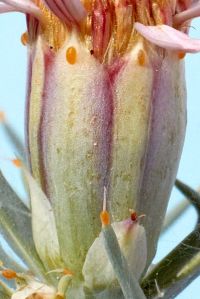
The phyllaries of these species are shown in Fig. 8.

Adenophyllum porophylloides | 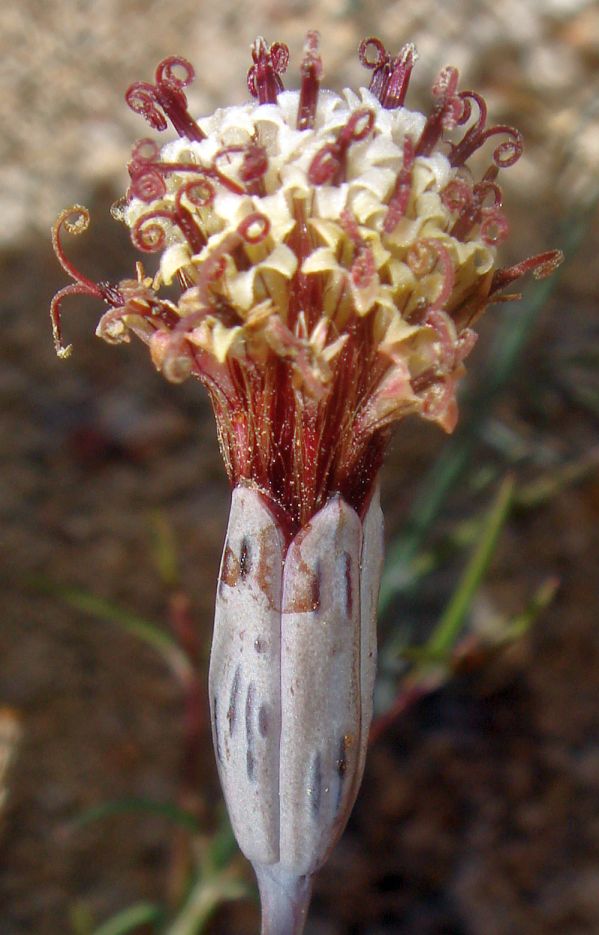
Porophyllum gracile |
Pectis papposa |
Nicolletia occidentalis | 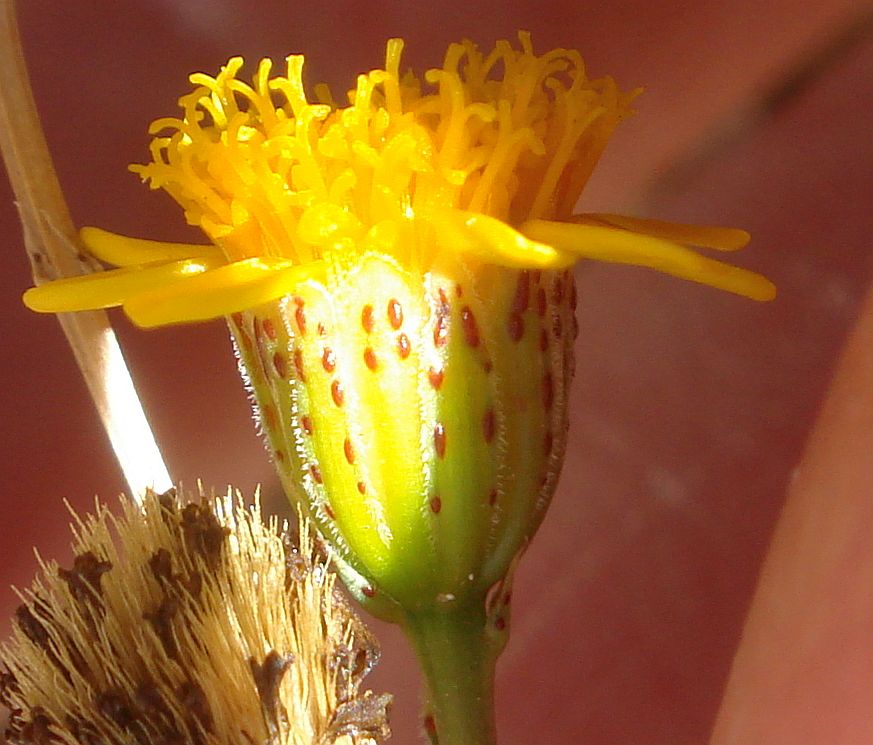
Thymophylla pentachaeta | (intentionally blank) |
| Fig. 8. Phyllaries of members of the marigold family in Borrego Springs and the Mojave Desert. All pix by Tom Chester except for the pix of Nicolletia occidentalis from @plantsoflacounty at iNat.
Click on the pix for larger versions, or to go to the iNat obs of Nicolletia occidentalis. | ||
The genus Pectis is the largest genus in the marigold tribe, with about 90 xeric adapted species, all in the New World. All species in that genus have C4 photosynthesis.
The genus Pectis is most closely related to the genus Porophyllum. They diverged from a common ancestor ~11 million years ago. The common ancestor is thought to have lived in Central/Northern Mexico.
Don Rideout said that the fragrance of Porophyllum is similar to the fragrance of Pectis.
Porophyllum never evolved C4 photosynthesis, which is perhaps the reason that it has evolved just ~25 species, compared to the ~90 species of Pectis.
References:
- The Sunflower Family, Spellenberg and Zucker 2019.
- Molecular Phylogeny of Pectis (Tageteae, Asteraceae), a C4 Genus of the Neotropics, and its Sister Genus Porophyllum, Hansen et al 2016, Lundellia 19:1.