Plant Species of San Jacinto Mountain:
Sarcodes sanguinea, snowplant
Sarcodes sanguinea, snowplant
| 
|
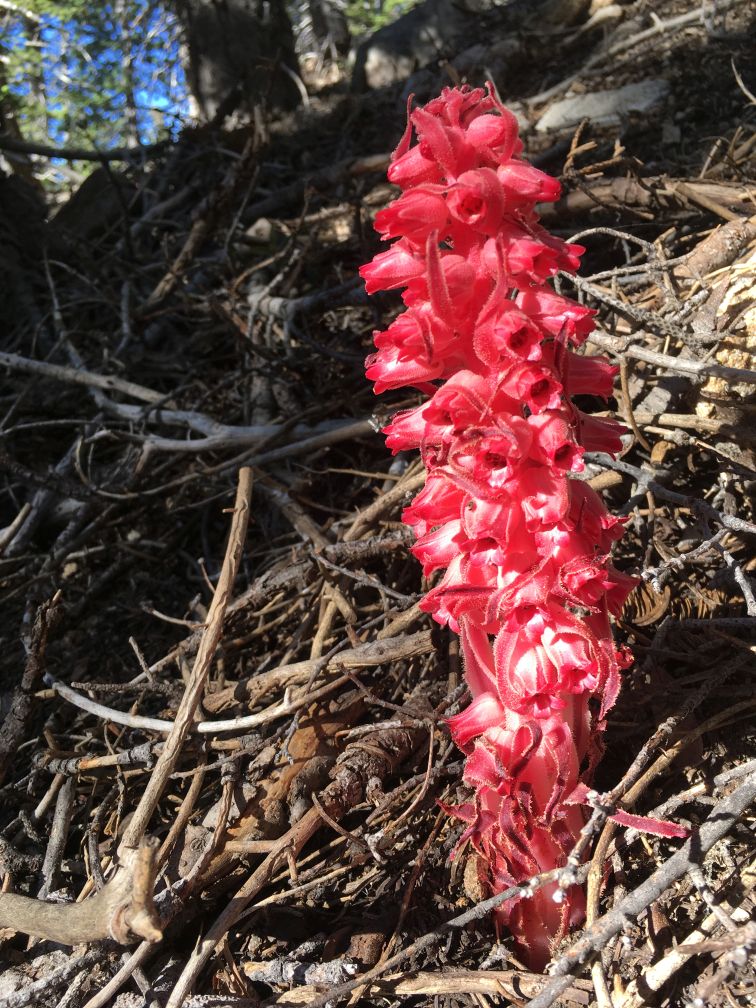
| Fig. 1. Left: A blooming plant of Sarcodes sanguinea, snow plant, growing through pine duff on a steep slope.
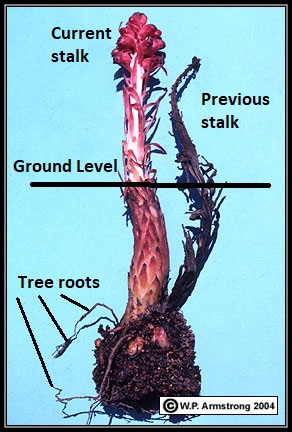
Right: A plant Wayne Armstrong excavated and photographed, showing the large rootball of Sarcodes sanguinea, a current inflorescence, another inflorescence now dead, and tree roots growing into the root ball. It isn't clear whether the three pink scales in the upper part of the root mass are scales at the bottom of the current stalk, or represent buds that might grow new stalks. The outside of the root ball contains the ectomycorhizal fungus Rhizopogon ellenae, which transfers nutrients from the tree roots to the snow plant. The now-dead inflorescence is probably from the same year as the current stalk, since we have never seen a stalk survive from one year to the next, but we have seen neighboring stalks of very different bloom stages, such as this one. Left pix by Nancy Accola; click on the picture for a larger version. Right pix by Wayne Armstrong; click on the pix to go to his original webpage. | |
The Lifecycle of a Snowplant in Words and Photos
Dates of Emergence, Full Bloom, and Full Fruit in 2026 at San Jacinto Mountain
Do Snowplants Ever Appear in the Same Place Again?
Analysis of Plants Seen in 2026
Analysis of Plants Seen in 2025 and 2026
Analysis of Plants Seen in 2021 through 2026
Conclusions
How are Snowplant Seeds Dispersed?
Introduction
Most people are stunned when they first come across a Sarcodes sanguinea, snowplant or snow plant; both names are used; see Fig. 1. Its bright red color makes it visible from some distance. It is such a bright red deep color that many photographs of it saturate on the red component, no matter how you change the exposure length!
Snowplant looks so different from all other plant species in southern California that everyone who sees one, including non-botanists such as PCT thru-hikers, want to know what it is. Some people think it might be a red mushroom. Others mistake it for something completely alien to the forest, like something made out of brightly-colored plastic, or a piece of fresh meat. Its scientific name alludes to that, since it translates as "flesh-like blood-red".
Amazingly, snowplant is a member of the heath family, the Ericaceae, which also contains wintergreens, manzanitas, rhododendrons, and blueberries! It is in the Monotropoideae (monotropes) subfamily of parasitic plants, which includes pinedrops, prince's pines, and wintergreens. None of the other species in that subfamily evolved such a bright red color.
Snowplant is parasitic on a single species of fungus, Rhizopogon ellenae, and receives all its nutrition from that fungus. That fungus forms a symbiotic relation with white firs and conifers. Hence the nutrition for snowplant growth ultimately comes from the surrounding trees, and thus snowplant is only found in conifer forests. It is most often found in areas that have thick pine duff that are moist enough to support the fungus.
The above-ground part of a snowplant, its inflorescence, is generally 15 to 30 cm tall (6 to 12 inches), with diameters of 1 to 11 cm (0.4 to 4 inches). The width variation causes quite a difference in the appearance of the plants, from somewhat slender inflorescences to ones that are quite stout.
Hinson and Sadek did a study of 51 snowplants at the James Reserve, and found that 84% of those snowplants were on south-facing slopes. They found that snowplants at the James Reserve had pine duff depths of 1 to 17 cm (0.4 to 6.6 inches) and were found on slopes of 9 to 45 deg, with larger snowplants somewhat more likely to be growing in deeper litter and be found at higher slope angles.
Bidartondo et al 2000 describe the root ball as a congested and dense mass of brittle, succulent, highly branched monotropoid mycorrhizal roots from which adventitious inflorescence axes emerge; see Fig. 1. They say the Sarcodes rootball can be "1000 cm^3 or more", a radius of ~15 cm (6 inches). Wallace noted that the root mass can spread up to 60 cm in diameter, 30 cm (12 inches) in radius.
As with many exotic things, there is some misinformation about snowplant. One erroneous story probably comes from its "red hot" color, that it therefore must be warm enough to melt through snow to emerge. That misinformation is even in the common name! In fact, it is very rare at San Jacinto Mountain to see snow surrounding emerging snowplants. Out of 221 iNat posts of it from 2026 that Tom examined, only a single observation had snow in the image. Instead, snowplants usually emerge only after the snow has melted and the soil has already warmed.
John Muir wrote in his 1912 book The Yosemite:
Soon after the snow is off the ground, it rises through the dead needles and humus in the pine and fir woods like a bright glowing pillar of fire.... It is said to grow up through the snow; on the contrary, it always waits until the ground is warm, though with other early flowers it is occasionally buried or half-buried for a day or two by spring storms.
Snowplants are pollinated by bumble bees and hummingbirds. Matt Berger captured a video of a hummingbird visiting snowplant. Tom has also seen hummingbirds at a snow plant, and then searching for more, in Long Valley when snowplant was the only plant species blooming, and individual snowplants were few and far between. Matt Berger wrote that the bright red snowplants are "massive beacons in the dark and usually pretty barren understory of dense forests".
For more information about the development of the flowers and fruit of snow plant, and a photo of its seeds, see Botanical Society of America's page on snowplant. See also an informative video about snowplant by the Jepson Herbarium.
One of the most interesting things about snowplants at San Jacinto Mountain is that they never seem to pop up in the same place from year to year! A section below analyzes data from the Devils Slide Trail from 2021 to 2026 to see if any spot had a repeat performance by the same plant.
In that analysis, we found no definitive observations of any plant that bloomed in more than one year, out of a total of 38 plants observed in 2021 through 2026. There is only one possible repeat bloomer, but there is no evidence that the photographs from different years show the exact same field, and the twigs in the photos do not match up.
The Lifecycle of a Snowplant in Words and Photos
A snowplant begins as a seed less than 1 mm wide, which is usually dropped in the close vicinity of the parent plant. This is a good strategy, since the seed will only germinate when it contacts its specific fungus host. The fungus host is apparently not uniformly found throughout the forest duff, but is instead concentrated in the vicinity of previous snowplants (Bidartondo et al 2000). This probably is the main reason that many snowplants are found in clusters.
The development of the germinated seed is not known in detail. Blooming snowplants can have a root mass that is ~15 cm (6 inches) to 30 cm (12 inches) in radius, and it is unknown how long it takes for the root mass to get that large.
Once the root mass becomes large enough to send up a bloom, when the soil warms up in early spring, it sends up a compact shoot with all its bracts in a tight cluster to protect the shoot. At one point after it emerges from the ground, the lower bracts unfurl so that the flowers can bloom. The bloom progresses up the stalk so quickly that the entire stalk can be in full bloom at once. The lower flowers go to fruit first, with the same progression up the stem until the entire stem is in fruit.
The plant in fruit almost always eventually bends where it emerged from the soil, with the above-ground stem ending up lying on the ground. The individual fruits gradually detach from the stem until only a bare stalk is left. All these above-ground parts decay fairly rapidly, and none persist beyond the year in which the stalk bloomed.
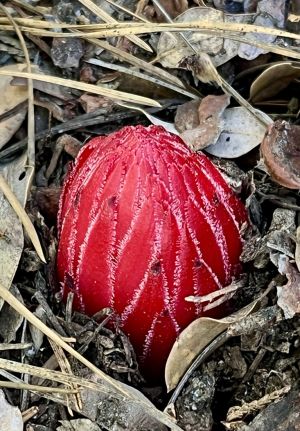
Fig. 2 shows how snowplant varies in appearance over its lifetime.
Just emerging from the forest litter | 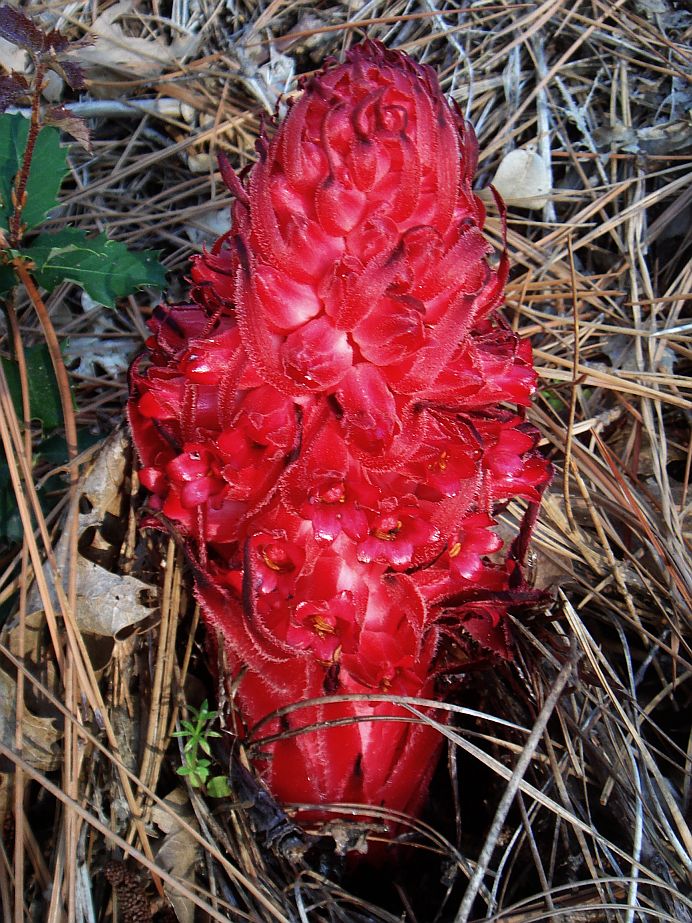
First flowers |
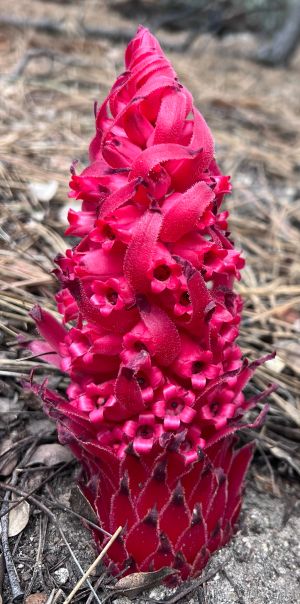
Full bloom | 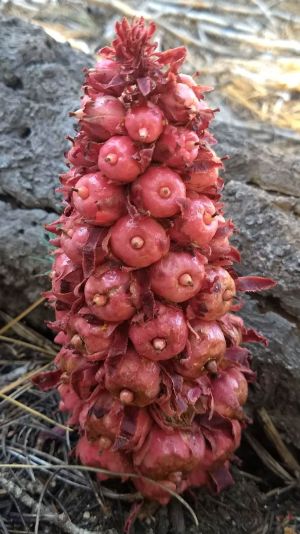
Full fruit |
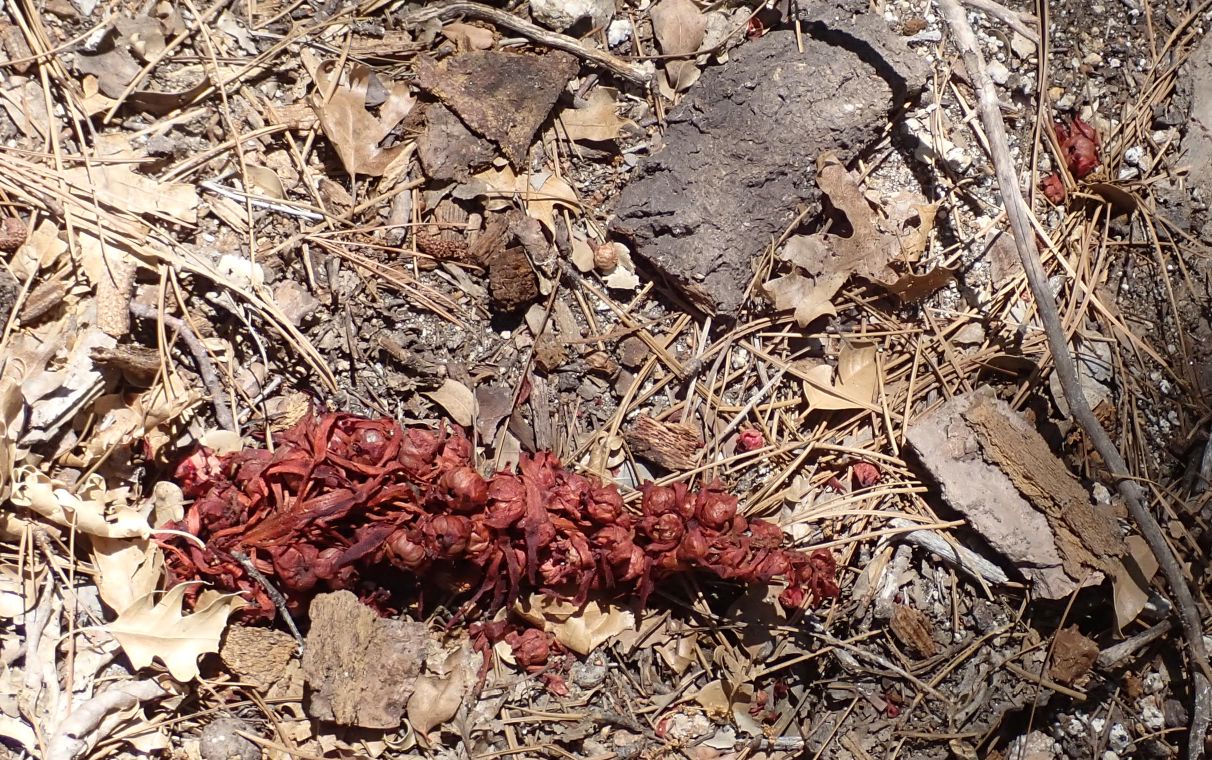
Stalk fallen over, lying flat on the ground, with some fruit scattered about (in white circles), but most fruit still attached. | |
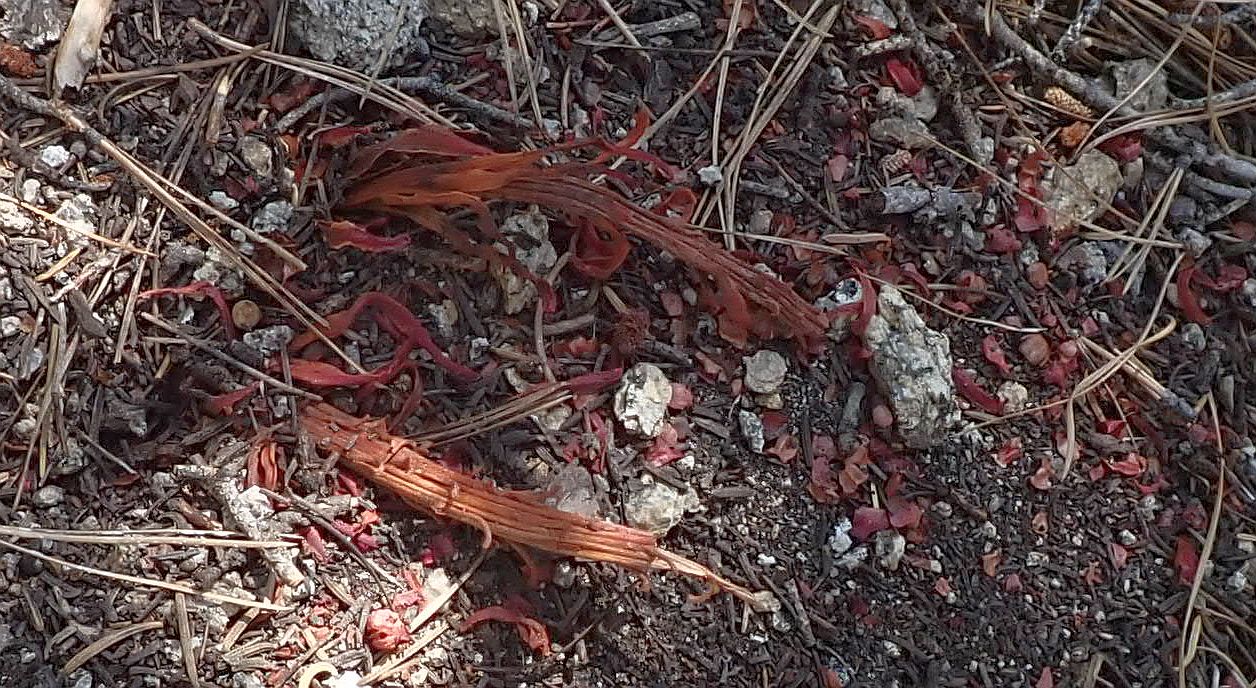
Stalk now has lost all its fruit, which are scattered about in the close vicinity of the dead stalk. | |
| Fig. 2. The above-ground life-cycle of snowplant.
Click on the pix to go to the original iNat observations with the observer's name, or to see a larger photo. | |
Dates of Emergence, Full Bloom, and Full Fruit in 2026 at San Jacinto Mountain
Tom gathered info about the dates of each phase of the life cycle of snowplants at San Jacinto Mountain by visually examining the 221 iNat posts of it from 2026 (as of 13 July 2026), and evaluating the stage for each stalk shown. Because Tom was interested in how the stages depended on elevation, observations with poor positions were not used in the analysis.
The dates and elevations of each stage in the life cycle are displayed in Fig. 3.
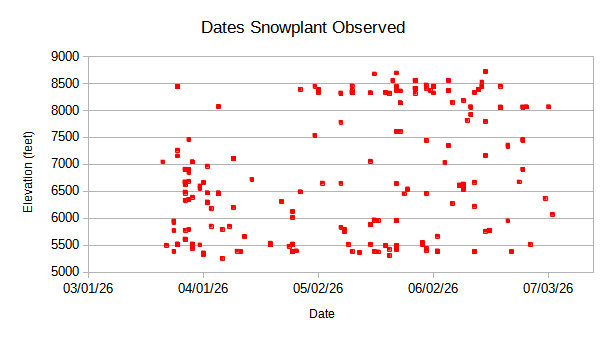
Elevation vs. Date for all observations |
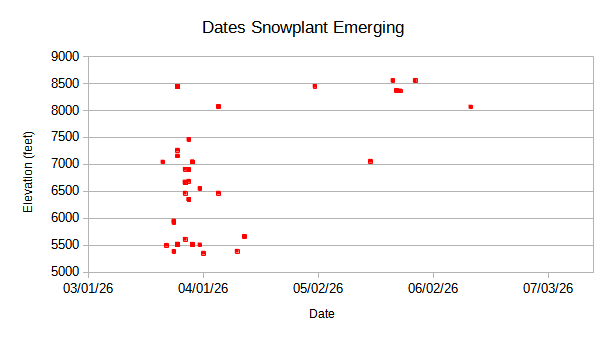
Elevation vs. Date for observations of plants just emerging |
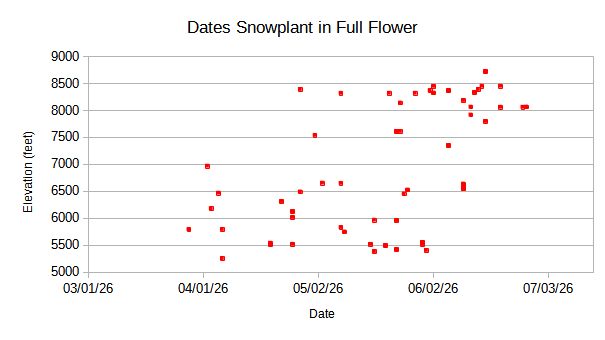
Elevation vs. Date for observations of plants in full bloom |
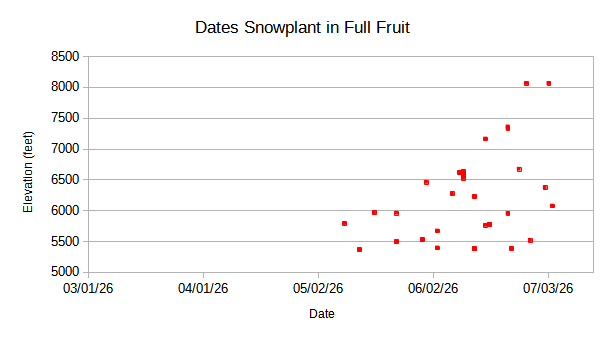
Elevation vs. Date for observations of plants in full fruit |
| Fig. 3. Elevation vs. Date for iNat obs with accurate positions, for all observations (top graph), observations showing plants just emerging (second graph), observations showing plants in full bloom (third graph), and observations showing plants in full fruit (bottom graph). |
Snowplants were observed at iNat between elevations of 5250 feet and 8720 feet. This matches well with our GPS locations of snowplant in our database, which range from 5320 to 8890 feet. Our GPS database is incomplete at lower elevations, and it contains many off-trail locations at higher elevation, accounting for the slightly lower elevations observed at iNat and the 170 feet higher maximum elevation from our observations. The lowest elevation 2026 iNat obs was by Eric Bo Garcia from just south of Idyllwild Nature Park. The highest elevation 2026 iNat record was by Mercedes St. John from Hidden Divide. (The highest record in our GPS database is from the Wellman / Hidden Divide Ridge above the Round Valley Trail.)
There was a 2026 record of snowplant from San Jacinto Peak, but that location is almost surely erroneous. We have never spotted a snowplant there, and the habitat in the photo is very different from the Peak area. iNat observations with unknown precise locations are sometimes just plotted at the Peak with a large uncertainty radius.
Snowplants were seen to be emerging from the ground mostly in the last half of March 2026, at all elevations. The earliest iNat post was by @docwalk76 on 21 March 2026 from the Suicide Rock Trail just before Marion Creek. Some plants must have emerged well before that date since one plant was almost in full bloom on 28 March 2026. It isn't surprising that there were no earlier observations of snowplant since it normally is too cold and too early in the season for most botanists to hike the higher elevations of San Jacinto Mountain.
March 2026 was a very anomalous month for weather, with high temperatures more typical of June for almost the entire month. This may have made the early-season iNat record much more complete for 2026 than in most other years.
Snowplants didn't emerge at lower elevations after mid-April, with the latest snowplant seen emerging on 4/12/26 in the James Reserve at 5660 feet elevation.
Snowplants were seen emerging at higher elevations on the south side of Marion Mountain on 25 March 2026 and on 5 April 2026. Those snowplants were probably the first to emerge at higher elevations due to that south-facing slope heating up before the other locations in shadier areas.
However, overall, there are many fewer records of emerging snowplants at elevations of 8000 to 8500 feet than expected, almost surely due to an absence of observers recording emerging snowplants in April at those elevations. The last posted observation of an emerging plant on 12 June 2026 was at 8060 feet near Tahquitz Meadow. Interestingly, the emerging plant was immediately next to a plant in full flower.
Snowplants were observed to be in full bloom in April and May at elevations of 5500 to 7000 feet, and mostly in June at elevations of 8000 to 8500 feet.
Snowplants were observed to be in full fruit in May and June at elevations of 5500 to 6600 feet, and were just starting to be observed in full fruit in July at elevations above 8000 feet. Since the dataset Tom analyzed stopped at 13 July 2026, the data are incomplete past that date.
Number of Stems per Plant
Snowplants often come singly, or in pairs of plants that almost touch. Infrequently, more stems are found in a single cluster in which each stem almost touches at least one other stem. We have no idea whether these are all coming from a single unique underground root mass, or whether these are independent stems that resulted from the germination of neighboring seeds. The latter possibility certainly seems plausible, since a mother plant can deposit thousands of seeds in a radius of just 10 cm or so.
We here define a single plant as those closely-spaced stem groups, keeping in mind that they may not actually be plants with unique genomes.
Sometimes snowplant stems can be found at larger distances from a given snowplant, perhaps 100 to 1000 cm away. We consider those to be different plants. In the iNat posts reviewed by Tom, there is never any ambiguity in defining how many stems are from a single plant, using our definition above.
We can use the iNat data to compile a histogram of the number of stems per plant, but it is a bit problematic to make an accurate histogram because the same plant is often posted by different observers at the same time, and sometimes the same plant is posted by observers from different dates. It would be difficult to match up all those observations by hand, but since there are so few plants with three or more stems, we have corrected the counts from them by hand, to only contain unique plants.
For the observations with one or two stems per plant, the histogram contains the raw numbers which includes dupes, as well as numbers from an attempt to remove dupes based on coordinates alone. That method is not perfect, but gives a more accurate number than the one including dupes.
Fig. 4 shows the resulting histogram, with the numbers also given in Table 1.
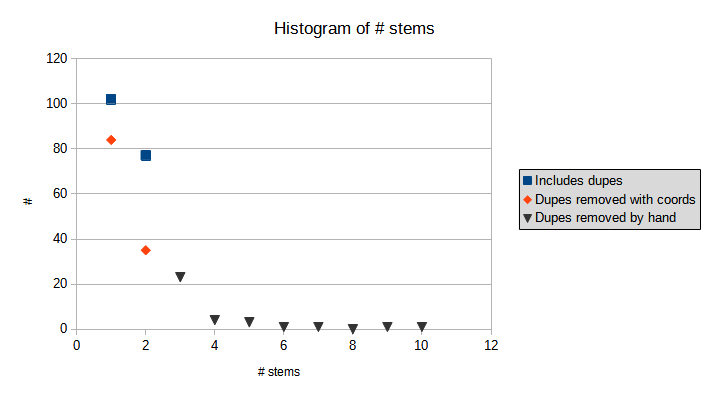
Fig. 4. Histogram of the number of stems per plant for the 2026 iNat snowplant data. The number of stems for plants with 1 and 2 stems are given twice. The larger numbers are inflated by duplicate iNat observations of the same plant. The smaller numbers are after an attempt to remove duplicates using coordinates alone. The numbers for plants with 3 or more stems have been corrected by hand for duplicate iNat posts. See the text.
Table 1. Number of snowplants with a given number of stems
| # stems | # of Plants* | # of Plants^ |
|---|---|---|
| 1 | 102* | 84^ |
| 2 | 77* | 35^ |
| 3 | 23 | 23 |
| 4 | 4 | 4 |
| 5 | 3 | 3 |
| 6 | 1 | 1 |
| 7 | 1 | 1 |
| 8 | 0 | 0 |
| 9 | 1 | 1 |
| 10 | 1 | 1 |
| Total | 213 | 153 |
^ Number after attempting to remove duplicates using coordinates alone.
After correction for duplicate plants, 55% of the plants have just a single stem; 23% have two stems; 15% have three stems; and 7% have 4 to 10 stems.
Here are the observations showing 7, 9, and 10 stems.
We were also curious as to whether there was a dependence on elevation for the number of stems. There does not appear to be; see Fig. 5.
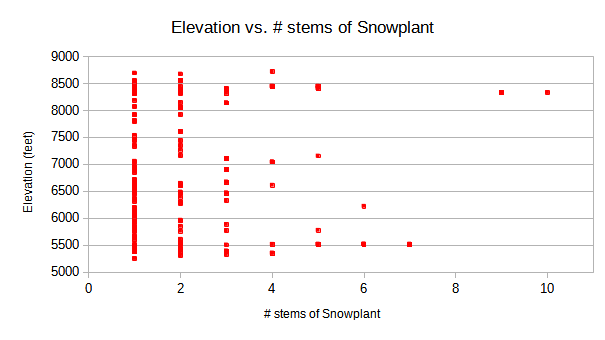
Fig. 5. Elevation for each iNat obs plotted vs. the number of stems per plant.
Do Snowplants Ever Appear in the Same place Again?
One of the most interesting things about snowplants at San Jacinto Mountain is that they never seem to pop up in the same place from year to year!
We have hiked the Devils Slide Trail repeatedly since 2002, and it seemed to us that from one year to the next the snow plants are in completely-different locations. This was annoying to Tom since he had to keep moving up the first snowplant occurrence on the trail in his Devil's Slide Plant Trail Guide whenever a new location appeared closer to the trailhead than previous occurrences. A plant trail guide works because nearly all the plants are found at the same location from year to year - except snowplants!
Never popping up in the same place is very odd behavior for a plant that is supposed to be a perennial. Being a perennial means that the same roots produce flowering stems in more than one year. Nearly all perennials produce flowering stems year after year for many years.
However, Keir Morse pointed out that we have no idea how long a Sarcodes plant spends underground, storing up reserves from its fungus host, before it produces its inflorescence above ground. If the underground process takes longer than a year, the plant could be considered a perennial even if it only produces a single inflorescence in a period of multiple years, as long as it eventually does produce another flowering stem from the same roots.
There have been two reports from locations to the north of San Jacinto Mountain of flowering stems appearing in the same spot in successive years. Mrs. R.M. Austin reported in the Botanical Gazette of August 1883, vol. 8, no. 8, pp. 284-285, that in the years 1875 and 1876 she dug up "dozens of plants" and found that the rootball is consumed by the current season's flowering stems, but that a "little snow plant" was present "just below and a little to one side of the old underground stem", with one cubic inch of root. She observed that in November, "after the rains had commenced", that the "root mass and little plantlet had greatly increased in size". She concluded that individual plants flowered "through many years". Unfortunately, she did not reveal the location where she studied the plants, or support her observations with numbers from different years.
Vreeland (1980) also reported that the root mass of Sarcodes contains immature buds of flowering stalks. They had different sizes, suggesting that the maturation process may cover more than one year. (as reported in Luoma; see below).
Daniel Luoma reported on a population in the Limpy Rock Research Natural Area in the Umpqua National Forest, Oregon, in the south central portion of the Cascade Mountains. This is the northernmost known occurrence of snowplant. Luoma found very different results from those of Austin, that the "flowering of individual plants in subsequent years was low in frequency. Despite the low rate of flowering recurrence, population levels were relatively stable over the five years of monitoring".
Luoma used a definition of a Sarcodes "plant" as:
"a group of one or more caespitose clusters of annual flowering stems (or stem) which are each other's nearest neighbors and can be encompassed within a circle of 1 m diameter. This definition was used fully only with plant # 3 in 1983.... All other occurrences were of single or nearly touching stalks and recurrences within a few centimeters of the previous years stalks."
Luoma found that repeat flowering in the immediately subsequent year ranged from 3 to 35%, with only one recurrence beyond the subsequent year. Table 2 gives his flowering recurrence data.
Table 2. Flowering Recurrence from Luoma in Oregon
| Years Comparison | Interval (years) | Flowering Recurrence |
|---|---|---|
| 1982-1983 | 1 | 35% |
| 1983-1984 | 1 | 17% |
| 1984-1985 | 1 | 24% |
| 1985-1986 | 1 | 3% |
| 1982-1985 | 3 | 6% |
| 1982-1986 | 4 | 0% |
This unusual behavior by snowplants stimulated the authors to begin photographing all the snowplants we saw at San Jacinto Mountain, starting in the year 2000, to see if any were present at the same spot in subsequent years, which may not be consecutive years.
Our original plan was to do a grand analysis of our observations, and those of others posted at iNat, to see if we could statistically derive an estimate of how many plants repeat at the same location.
On 26 June 2026, we made follow-up observations on snowplants we and others had seen earlier in the year on the Devils Slide Trail. That stimulated us to analyze all the iNat observations on that trail for six years, from 2021 through 2026. That analysis is presented below. It immediately became clear from that analysis that a grand statistical analysis was not possible, because of statistical and other errors in GPS locations, and because most iNat photographs don't show enough of the location to be confident of matching locations using only the coordinates.
Details are given below, but the bottom line is that we found no definitive observations of a plant that bloomed in more than one year, out of 38 plants observed in 2021 through 2026. There is only one possible repeat bloomer, showing a snowplant in similar habitats in the two observations. However, there is no evidence that the photographs from different years show the exact same field, and the twigs in the photos do not match up. But the position of twigs can change from year to year, so we cannot clearly state that these are not in the same location.
If one takes that possible repeat bloomer as an actual repeat bloomer, then only a single plant out of 37 plants rebloomed during this six year period.
If one does not consider that possible repeat bloomer as an actual repeat bloomer, then zero out of 38 plants rebloomed during this six year period.
In either case, the rebloom rate on the Devils Slide Trail over a period of six years is far lower than the two reports detailed above.
Analysis of Plants Seen in 2026
Our first analysis was on the plants observed on the Devils Slide Trail in 2026. Table 3 gives information about the snowplants seen on the Devils Slide Trail in 2026, in order of their occurrence from the bottom of the trail to the top.
Table 3. Snowplants observed on the Devils Slide Trail in 2026
| # | Link to Discovery obs | Link to Follow-up obs | Previously-seen plants in vicinity? | Miles from Trailhead |
|---|---|---|---|---|
| 1 | 28 March 2026 | not relocated on 26 June 2026 | No | 0.30 |
| 2 | 28 March 2026 28 March 2026 | 26 June 2026 26 June 2026 | No | 0.65 |
| 3 | 31 May 2026 | 26 June 2026 26 June 2026 | Many | 1.43 |
| 4 | 28 March 2026 | 26 June 2026 26 June 2026 | No | 1.44 |
| 5 | 1 May 2026 | not relocated on 26 June 2026 | Many | 1.57 |
The information about "previously-seen plants in vicinity" refers to having other iNat obs from any year within several hundred feet, and does not imply that there were previously-seen plants at the exact location of the plant in question. It requires careful analysis of the iNat obs to try to conclude that any were taken at the exact location.
This analysis found that three of the five snowplants observed on the Devils Slide Trail in 2026 had no previous iNat observations from any year in their vicinity!
Two of the snowplants observed in 2026 have many iNat posts from previous years from the vicinity of their location, but not necessarily the same location as the plants observed in 2026. GPS locations are often problematic at San Jacinto Mountain, so it takes careful study of the previous year's plants to see if any are from the same location.
Analysis of Plants Seen in 2025 and 2026
To check on this further, we analyzed the observations from 2025, and found that there were eight distinct plants, at mile 0.13, 0.46, 0.67, 1.00, 1.43, 1.45, 1.46, and 1.88. Those locations, and the 2026 locations, are plotted in Fig. 6.
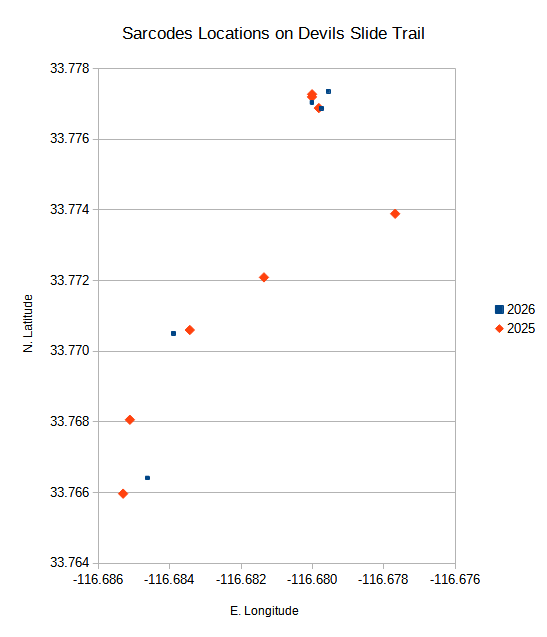
Fig. 6. Sarcodes locations on the Devils Slide Trail in 2025 and 2026. The iNat observations within each year have been carefully reviewed, so that there is only one position for each plant, even though there might be multiple iNat observations with different GPS positions.
This map is strikingly different than would be produced for essentially every other species on this trail! The plants of nearly every species, be they annuals, perennials, or shrubs, are found at the exact same location from year to year. Their markers from one year would fall exactly on top of ones from another year, with no locations at all with markers from only a single year.
Instead, there is an amazing difference in many locations between 2025 and 2026, with the exception of the northernmost area which had three plants observed in both years, albeit not at exactly the same locations. The markers must be right on top of each other to be at the same location. For example, the two red 2025 diamonds at top middle with just a small visible shift, are distinct plants separated by about 30 feet (10 m).
That northernmost area might simply be richer in the number of Sarcodes plants because the trees and their leaf litter appear to be thicker there. That area is also moister, with seeps that appear in the wettest years. As a result, the fungus host of Sarcodes might be more abundant there.
It appears from Fig. 6 that no Sarcodes plant came up at the same location in the two years.
Analysis of Plants Seen in 2021 through 2026
We then went through the same careful analysis of iNat observations from 2021 through 2024 on the Devils Slide Trail, to have a larger dataset spanning a longer period to look for plants with repeat flowering.
Table 4 gives the total number of unique snowplants seen in each of the years from 2021 through 2026.
Table 4. Number of Unique Snowplants on the Devils Slide Trail by Year
| Year | # of Plants | # of Stems |
|---|---|---|
| 2021 | 12 | 21 |
| 2022 | 3 | 3 |
| 2023 | 5 | 5 |
| 2024 | 6 | 9 |
| 2025 | 8 | 16 |
| 2026 | 5 | 8 |
| 2021- 2026 | 38 | 62 |
For 2021 through 2026, there were 30 plants with a single stem; 5 plants with two stems; 3 plants with three stems; one plant with five stems; and one plant with eight stems.
Fig. 7 shows the locations of all plants observed in 2021 through 2026.
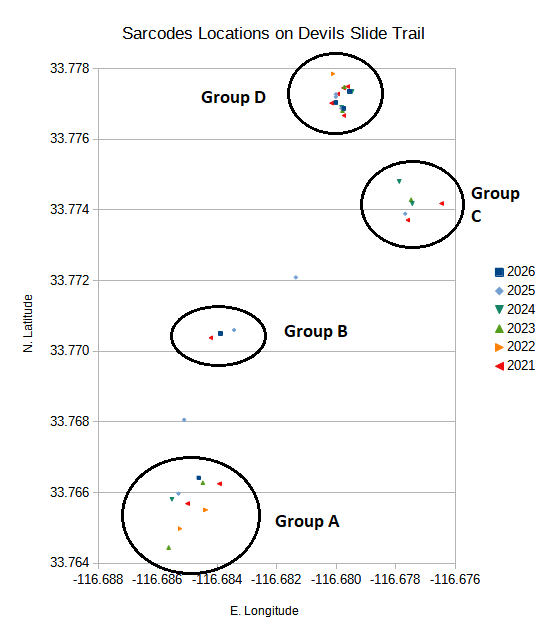
Fig. 7. Sarcodes locations on the Devils Slide Trail in 2021 through 2026. The iNat observations within each year have been carefully reviewed, so that there is only one position for each plant, even though there might be multiple iNat observations with different GPS positions.
The color coding for the locations is such that the colors grade from red in 2021 to deep blue in 2026.
Four groups of plants have been labeled and are discussed in the text.
Fig. 7 shows a very surprising variation in where snowplants occur from year to year.
Remember that, at the scale of this figure, the markers must be right on top of each other to be at the same location. That does not happen anyplace on the trail except possibly in Group D. The markers are clearly separate elsewhere.
Each area in Fig. 7 is discussed below.
The ten locations in Group A are mostly well-spaced, with typical separations of over 200 feet, which is way too large for any to be at the same actual location.
The closest two locations are 70 feet apart, and do not appear to be in the same location from their photographs. The 2026 location is between a large rock and a large tree trunk on the ground (see the second photograph), whereas the 2023 location is next to a small branch.
It is interesting that the 2021 and 2022 locations (orange and red) are systematically shifted from the 2023 to 2026 locations (green and blue).
Two locations were seen only in 2025, with no other snowplants anywhere close to them! The first is in-between Group A and Group B; the second between Group B and Group C.
The six locations in Group C are well-spaced like the locations in Group A, with the exception of two points just 52 feet apart. These do not appear to be in the same location, with the 2023 location well above the trail crossing of the Powderbox Spring Drainage in an open area, and the 2024 observation in a field of branches close to the trail.
19 locations in Group D are shown at an expanded scale in Fig. 8. (There is a 20th location that is well-separated to the north of the others, seen in Fig. 7, that isn't shown in Fig. 8.)

Fig. 8. Sarcodes locations in Group D from Fig. 7 shown at an expanded scale.
There are six locations in Group D1. Two of those six locations have identical coordinates since they were taken from the position on the trail, with the same landscape features in each observation. But the snowplants were at different distances from the camera. In 2023, the snowplant was well in the distance, whereas in 2021, the snowplant was much closer to the camera.
The other four locations do not have any features that match. One location is very distinctive, with the snowplant between a boulder and a log, that is not seen in the other three obs. Two of those other three obs were taken at the same time on the same day from the same year, 2024, and are clearly of different plants: Plant 1 and Plant 2. The third observation, from 2026, appears to be in a different location, but it is difficult to be sure due to the small field of view of the two 2024 posts.
There are three locations in Group D2, with two observations in 2021 of very nearby, but separate plants, and a single observation from 2026 that is 60 feet away from the 2021 plants. That single observation is a very different location in an open area on the north side of the trail, whereas the 2021 observation was at the base of trees on the south side of the trail.
Group D3 also has three locations, with two distinct plants in 2025 and a single plant in 2021. The 2021 plant is next to a boulder that looks similar to the boulder seen in the photo for one of the 2025 plants, but the details of the boulders look different in the two observations.
Group D4 has two plants with coordinates different by just 32 feet, which is within the uncertainties of the positions and appears as a single location in the plot. One plant is from 2024 and one is from 2026. The symbol for the 2026 plant covers up the symbol for the 2024 plant. The habit looks very similar as well, so this is the best possibility for a repeat-blooming plant.
However, the twigs in the photos do not match up, and this is an area filled with pine duff, where snowplants are often seen in various locations. Hence this is far from a definitive find of a repeat flowering plant.
Group D5 has three plants, two from 2021, and one from 2023. The 2023 location does not match either the first or the second observation from 2021.
Conclusions
Detailed analysis of the 38 snowplants observed in 2021 through 2026 found no definitive observations of a plant that bloomed in more than one year. Most of those 38 snowplants had locations clearly different from those of any other snowplant. Of those whose locations from different years were close enough that they might represent plants blooming in more than one year, examination of the photos ruled out the possibility of them being in the same location for all snowplants except a single pair of plants that might be a possible repeat bloomer discussed in Group D4 above. However, there is no evidence that the photographs from different years show the same field, and the twigs in the photos do not match up. But the position of twigs can change from year to year, so we cannot clearly state that these are not in the same location.
If one takes that possible repeat bloomer as an actual repeat bloomer, then only a single plant out of 37 plants rebloomed during this six year period.
If one does not consider that possible repeat bloomer as an actual repeat bloomer, then zero out of 38 plants rebloomed during this six year period.
In either case, the rebloom rate on the Devils Slide Trail over a period of six years is far lower than the two reports detailed above, of plants that flowered "through many years" from an unknown location, and of 3 to 35% repeat flowering from Oregon.
How are Snowplant Seeds Dispersed?
If snowplants pop up in new locations each year, how do the seeds get to those new locations?
Apparently no one knows how the seeds are dispersed, or why there is such surprising variation in the locations from year to year.
One possibility is that the birds are involved in spreading the seed. The bright red plants clearly use their color to attract pollinators. That allows birds to spot the plant from the beginning, and keep it in their amazing memories to harvest the seeds when they are ripe. We've seen hummingbirds in Long Valley very early in the year, nectaring on Sarcodes when Sarcodes is the only plant blooming there. If birds spread seeds that they do not eat, by having them as hitchhikers on the outside of their beaks, or on their bodies, that easily explains why Sarcodes plants pop up in very different places each year.
Perhaps insects are also involved in spreading the seeds. Sarcodes flowers have a UV blue fluorescence to attract insects to the flowers. Perhaps the fruit fluoresces, too!
But it still doesn't explain why plants don't come up in the same location every year, since hundreds to thousands of the seeds fall to the ground immediately below the plant. Perhaps the presence of Sarcodes plants alters their immediate environment in such a way as to inhibit its own seeds from germinating in that spot.
Our analysis of snowplants on the Devils Slide Trail from 2021 to 2026 rules out part of the following alternative hypothesis. If snowplant seeds can germinate under an existing plant that fruited, and if it takes two or more years for seeds to develop into flowering plants, that would imply that there would be inflorescences at the same positions only every two or more years. Since we observed no repeat flowering of the 12 plants on the Devils Slide Trail observed in 2021, we can state that it must take more than five years for seeds to develop into flowering plants there.
Snowplant Stem Persistence
Snowplant stems do not persist at San Jacinto Mountain from one year to the next. On the Devils Slide Trail, one year we monitored a number of Sarcodes plants week after week, and found that after the plants develop their fruit, their stem eventually bends where it emerged from the soil, with the above-ground stem ending up lying on the ground. The stem gradually falls apart, with the fruit falling in the vicinity of the plant, as shown in Fig. 2.
It is possible that some stems decay earlier. Three of the five snowplants observed in 2026 were relocated long after they had fruited and the stalks had withered. It is possible the other two snowplants were in a more advanced stage of decay, accounting for why they were not relocated. It is also possible that something ate those plants.
Perhaps the persistance on the Devils Slide Trail is because there are essentially no deer there due to the large number of hikers on that trail.
We have never seen a recognizable dead stalk of a snow plant that came from the previous year. In contrast, we have seen a number of pine drop stems that came from the previous year. They apparently persist better since they are less fleshy.
Surprisingly, this pattern of decay is different at other snowplant locations. Snowplants in northern California are said to vanish quickly after setting seed, from deer, fungus gnats, etc. (see the comment by @aelcolwell about two-thirds down the page).
In contrast, Luoma found that "the flower stalks and indurate seed capsules of Sarcodes persist for two or three years. Many of the capsules had no openings."