Plants of Southern California: Quercus agrifolia, Q. wislizeni, and hybrids between them using the Brophy and Parnell Analysis
Quercus agrifolia, coast live oak ("clo"), and Q. wislizeni, interior live oak, are closely-related oaks that can occasionally form hybrids. I have recently come across several specimens that appear to be Q. wislizeni (henceforth "wisliz") in most respects, but have leaves cupped like those of Q. agrifolia (henceforth "clo"), and with hairs on their leaves, which wisliz is not supposed to have. The question is: how do I definitively determine that these are hybrids, and not just variants within wisliz?
I was very pleased to find a paper on hybrids between these two species by Brophy and Parnell from 1974 which gave seven characteristics that reliably distinguished the two species. They used five of those seven characteristics to score individual specimens from areas that seemed to contain possible hybrids, and found that these populations indeed had intermediate scores.
Brophy and Parnell analyzed 52 specimens that appeared to be the pure species, from areas which only had one species, and found that they separated well in a plot of the {leaf width / leaf length} vs. {average angle of lateral vein to midvein} in their Fig. 1, reproduced below.

Fig. 1. The Brophy and Parnell plot of the ratio of the {leaf width / leaf length} vs. the {average angle of lateral vein to midvein} for their 52 specimens of the pure species. The individual symbols show five additional characteristics by the color of the dot and four short lines at different angles around the dots.
Their plot is a very clever one since it also shows the five other characteristics by the color of the dot and four short lines at different angles around the dots!
Their plot shows a beautiful separation between the species, showing that their "standard Q. agrifolia populations" were perfect clo, with the two plotted characteristics fitting inside their clo box, and the five other characteristics shown by each symbol matching clo as well. Their "standard Q. wislizeni populations" were nearly perfect wisliz as well, with just seven specimens having small or intermediate vein islets (short line to right); four specimens having convex leaves (short line to left); one specimen having a small number of lateral veins (short line to top); and one specimen having a dull green lower leaf surface (short line to bottom).
Their analysis looked so good that I made a similar plot for the wisliz population on the PCT north of SR74 at San Jacinto Mountain, and immediately tentatively concluded that the "wisliz" plants there appeared to be hybrids, since only three of the eight "wisliz" specimens measured there fell within the Brophy and Parnell wisliz box. Furthermore, five of the eight specimens had at least one leaf with hairs on the upper or lower surface. Since every flora states that the leaves of wisliz are glabrous, this seemed to be another indication that all these "wisliz" plants were hybrids.
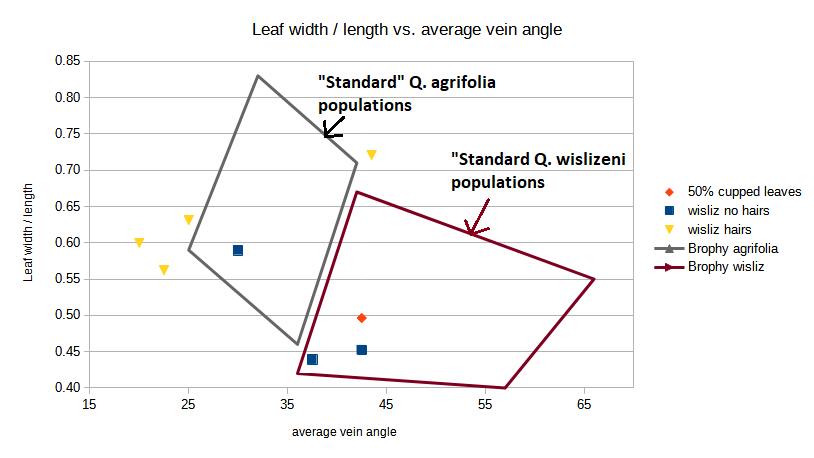
However, I noted that this conclusion was tentative, and further work needed to be done before I could conclude anything more certain about these "wisliz" plants.
I next measured eleven specimens from the Deer Springs Trail, which gave similar results. At that point, I began to be skeptical that all of our wisliz plants at San Jacinto Mountain appeared to be hybrids, and tried to reproduce the results of Brophy and Parnell using iNat observations.
I measured populations of clo from the same area in Contra Costa County that Brophy and Parnell analyzed, the Lafayette area, and wisliz populations from their same population from the Deer Valley Road area southwest of Brentwood. Fig. 2 shows my results.

Fig. 2. Plot of the ratio of the {leaf width / leaf length} vs. the {average angle of lateral vein to midvein} using my measurements of iNat pix for the pure species of clo and wisliz using the same areas analyzed by Brophy and Parnell.
My plot doesn't look anything like the Brophy and Parnell plot! None of the six clo iNat specimens I measured fell within the Brophy and Parnell area for clo. Only three of the 13 wisliz iNat specimens I measured fell within the Brophy and Parnell area for wisliz. Instead, the location of the measurements for wisliz look very similar to my results for the San Jacinto Mountain plants.
Clearly, the evidence for the San Jacinto plants being "possible hybrids" has vanished.
The measurements of these two characteristics, the leaf width / length, and the angle of the secondary veins, are very straightforward, so it is unlikely that I have measured them in some way that is different from Brophy and Parnell. However, the vein angle varies tremendously within a single leaf, so it is possible their method for coming up with an "average" vein angle is different. I measured the minimum and maximum vein angles within a single leaf, and then used the average of those two angles. In addition, Brophy and Parnell sampled more leaves for each of their specimens, and presumably averaged those numbers, so their average values for each specimen have much reduced scatter than a measurement made on a single leaf from a single iNat obs.
The only other explanation I can think of for the difference between my results and their results is that Brophy and Parnell only measured "trees with a trunk diameter greater than 11.15 cm at breast height". Their leaf samples came from twigs "from the outside of the canopy from 1.5 to 2.7 m from ground level and were collected from four sides of the tree". The iNat specimens had no such restrictive sampling, and were probably preferentially sampling smaller specimens, at lower heights, that could more easily be photographed.
Oaks in general have very different leaves near ground level, especially for young plants, to deter herbivory. So it is not surprising that plots made from iNat pix are different from plots made from more mature plants.
Clearly, it is not appropriate to use the Brophy and Parnell plot to conclude anything about hybrids unless the sampling is done in the same way, only on mature trees, and averaging multiple samples to decrease the statistical error.
We have an additional fundamental difficult in using the Brophy and Parnell analysis in southern California, because nearly all of our wisliz specimens are not trees! Our plants are to a high degree shrubs, and probably almost none have trunk diameters of 11.15 cm or greater.
Although the leaf width to length ratio, and the vein angles, do not appear to separate the species using photographs of a single leaf, the other five characteristics given by Brophy and Parnell to separate the two species may still be valid separators. See Quercus agrifolia, Q. wislizeni, and hybrids between them.