Plants of Southern California: Chollas "like Opuntia ganderi" in the Santa Rosa Mountains
Introduction
Data
Pictures of Specimens
Analysis
Principal Component Analysis
Analysis of Spines
Comparison to Descriptions in Floras
Conclusions
Introduction
Cacti in general have long been a difficult group for botanists; see Chollas for a list of some of the changes in taxonomy with time. Many botanists rely upon the determinations of specialists, but even those determinations have changed significantly with time for some taxa.
The north side of the Santa Rosa Mountains has an extensive population of chollas with thick, ascending stems found between 1000 and 5300 feet. Zabriskie, in his Deep Canyon Flora (1979) called these chollas "O. wolfii" at higher elevations (3800-5300 feet), and "O. ganderi" at lower elevations (500-3900 feet). His flora was vouchered, and thus specimens were collected and stored in herbaria for these two taxa.
Interestingly, there are no vouchers determined as O. wolfii in online sources in Riverside County, and there is no voucher with that name in the current collection at the Deep Canyon Herbarium.
Current online vouchers for these chollas are all determined as O. ganderi, from the following elevations along SR74: 3169 feet by Rebman (UCR99885); 3500 feet by Wolf (RSA22788); and 4000 feet by Benson (POM285348, POM285600). (Data provided by the participants of the Consortium of California Herbaria (ucjeps.berkeley.edu/consortium/.)
I suspect the Wolf voucher might originally have determined as "O. wolfii", although it is at a bit lower elevation than the 3800 feet minimum elevation for O. wolfii of Zabriskie. Just to show how confusing cholla taxonomy is at times, a duplicate of the Wolf specimen (UC718131) is determined as Opuntia acanthocarpa var. coloradensis, a taxon confined to the immediate vicinity of the Colorado River.
On 29 January 2007, Wayne Armstrong, Paula Knoll and myself surveyed these plants along SR74, and I measured five specimens in detail to compare against similar measurements for four cholla species found in the Anza-Borrego Desert in San Diego County.
These specimens are not good matches for any of those cholla species. They are closest to O. ganderi, but the plants here have a near-absence of the strict, erect stems found in San Diego County, and hence look fundamentally different in their habit. Principal Component Analysis of my detailed measurements show that these plants also differ significantly from that O. ganderi population.
I plan to study more specimens in the future, especially from flowers, to try to better understand the relationship of these chollas to O. ganderi
The rest of this page presents the measurements I made, pictures of these plants, and analysis of the data.
Data
Cholla Measurements
| Spec- imen # | Stop # | GPS # | # Main Sts | St Segment Length (cm) | St Segment Diameter (cm) | Tubercle Length (mm) | Tubercle Rib Width (mm) | Fr Length (mm) | Fr Width (mm) | ||
|---|---|---|---|---|---|---|---|---|---|---|---|
| Min | Max | Min | Max | ||||||||
Map Showing GPS Locations
Pictures of Specimens
Entire Plant
| #9, elevation 4000 feet | 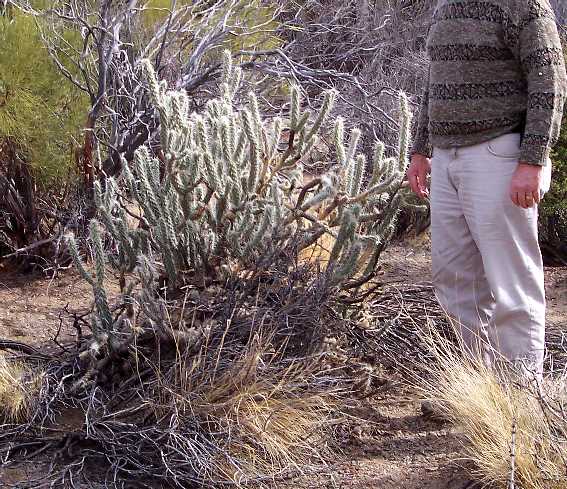
|
| #10, elevation 4000 feet | 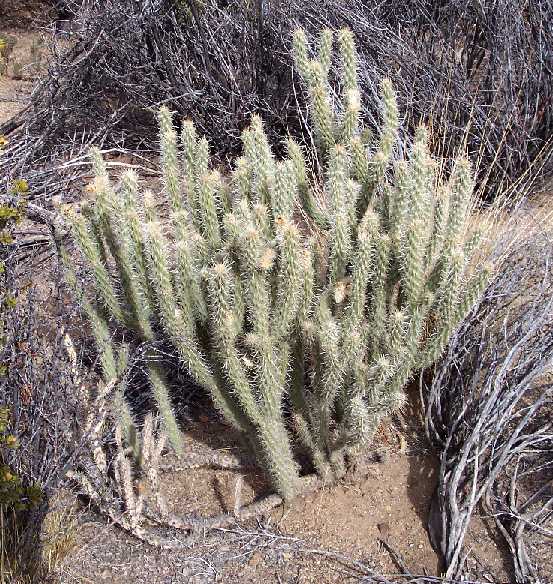
|
| #11, elevation 3800 feet | 
|
| #12, elevation 3800 feet | 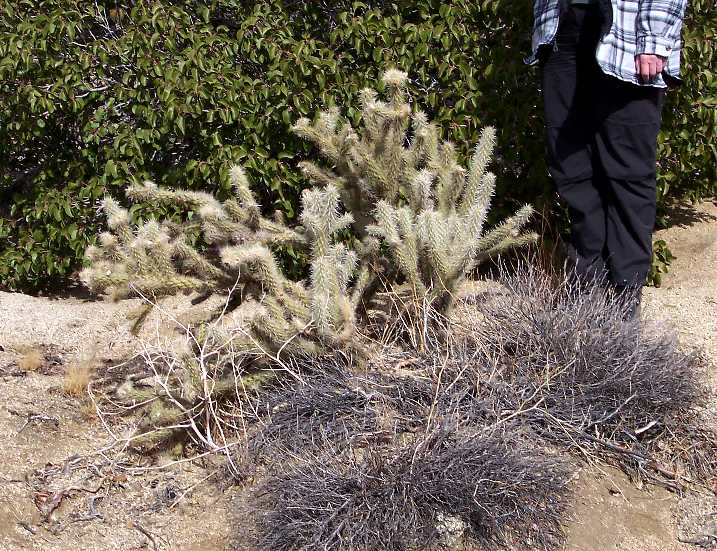
|
| #13, elevation 2400 feet | 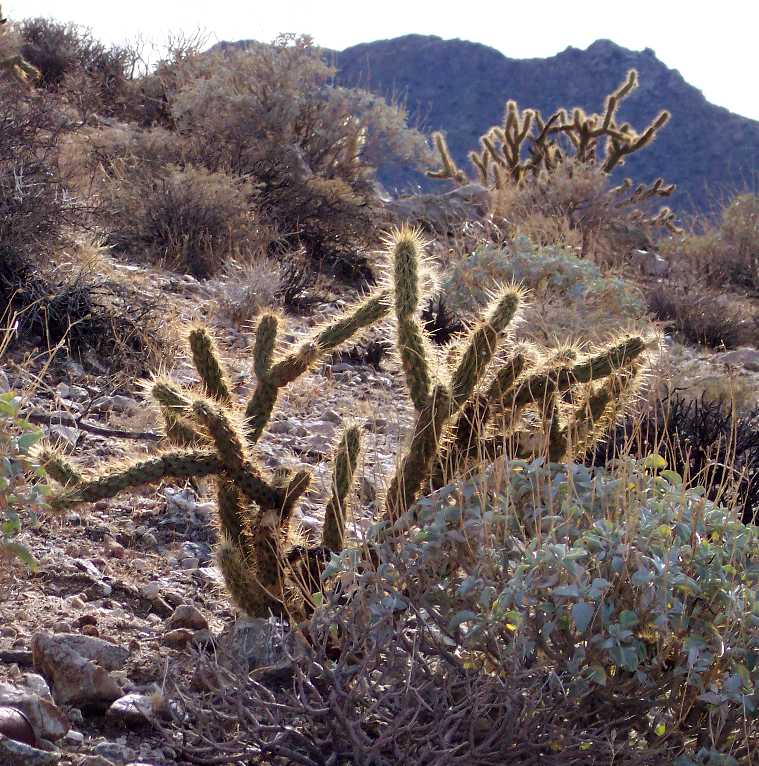
|
In addition, the following pictures are of unmeasured plants from the Cahuilla Tewanet Vista Point Trail at ~3800 feet:
| A | 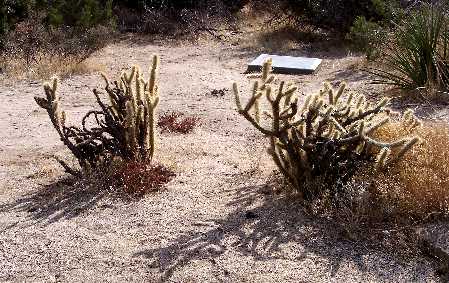
|
| B | 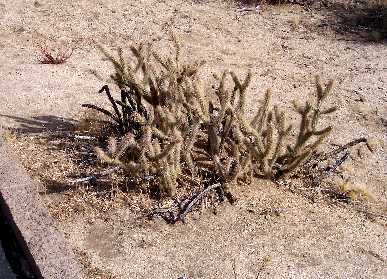
|
| C | 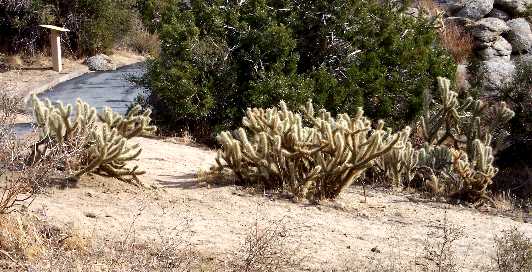
|
| D | 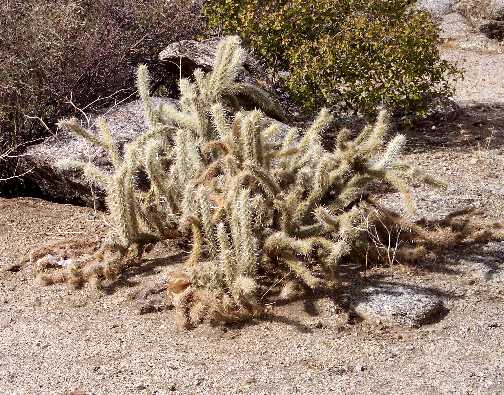
|
| E | 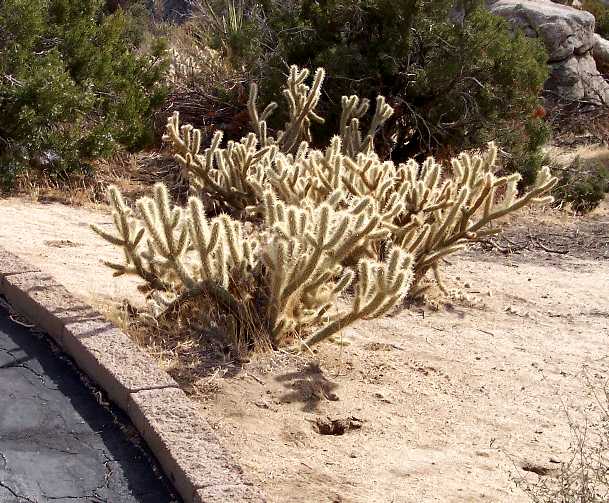
|
| F | 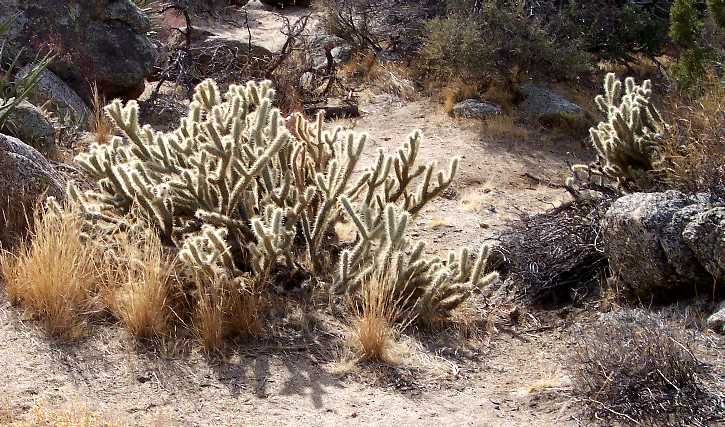
|
| G | 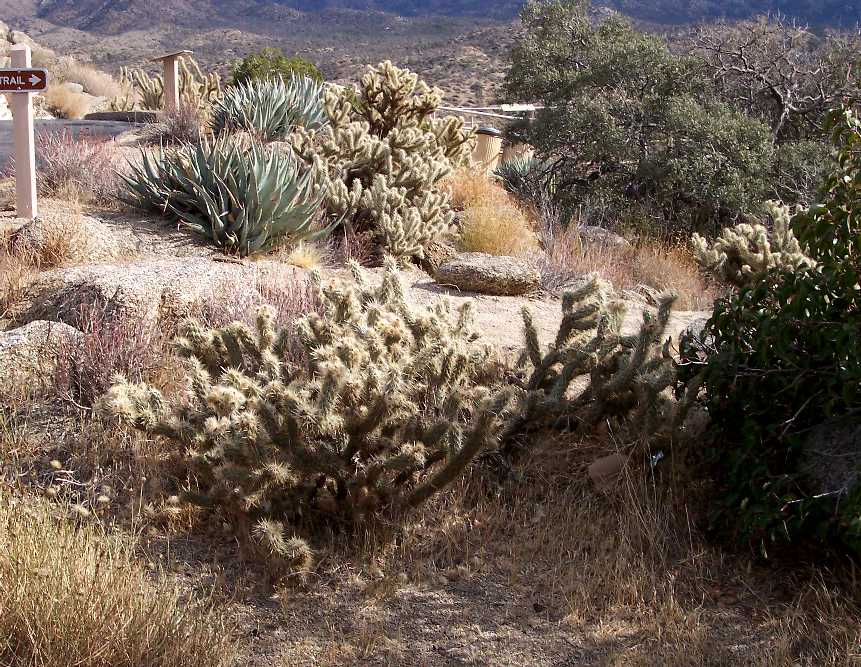
|
| H | 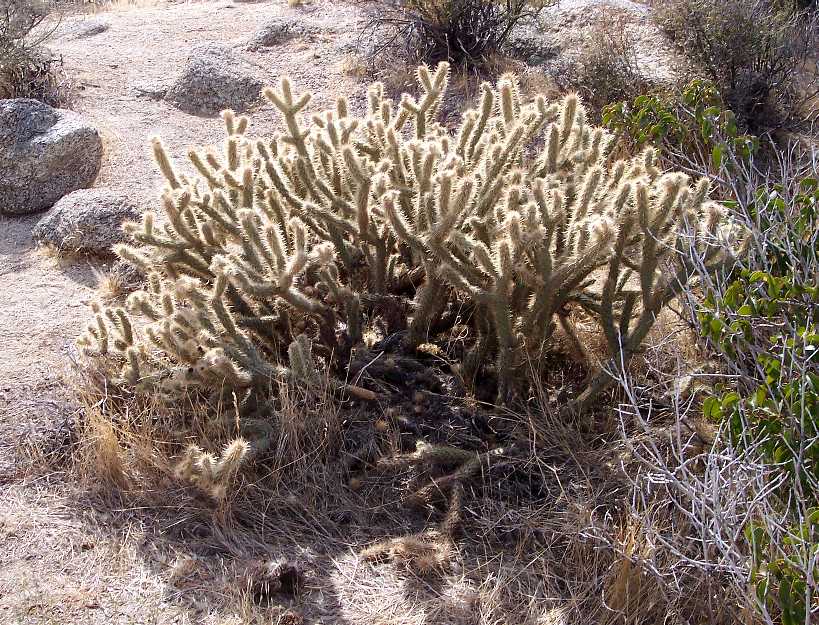
|
| I | 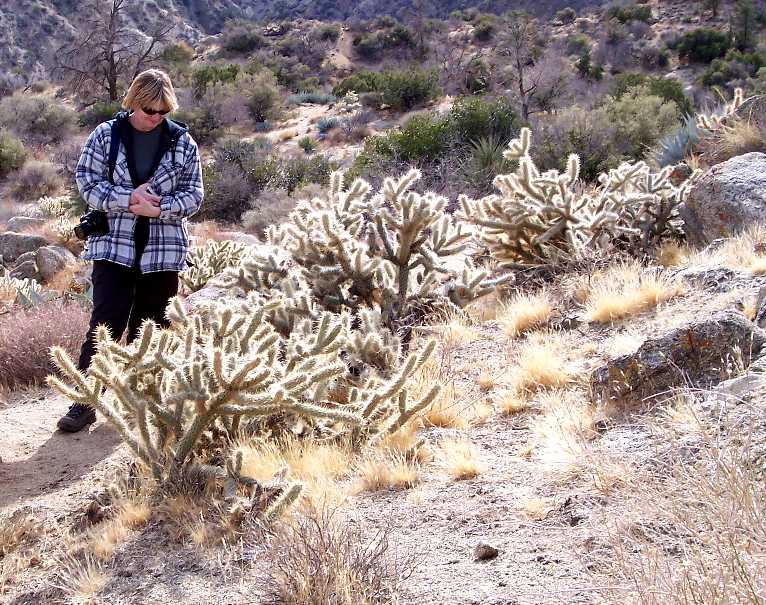
|
| J | 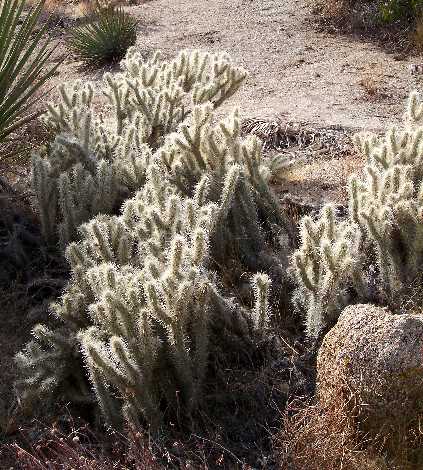
|
Stem and Fruit
| #9 | 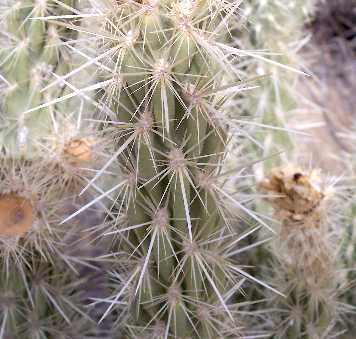 | 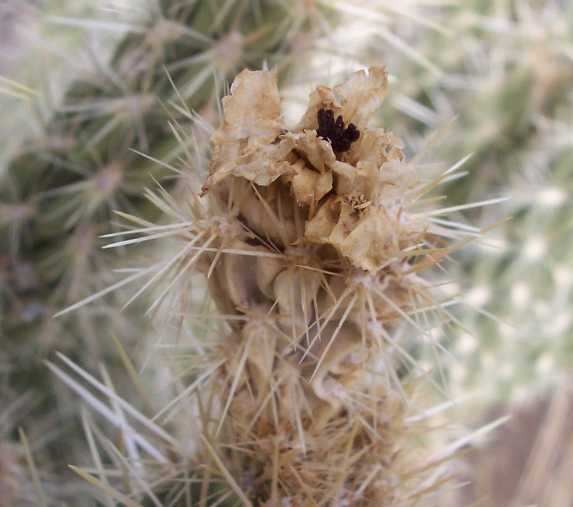
|
| #10 | 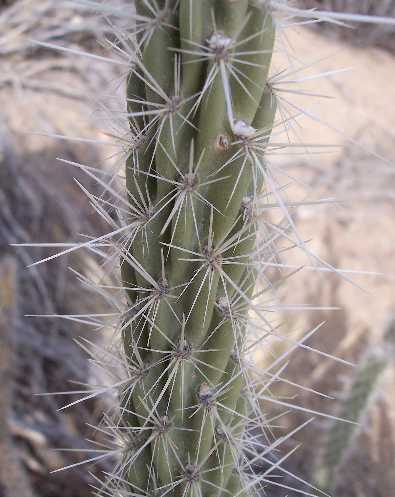 | 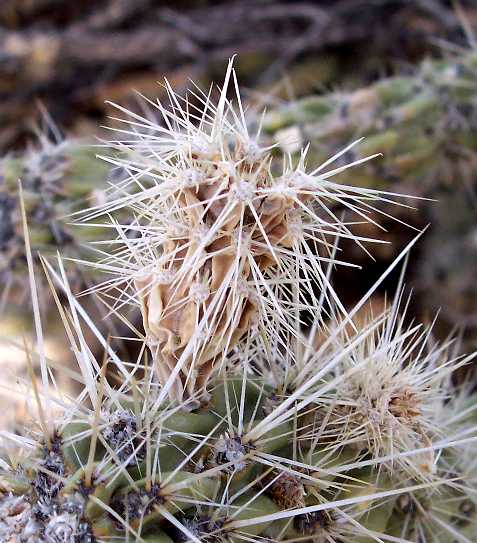
|
| #11 | 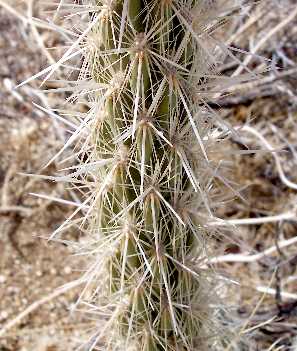 | 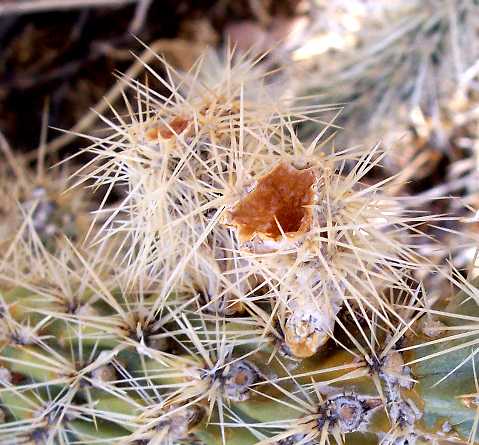
|
| #12 | 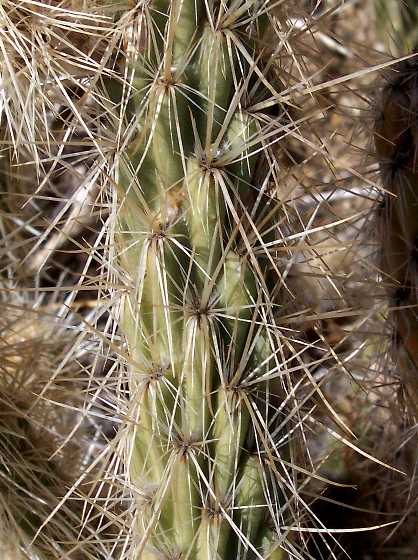 | 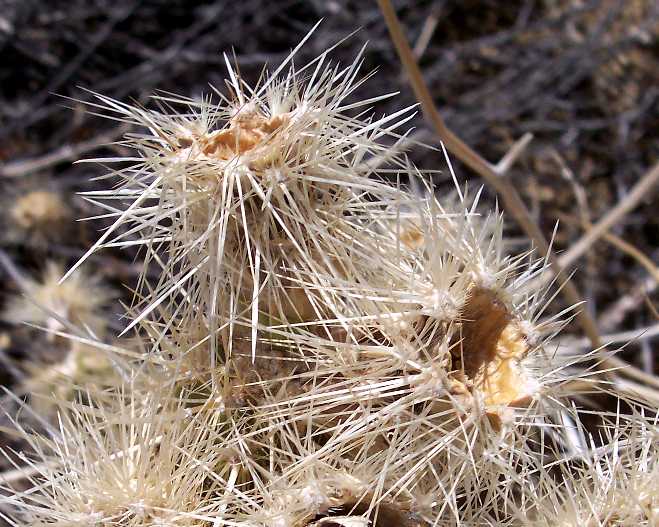
|
| #13 | 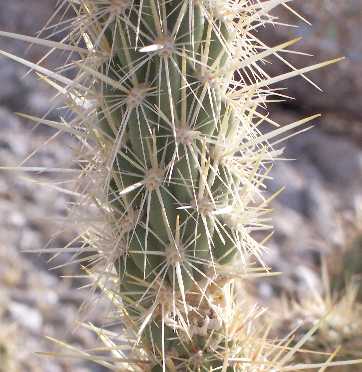 | 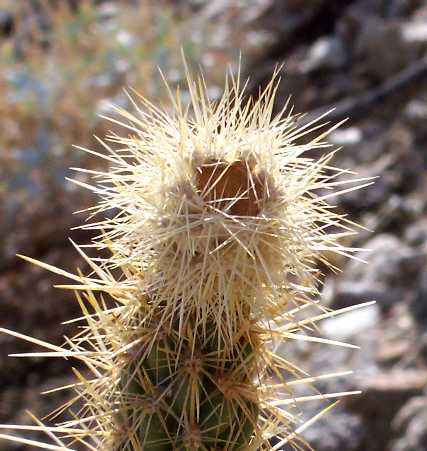
|
Analysis
Principal Component Analysis
Since some of these plants have been called O. wolfii, I first did a PCA including all specimens of O. parryi, O. ganderi and O. wolfii. The following three plots show that the Santa Rosa Mountains specimens are clearly distinct from O. wolfii.
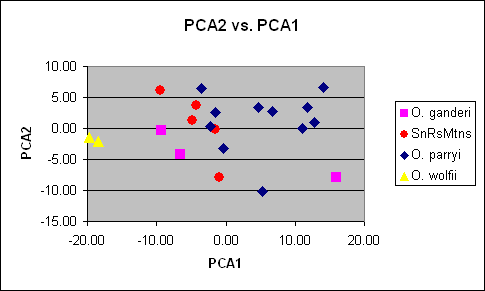
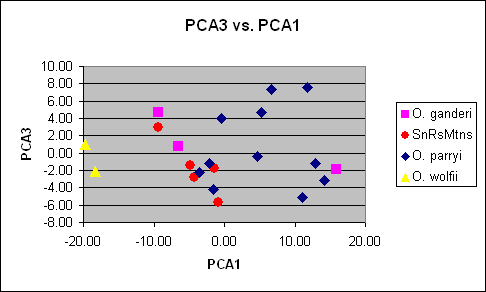
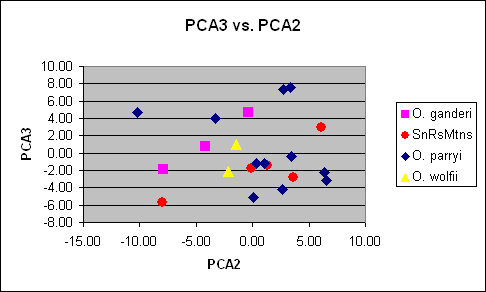
I next did a PCA without O. wolfii:
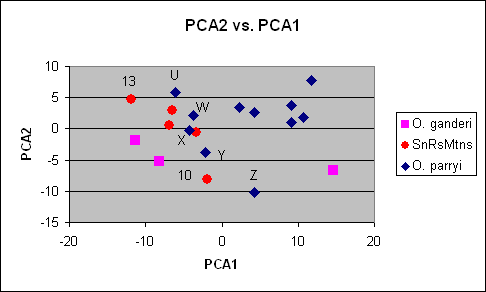
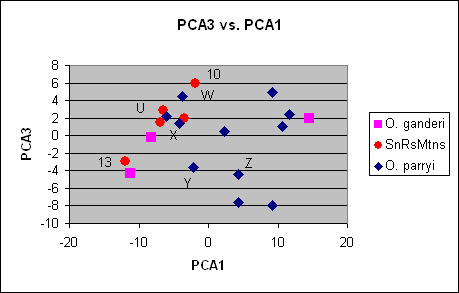
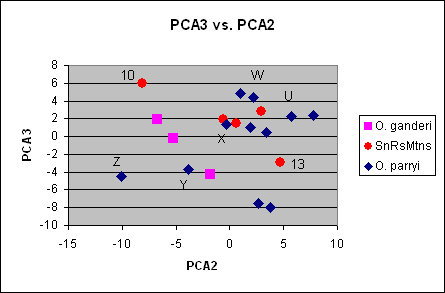
The Santa Rosa Mountains specimens are not clearly consistent with either O. parryi or O. ganderi. Instead, they appear intermediate between those two species.
Only two specimens come close to O. ganderi in the PCA analysis:
- Specimen #10, from the highest elevation, is consistent with O. ganderi. It has the strict stems, and lies within the O. ganderi region in two of the Principal Component Plots. In the third plot, PCA3 vs. PCA1, it is possible that with more measurements specimen #10 might lie within the spread of the O. ganderi points. However, the spines of #10 do not look like typical O. ganderi spines; they are instead similar to the spines of O. parryi.
- Specimen #13, from the lowest elevation, is almost as consistent with O. ganderi in the PCA analysis, and has spines similar to O. ganderi, but its habit is completely inconsistent with usual O. ganderi specimens.
The three other measured specimens fall just at the edge of the spread of the O. parryi points in the PCA plots. In fact, three O. parryi specimens from the San Felipe Valley, labeled U, W and X in the plots above, have nearly identical values for the first three PCA components. Two other O. parryi specimens, labeled Y and Z, have identical values for two of the three PCA components.
Clearly, as a group, these Santa Rosa Mountains specimens are inconsistent with being O. ganderi. The vast majority of these specimens do not look like the plants in the Anza-Borrego Desert.
Equally clearly, as a group, these Santa Rosa Mountains specimens are inconsistent with being O. parryi. The vast majority of these specimens do not look like the O. parryi specimens found on the coastal side of the Santa Rosa Mountains.
However, some of these plants are very similar to some of the O. parryi specimens found from San Felipe Valley along S2 to Cahuilla on SR371.
How to classify these plants probably depends on how one classifies the O. parryi plants found from San Felipe Valley along S2 to Cahuilla on SR371.
One point of view is to say that the entire set of plants north of Scissors Crossing through Aguanga and to Palm Desert are intergrades between O. ganderi and O. parryi. This point of view is supported by the similarity of some specimens between the Santa Rosa Mountains and San Felipe Valley locations.
Another point of view is to call the plants found from San Felipe Valley along S2 to Cahuilla on SR371 as part of the O. parryi population, and to call these Santa Rosa Mountains specimens a new species. This point of view is supported by the fact that these two sets of plants look different in general, have different centroids for their points in the PCA plots, and most likely form two separate breeding populations.
In this latter point of view, the intermediate position of the Santa Rosa Mountains specimens in the PCA plots is consistent with these plants originating from crosses between O. parryi and O. ganderi. It is quite unlikely that these plants are F1 hybrids between those putative parent taxa, nor is likely that these plants form a breeding population with either parent.
In this latter point of view, these plants satisfy the two main requirements for species recognition: they are a distinct breeding population, and they have characteristics distinct from any other species.
Coefficients of the Principal Component Variables 1 To 3
| Characteristic | PCA 1 | PCA 2 | PCA 3 |
|---|