Plant Species of the Grand Canyon South Rim Area:
Penstemon species
Penstemon species
This page gives a pictorial comparison of the Penstemon species found in the South Rim area of the Grand Canyon, roughly from Hermits Rest on the west to Desert View Tower on the east, and the Colorado River on the north to the Park Boundary on the south. Much of the information comes from the wonderful new Penstemon treatment by Glenn Rink for the Vascular Plants of Arizona Project.
Pictures are generally from the South Rim area, but are from elsewhere for species that are either uncommon or not actually present in the South Rim area.
Flowers found along the Bright Angel and South Kaibab Trails are often coated with red dust, and may have different colors after rain temporarily washes away the dust!
The photos are organized into three sections by flower color: red; mostly white; rose-pink; and blue, lavender, violet, or purple.
Red Flowers
Click on the pictures to get a larger version or to go to the original iNat observation.
White Flowers
Rose-Pink Flowers
Blue, Lavender, Violet, or Purple Flowers
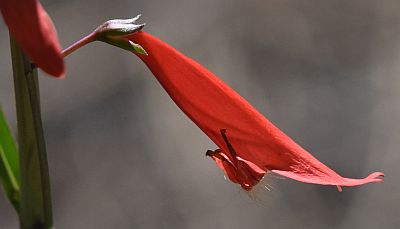
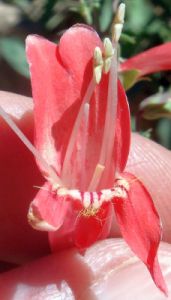
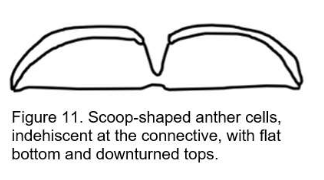
P. barbatus. Flower with strongly reflexed lower lip similar to that of P. rostriflorus, but the inflorescence of P. barbatus has no hairs or glands. Its flower has red lines on its lower lip near the mouth; usually has long hairs projecting from that lower lip; and has "scoop-shaped" anthers spread fully apart that open at the end farthest from their connection to the filament.

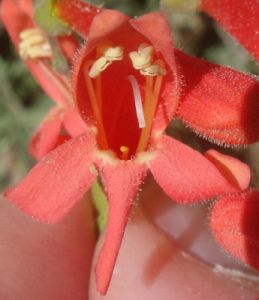
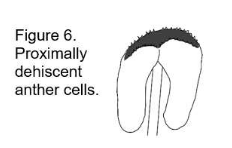
P. rostriflorus. Flower with strongly reflexed lower lip similar to that of P. barbatus, but the inflorescence of P. rostriflorus is glandular-pubescent. Its flower has no red lines or long hairs on its lower lip near the mouth; and its anthers are "horseshoe-shaped" with the two anther sacs parallel and side by side, opening at the end closest to their connection to the filament.
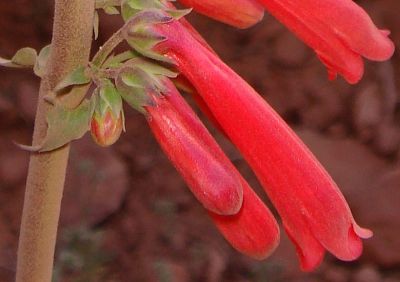

P. eatonii. Its flower is easily recognized since its corolla lobes are small and either erect or only slightly reflexed. Be careful not to mistake the other red Penstemon flowers in bud for this flower! The photo of the flower from the open end is from Zion National Park, because almost no one ever photographs this small flower from the open end!
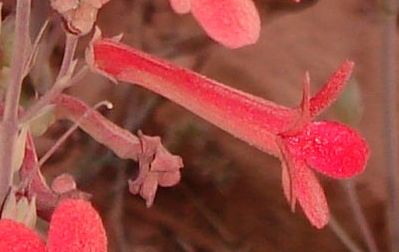
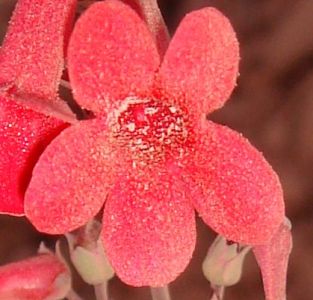
P. utahensis. Many people love this Penstemon best because it is one of our most common penstemons, and, unusual for a red-flowered penstemon, it opens its flowers fully. The flowers in these photographs are heavily coated with red Grand Canyon dust.
Fig. 1. Photos of the flowers of our Penstemons with red flowers, from the side (left column) and from the open end (right column). The links to the shape of the anthers go to figures from the Glenn Rink Penstemon treatment.
White Flowers
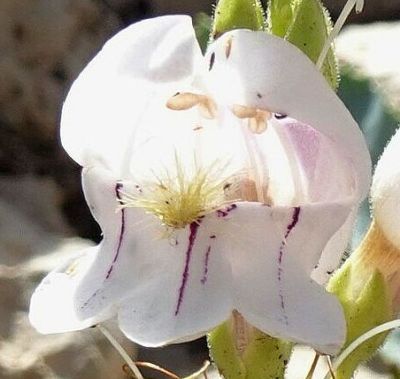
We only have one Penstemon with white to pinkish-white flowers, P. palmeri, which is one of our most common penstemons.

| 
|
| Fig. 2. Photos of the flowers of P. palmeri from the side (left) and from the open end (right).
Click on the pictures to get a larger version or to go to the original iNat observation. | |
Rose-Pink Flowers
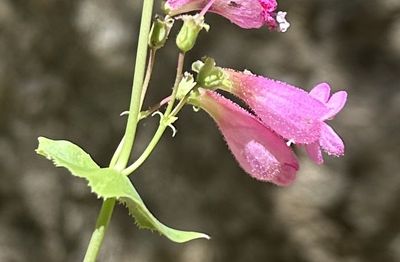
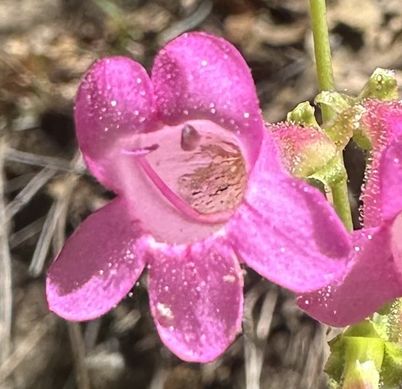
There is only one Penstemon species with rose-pink flowers that has been claimed to exist in the South Rim Area, P. pseudospectabilis. However, it either doesn't exist at the South Rim Area, or, if it does exist, it is extremely rare.
There is only a single voucher georeferenced in the South Rim Area, and its locality is "South - Grand Canyon National Park" at 6000 feet. There is another voucher from the Ten-X Campground in the Kaibab National Forest two miles south of Tusayan. Since no one has ever posted a photo of this species with flowers from the South Rim Area, it seems highly likely that the voucher georeferenced in the South Rim Area is actually also from south of GCNP.
The flower shown in Fig. 3 is from southeast of Prescott, AZ.
| 
|
| Fig. 3. Photos of the flowers of P. pseudospectabilis from the side (left) and from the open end (right).
Click on the pictures to get a larger version or to go to the original iNat observation. | |
Blue, Lavender, Violet, or Purple Flowers
Two of these species are small plants with woody bases, either matted or with stems shorter than one foot. Four of these species are larger plants with herbacious (non-woody) stem bases. Each category is shown separately.
Small plants with woody bases
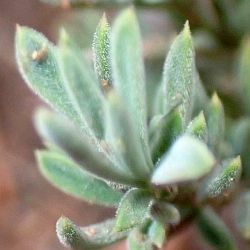
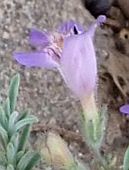
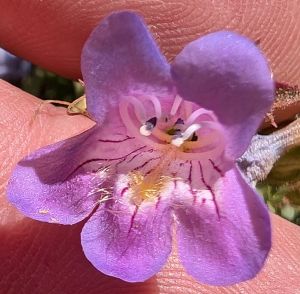
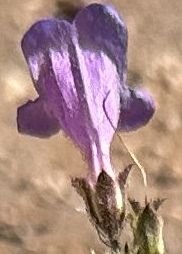
Our two species that are small plants with woody bases are P. caespitosus var. desertipicti and P. linarioides. These flowers of these two species are very similar. These two species are best separated by the following characteristics. P. caespitosus is a matted plant with short prostrate stems 2 to 8 cm long (0.8 to 3 inches), with leaves oblanceolate to obovate, and calyx lobes linear to lanceolate. P. linarioides has ascending to erect stems that are 5 to 50 cm long (2 to 20 inches), with linear to lanceolate leaves and ovate calyx lobes.
McDougall in his Grand Canyon Wildflowers also says the corolla of P. caespitosus is "flattened below and 2-ridged within", and the corolla of P. linarioides is "rounded below and not 2-ridged within". However, those characteristics seem to be hard to see in photographs.
Fig. 4 shows the flowers and the differences in the leaves and calyx lobes.

| 
| 
|
| P. caespitosus var. desertipicti. | ||
| 
| 
|
| P. linarioides. | ||
| Fig. 4. Photos of the flowers of P. caespitosus (top row) and P. linarioides (bottom row), from the side (left) and from the open end (right).
Click on the pictures to get a larger version or to go to the original iNat observation. | ||
Large plants with herbacious stems
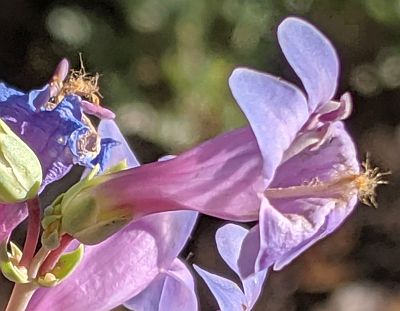
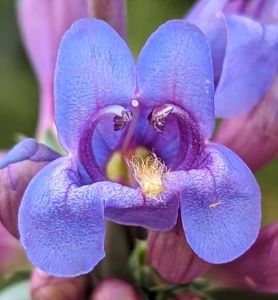
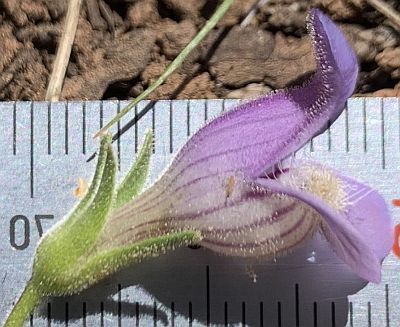
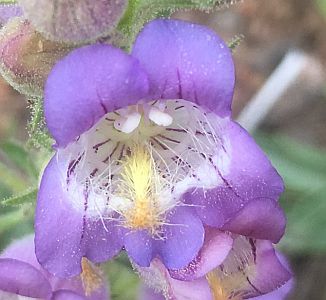
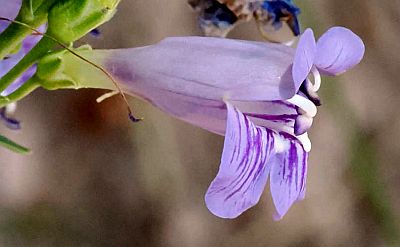
Our four species that are large plants with herbacious stems are shown in Fig. 5.
| 
|
| P. pachyphyllus is our most common penstemon in the South Rim Area. Most of the time it is photographed it has no blooms due to its commonality and distinctiveness, with its thick glaucous glabrous leaves. It has cauline leaves clasping the stem, and a glabrous inflorescence. | |
| 
|
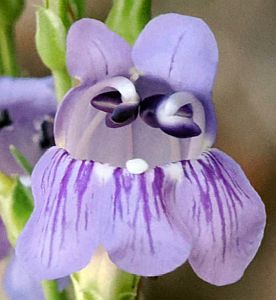
| P. ophianthus is only found on the South Rim, with most observations south of the Park itself. Its calyx is densely glandular-hairy. It was called P. jamesii in McDougall's Grand Canyon Wildflowers. | |
| 
|
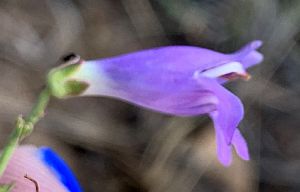
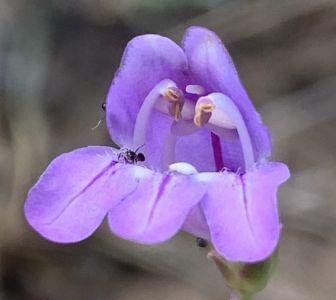
| P. pseudoputus is the Kaibab Plateau Beardtongue, which primarily lives on the Coconino and Kaibab plateaus of the North Rim. There are only a few records on the South Rim. It was called P. virgatus ssp. pseudoputus in McDougall. It has linear leaves, narrow at the base, and a lower stem with retrorse pubescent hairs. | |
| 
|
| P. virgatus. Most older records of this species at the Grand Canyon are actually of P. pseudoputus, as P. virgatus ssp. pseudoputus. P. virgatus is distinguished from P. pseudoputus by its oblanceolate, elliptic or spatulate basal leaves, compared to the linear to narrowly oblanceolate basal leaves of P. pseudoputus. | |
| Fig. 5. Photos of the flowers of P. pachyphyllus (row 1); P. ophianthus (row 2); P. pseudoputus (row 3); and P. virgatus (row 4), from the side (left column) and from the open end (right column).
Click on the pictures to get a larger version or to go to the original iNat observation. | |