The Glorious Rabbitbrush Displays in Grand Canyon Village

| 
|
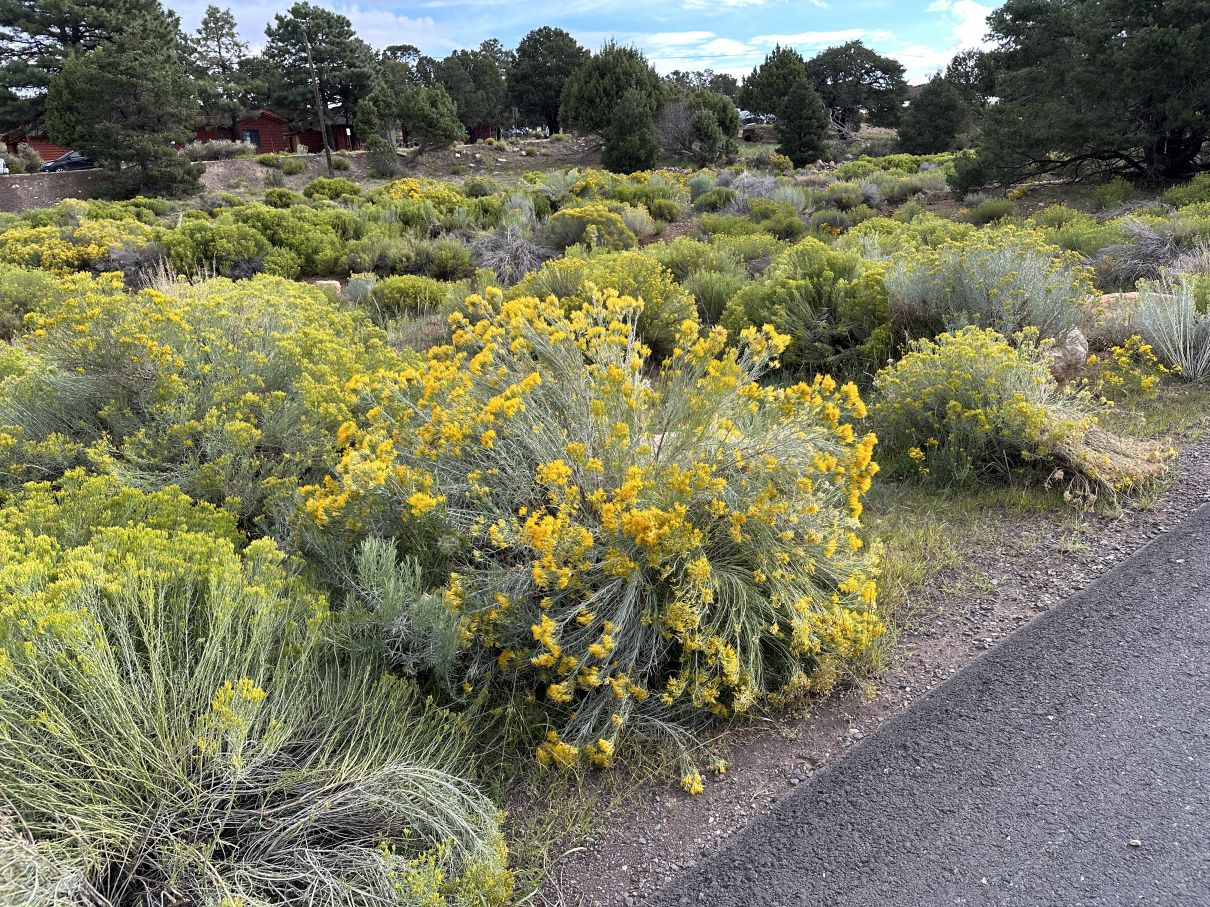
| Fig. 1. Rabbitbrush, Ericameria nauseosa, making glorious displays at Grand Canyon Village. In both photographs, the grayish plants (the stems below the flowers) are var. graveolens, gray rabbitbrush, and are just beginning bloom. The greenish plants are var. oreophila, threadleaf common rabbitbrush, and are mostly still in bud, with only a few showing their first blooms.
Left: Area planted with rabbitbrush at the edge of one parking area at the Visitor Center, photographed by Don Rideout on 17 September 2024. Note the rabbitbrush lining the other sides of the pavement in the distance as well. Right: A large field of rabbitbrush between the Bright Angel Lodge and the railroad tracks, photographed by Tom Chester on 14 September 2023. The Rim Cabins are at top left, and the Bright Angel Lodge is at top right. Tom is standing on the paved road that mostly parallels the train track. Click on the pix to see larger versions. | |
The most fabulous flower display in the Grand Canyon Village area happens almost every fall when the rabbitbrush plants come into full bloom. The plants are large shrubs, and each one is covered by as many as one hundred clusters of yellow flowers, with each cluster containing ~10 flower heads. Since each head contains five disk flowers, a single plant could have 5,000 individual flowers producing its display!
The S. Entrance road to the Village, beginning just north of the junction with the Desert View Drive, is lined in many places with this beauty; the Visitor Center is surrounded by it; and the Bright Angel Lodge / Railroad Track areas are ablaze from this species when it is in full bloom.
Rabbitbrush makes beautiful displays in southern California, too, especially in the San Gabriel Mountains and San Bernardino Mountains. Somehow it manages to make those displays there without summer rain, which has always amazed me.
But the displays at the Grand Canyon are extra glorious because those areas get summer rain as well as winter rain, allowing the plants to become bigger and to flower better. Each plant is typically two to three feet tall and wide, and they can grow up to six feet tall and wide!
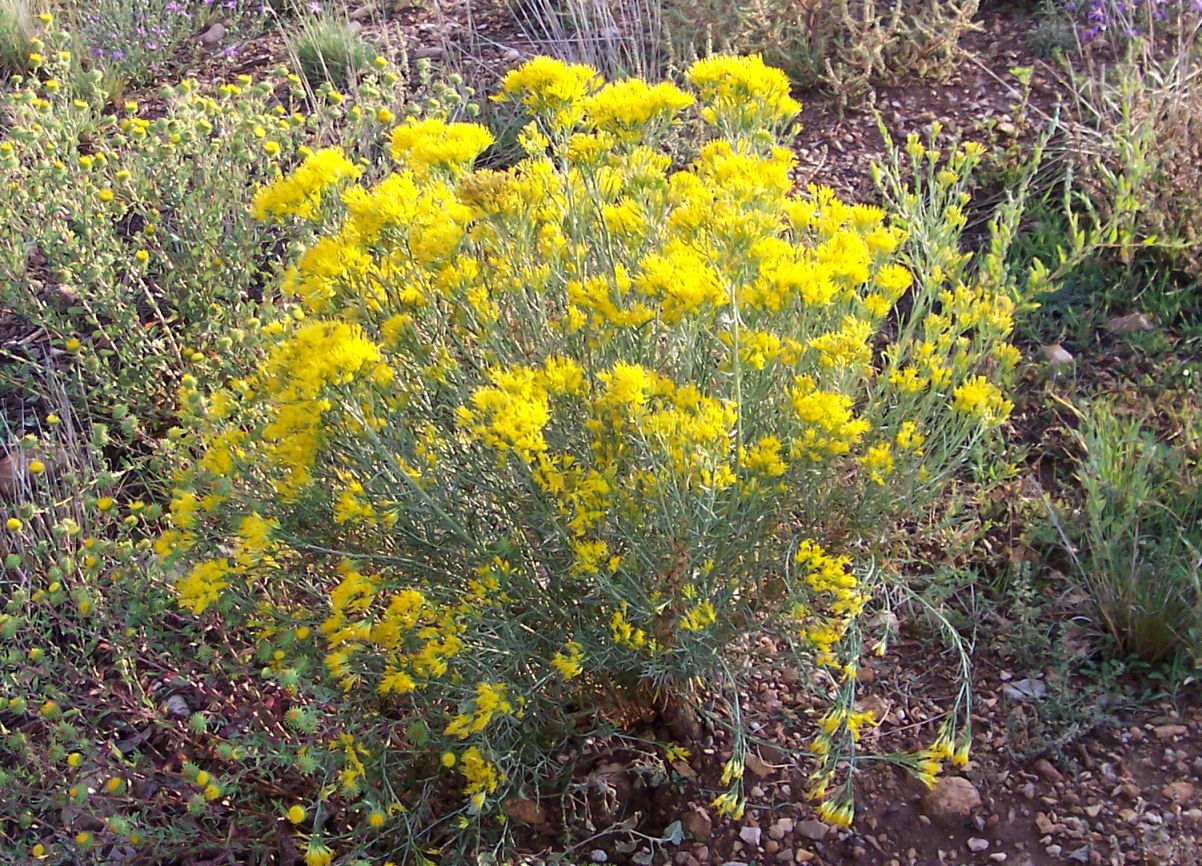
The two varieties in the GC Village area can easily be separated from a distance by the color of their leaves and stems - var. graveolens, gray rabbitbrush, has grayish / whitish / silvery leaves and whitish stems, whereas var. oreophila, threadleaf common rabbitbrush, has greenish leaves and whitish/greenish stems; see Figs. 1 and 2.

| 
|
| Fig. 2. View of an entire plant for two varieties of rabbitbrush. The plants are in different stages of blooms, so the bloom difference is not significant.
Left: E. nauseosa graveolens from the Visitor Center area, photographed by Tom Chester on 27 August 2019. Note the gray/silvery color of the body of the plant that is not obscured by the yellow flowers. Right: E. nauseosa oreophila from the Visitor Center area, photographed by Tom Chester on 14 September 2006. Note the gray/greenish color of the body of the plant that is not obscured by the yellow flowers. Click on the pix to see larger versions. | |
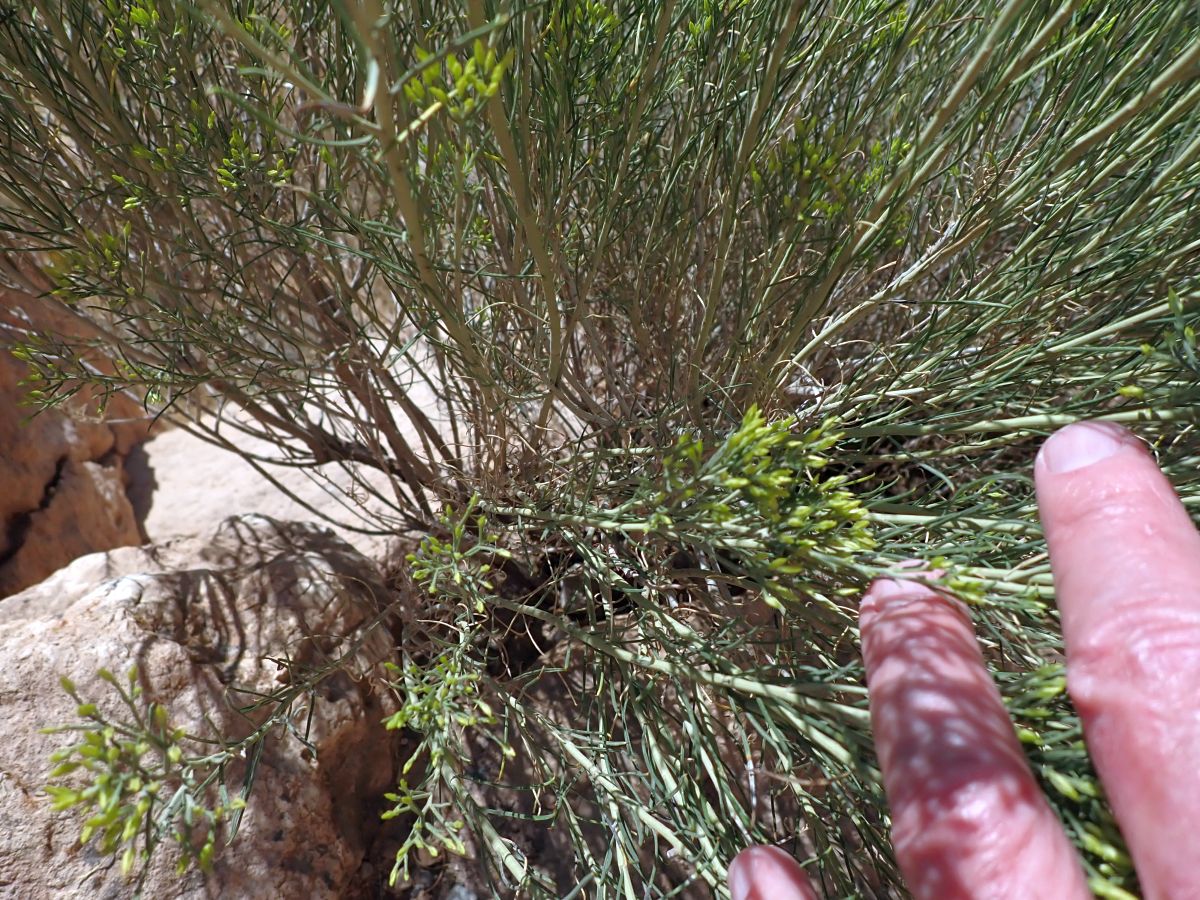
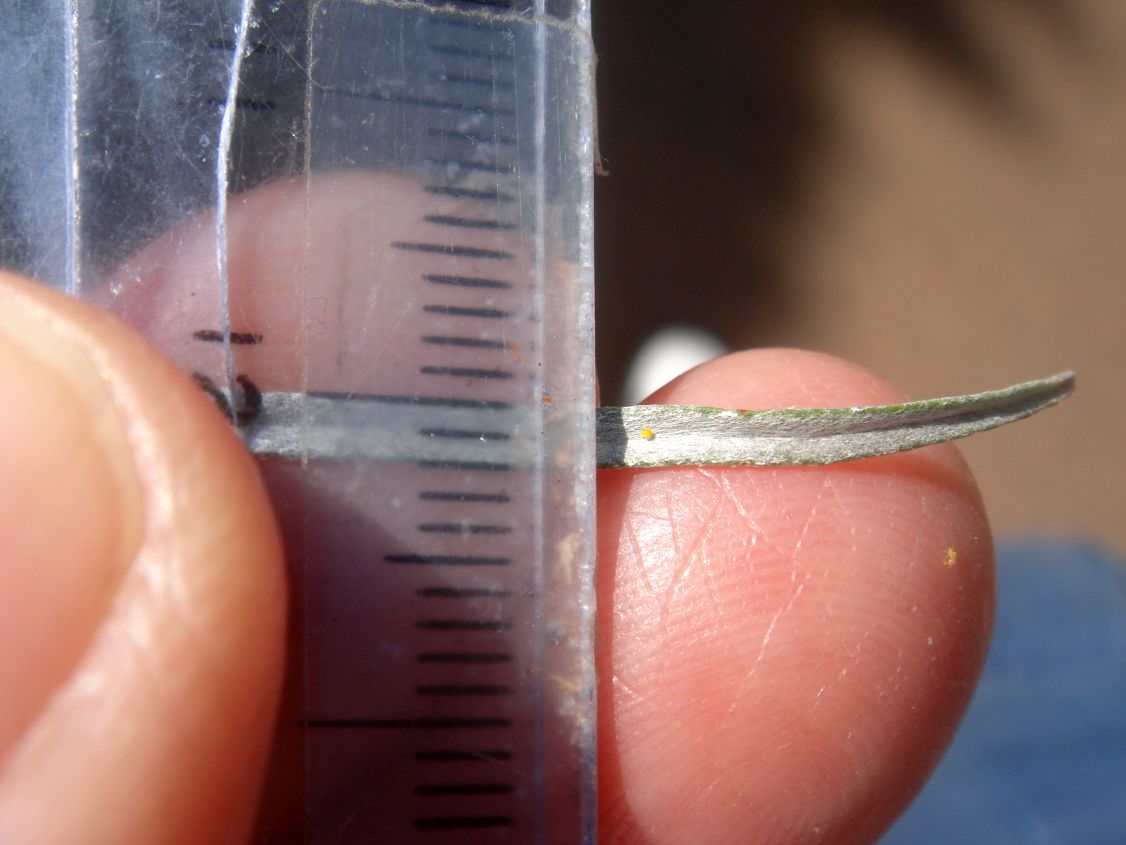
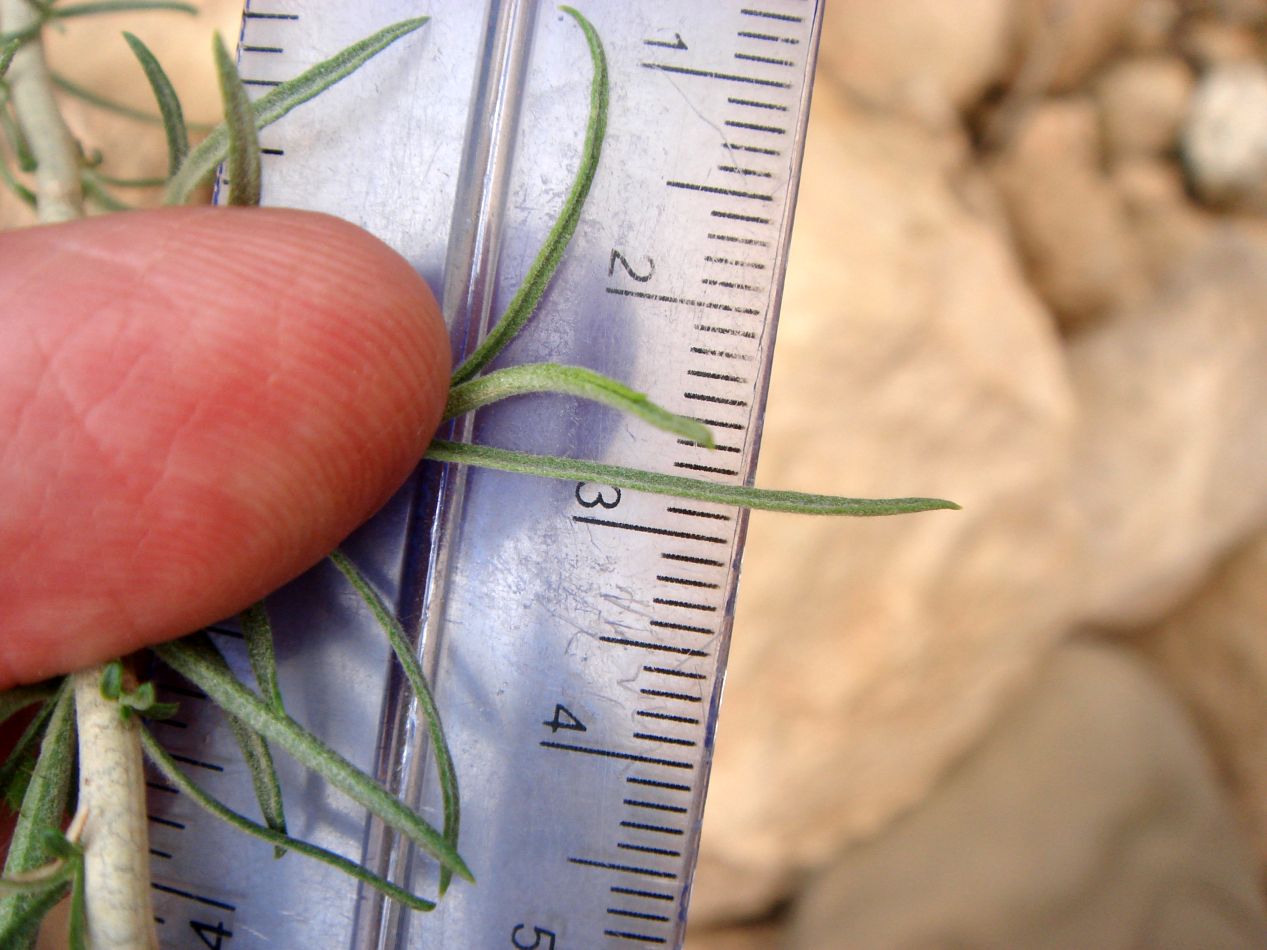
Up close, it is usually easy to confirm the identification from the difference in the width and color of the leaves. Var. graveolens has 1 to 2 mm wide silvery leaves. Var. oreophila has 0.5 to 1.0 mm wide narrow green leaves. Those narrow leaves gave it the common name of threadleaf rabbitbrush. See Figs. 3 and 4.

| 
|
| Fig. 3. Close-up views of the stem and leaves of the two rabbitbrush varieties.
Left: E. nauseosa graveolens from mile 1.4 of the Bright Angel Trail, photographed by Tom Chester on 27 August 2019. Right: E. nauseosa oreophila from mile 0.2 of the Bright Angel Trail, photographed by Tom Chester on 27 August 2019. Click on the pix to see larger versions. | |
| 
|
| Fig. 4. Photographs showing the width and color of the leaves of two rabbitbrush varieties.
Left: E. nauseosa graveolens from the Visitor Center area, photographed by Tom Chester on 27 August 2019. Leaf is 2.0 mm wide. Right: E. nauseosa oreophila from the Bright Angel Trail, photographed by Tom Chester on 24 April 2009. Leaf is 0.8 mm wide. Click on the pix to see larger versions. | |
There is another difference between the two varieties that only hard-core botanists will appreciate, since it requires the use of a hand lens in the field, or looking at a macro photograph. The tiny corolla lobes of each disk flower are erect for var. graveolens, but ascending to spreading for var. oreophila. See Fig. 5.

| 
|
| Fig. 5. Photographs showing habit of the corolla lobes for the two rabbitbrush varieties. Two corolla lobes in each photograph are inside white circles.
Left: E. nauseosa graveolens from the Visitor Center area, photographed by Tom Chester on 6 September 2013. Right: E. nauseosa oreophila from the S. Kaibab Trail, photographed by Tom Chester on 16 September 2024. Click on the pix to see larger versions. | |
Although I suspect this wonderful display is mostly due to planted specimens, given the locations of these plants, that doesn't detract from the beauty. Whoever was responsible for these plants should be justifiably well pleased with what they accomplished.