Plant Species of the Grand Canyon South Rim Area:
Bahiopsis parishii and Encelia resinifera
Bahiopsis parishii and Encelia resinifera
| Bahiopsis parishii | Encelia resinifera | |
| 
| |
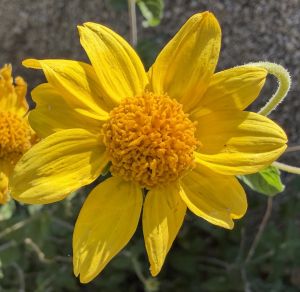
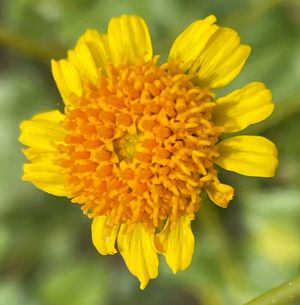
| Fig. 1. Photos of the flowers of Bahiopsis parishii (left) and those of Encelia resinifera (right). The flowers of B. parishii have more prominent ray flowers, which generally have a rounded narrow tip. The flowers of E. resinifera have more prominent disk flowers, and ray flowers which have a wide ~truncate tip. Specifically, the ratio of the width of the disk is ~0.25 to ~0.40 times the width of the entire flower for B. parishii, and ~0.40 to 0.65 times for E. resinifera; see Fig. 3.
Click on the pictures to go to the original iNat obs, which gives the information as to who took the photos. | ||
Bahiopsis parishii and Encelia resinifera are surprisingly hard to tell apart unless you know what to look for. See the discussion here and here.
Both species are similar-sized and similar-shaped shrubs; their leaves can be similar in shape; the stems and leaves of both are rough-hairy; and both have somewhat-similar radiate heads. Both have surprisingly-variable phyllaries.
The purpose of this page is to show how to separate the two species, as well as to show the variation in the flowering heads and the phyllaries.
This page was stimulated by the comments in this observation about the phyllaries.
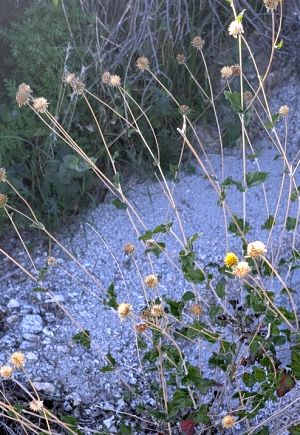
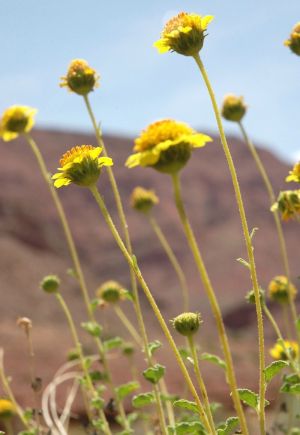
Perhaps the easiest difference to see in a photograph is whether there is just one flower head per flowering stem (E. resinifera) or multiple heads (B. parishii). See Fig. 2.
| Bahiopsis parishii | Encelia resinifera | |
| 
| |
| Fig. 2. Photos of the flowering stems of Bahiopsis parishii (left column) and those of Encelia resinifera (right column). Note the branched flowering stems of B. parishii, and the long unbranched flowering stems of E. resinifera. This is not a perfect 100% clear difference, since some individual heads of B. parishii can have long peduncles, and some flowering stems of E. resinifera can be branched at the base. But overall this is a pretty good character.
Click on the pictures to go to the original iNat obs, which gives the information as to who took the photos. | ||
Also, the older stems of E. resinifera are said to be white, whereas the older stems of B. parishii appear to be brownish. But most iNat posts do not show old stems.
Other differences that are used in floras to distinguish them, but which are almost never shown in photographs are whether the fruit has a pappus of scales (B. parishii) or no pappus at all (E. resinifera), and whether the fruit is strongly compressed (Encelia) or not (Bahiopsis).
Two characteristics of the flowers which can be easily seen in pictures of the flowers from the front are mentioned in Fig. 1, and plotted in Fig. 3. The first is the ratio of the width of the disk flowers as a whole to the width of the entire flower. The second is the ratio of the width of the tip of the ray flowers to the length of the ray flowers.
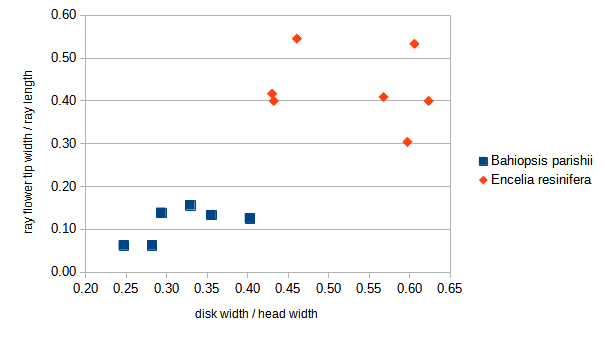
Fig. 3. The ratio of the width of the tip of a ray flower to the length of the ray flower, plotted vs. the ratio of the width of the disk flowers as a whole to the width of the entire flower. The flowers used for the measurements are shown in Fig. 4.
Measurements of those ratios easily discriminate the two species. Fortunately, the difference in these two characteristics is almost always easily seen in photographs, without the need to make measurements.
Fig. 4 shows some of the variation in the flowers of the two species, ordered by the ratio of the disk width to the head width for each. That ratio is given for each photograph, along with a measurement of the ratio of a ray flower tip width to the ray flower length for one of the ray flowers. For the latter measurement, I usually tried to select the longest ray flower with the clearest view of the tip.
| Bahiopsis parishii | Encelia resinifera | |
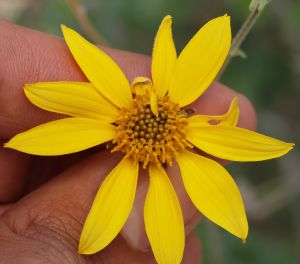
Disk width / Head width = 0.25 Ray flower tip width / Ray flower length = 0.06 | 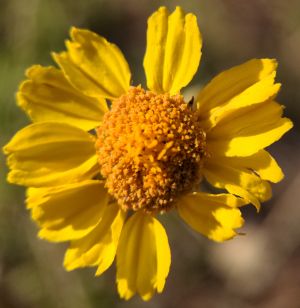
Disk width / Head width = 0.43 Ray flower tip width / Ray flower length = 0.40 | |
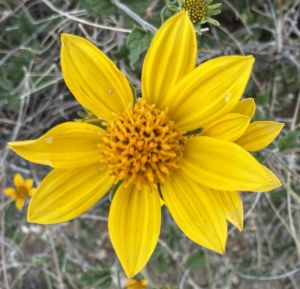
Disk width / Head width = 0.28 Ray flower tip width / Ray flower length = 0.06 | 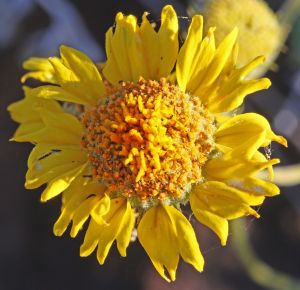
Disk width / Head width = 0.46 Ray flower tip width / Ray flower length = 0.55 | |
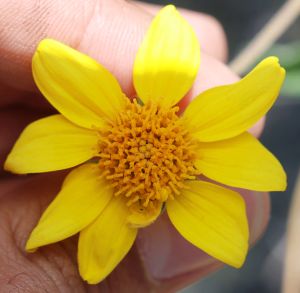
Disk width / Head width = 0.29 Ray flower tip width / Ray flower length = 0.14 |
Disk width / Head width = 0.57 Ray flower tip width / Ray flower length = 0.41 | |
|
Disk width / Head width = 0.33 Ray flower tip width / Ray flower length = 0.16 | 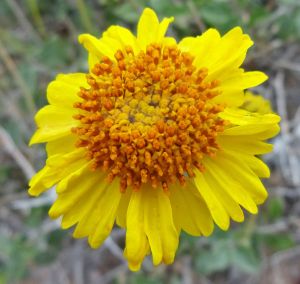
Disk width / Head width = 0.60 Ray flower tip width / Ray flower length = 0.30 | |
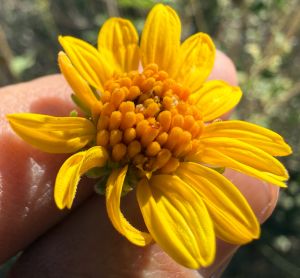
Disk width / Head width = 0.36 Ray flower tip width / Ray flower length = 0.13 | 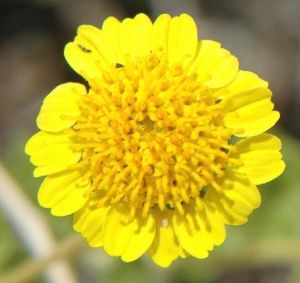
Disk width / Head width = 0.61 Ray flower tip width / Ray flower length = 0.53 | |
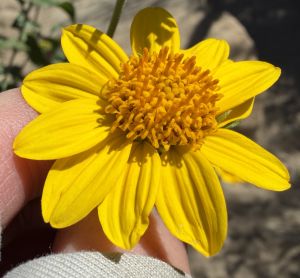
Disk width / Head width = 0.40 Ray flower tip width / Ray flower length = 0.13 | 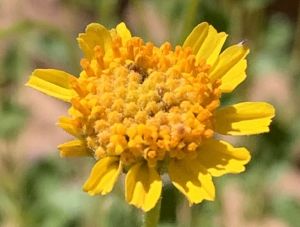
Disk width / Head width = 0.62 Ray flower tip width / Ray flower length = 0.40 | |
| Fig. 4. Photos of the flowers of Bahiopsis parishii (left column) and those of Encelia resinifera (right column). The photos of B. parishii are all from the Borrego Desert in San Diego County with the exception of the one in the third row, which is from an unspecified location in the webpage Southwest Desert Flora.
Click on the pictures to go to the original source, usually the iNat obs, which gives the information as to who took the photos. | ||
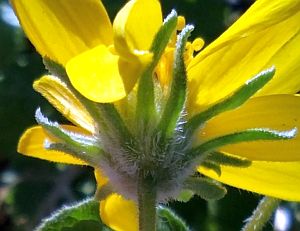
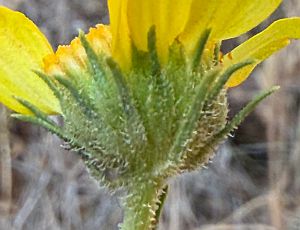
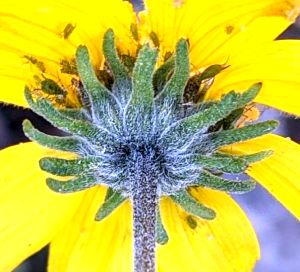
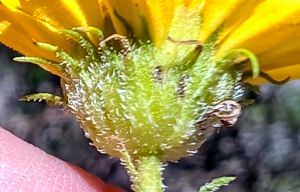
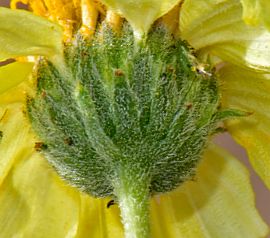
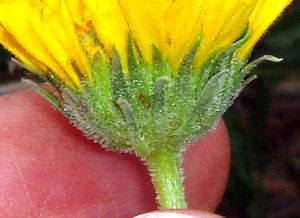
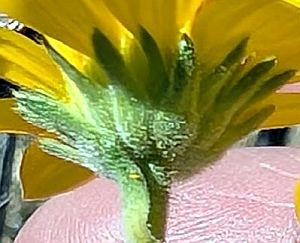
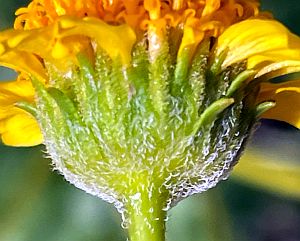
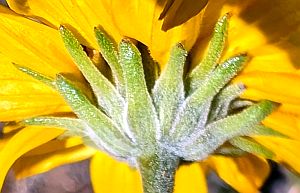
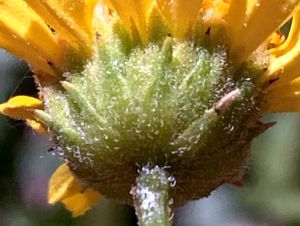
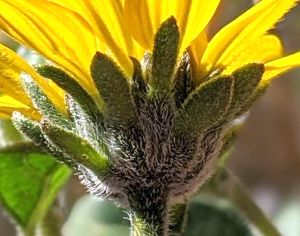
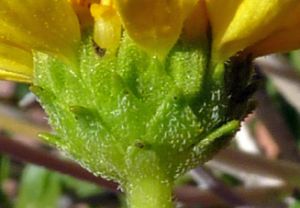
Fig. 5 shows the variation in the phyllaries for each species, ordered from the most slender phyllaries to the widest phyllaries.
There's quite a variation within each species! The phyllaries do distinguish the two species, but the variation in the phyllaries for each species is so large that the differences might be hard to pick out.
Generally, the phyllaries of B. parishii have an oblong upper ~half, whereas the phyllaries of E. resinifera have an acute to acuminate tip.
| Bahiopsis parishii | Encelia resinifera | |
| 
| |
| 
| |
| 
| |
| 
| |
| 
| |
| 
| |
| Fig. 5. Photos of the phyllaries of Bahiopsis parishii (left column) and those of Encelia resinifera (right column). The photos of B. parishii are all from the Borrego Desert in San Diego County with the exception of the one in the third row, which is from an unspecified location in the webpage Southwest Desert Flora.
Click on the pictures to go to the original source, usually the iNat obs, which gives the information as to who took the photos. | ||
Some random other information about Encelia resinifera:
Interestingly, the Flora of North America treatment of E. resinifera by Curtis Clark gave only one variety different from the nominal one:
Plants of Encelia resinifera from the Grand Canyon of the Colorado with lengths of leaf blades and ray laminae at least three times their widths are subsp. tenuifolia.
Singhal et al in their paper Diversification, disparification and hybridization in the desert shrubs Encelia, comment that:
Previous studies of Encelia identified four putative cases of hybrid species: E. actoni X E. frutescens to result in both E. virginensis and E. resinifera; E. californica X E. frutescens to result in E. asperifolia; and E. farinosa X E. palmeri to result in E. canescens (Clark & Allan, 1997; Allan et al., 1997; Clark, 1998). As is common in hybrid species (Kadereit, 2015), and as expected by theory (Buerkle et al., 2000), our spatial analyses suggest that these hybrid species occur in disjunct habitats from either progenitor species.
That's worth saying again. Hybridization of the same two species at two separate times resulted in two closely-related, but different, species!!!!
This is not as surprising as it seems. For one thing, one may have resulted from pollen from E. actoni on the ovary of E. frutescens, and the other may have resulted from pollen from E. frutescens on the ovary of E. actoni.
Also, hybrids go through a process of change to their genome with successive generations until the genome stabilizes; see Eukaryote hybrid genomes by Runemark et al 2019. This process may result in different end points, even when the hybrid starts in the same way. The two hybrids therefore might have differed significantly almost immediately, and then their separate evolution would increase their differences.