Photo Size Distortion
In the course of measuring tall specimens of Ferocactus cylindraceus, California barrel cactus for the table listing them, I noticed that photos by a number of people, that used a comparison person, ruler, or other scale in the picture, overestimated the size of the barrel cactus when compared to actual measurements of the barrel height. Finally, it occurred to me to photograph a ruler to see what the distortion is in such photographs.
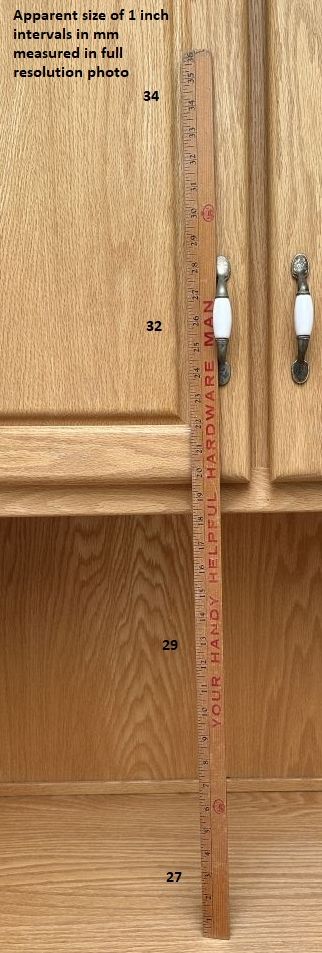
My initial photograph showed considerable distortion in the photo from top to bottom. The measured size of an inch in the yardstick in the full-resolution photo ranged from 34 mm near the top of the yardstick, to 27 mm near the bottom of the yardstick, corresponding to a 26% distortion in size between the top and bottom of the photograph; see the left photo in Fig. 1. The measurements in mm are just arbitrary units here, and should not be compared to one inch.
This distortion was easily large enough to account for the discrepancy in measuring tall specimens of barrel cactus. For example, a barrel that seemed to be 10 feet tall in this observation was actually measured to be 8 feet 4 inches tall, a discrepancy of 22%. This so far is the largest known discrepancy, probably because it had the shortest comparison scale.
I couldn't make any sense of this distortion, which is opposite in sign to geometric effects and barrel distortion in the wide-angle lens used in the iPhone and other point and shoot cameras.
Fortunately, after I reported this on Henrik Kibak's iNat observation of the barrel cactus mentioned above, Henrik commented that the same issue probably had been encountered in trying to measure tall trees. Guillaume Baudry ran with that suggestion, and found a single paper discussing the use of camera phones to measure tree heights (Fulkerson 2021). Fulkerson found that if the camera phone was held exactly vertically, that the distortion disappears!
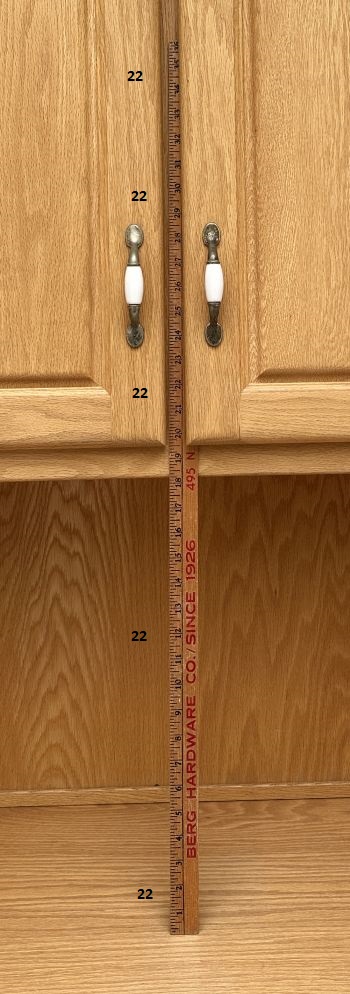
I photographed my yardstick again, using a level to ensure my camera was dead vertical, and indeed, Fulkerson was right; the distortion completely disappeared; see the right photo in Fig. 1.
| 
| |
| Fig. 1. Left: Photograph of a yardstick, scaled at 25% of the original, labeled in different areas by the size of one inch intervals, as measured in mm in the full resolution photo on my computer screen. I photographed the ruler from about 25" away. The base of the ruler is slightly tilted toward me in order to make it stand up by itself, leaning against the cabinet. The bottom of the yardstick should actually have appeared as a bit larger than the top of the yardstick due to its slight tilt, but instead it appears significantly smaller. For this photo I photographed the yardstick normally, without taking care about keeping the phone dead vertical.
The approximate full angle between the top and bottom of this photo is 77 deg (= 2 * arctan(20/25) ). This is a little larger than the 69 deg given on this page, but the difference isn't important. I just wanted to check that I was in the right ballpark. The camera lens was approximately at the 25 inch marker on the yardstick. Right: A similar photo, this time taking care to keep the phone dead vertical by using a level. Both photos were taken by an iPhone 14 Pro. I obtained a similar result to the right photo using an Olympus TG-6 with a level to ensure it was dead vertical when taking the photo. | ||
Presumably, a similar distortion is present for all point and shoot cameras with small lenses.
This distortion is almost surely related to the lens corrections made by the iPhone and other point and shoot cameras such as the Olympus TG-6. Those cameras all use wide-angle lenses that suffer from barrel distortion, which exaggerates the size of objects in the center of a photograph. The camera manufacturers strive hard to eliminate that, and other effects that would cause straight lines not to appear straight in the photos.
The lens corrections are almost surely designed to optimally correct photos where the iPhone or camera is vertical. Phone cameras are optimized to produce the best possible pictures of people. In those photographs, the camera is almost always held close to vertical orientation.
These correction algorithms probably work imperfectly for photographs that are not exactly vertical.
You can easily see how distorted such camera images are if the camera is not vertical, by having the camera view windows, computer screens, columns, etc. and then tilting the camera. A straight on shot, with the camera vertical, shows no distortion. Tilting the camera makes straight lines curve, where, for example, the top of the monitor is wider than the bottom of the monitor.
I suspect the lens corrections also might try to do a limited correction for what is called "perspective" in camera circles. "Perspective" is just a geometric effect caused by objects being at different distances, and different angles, in the photos. For example, if you photograph a person's face from a very close distance, with their nose in front, the photograph will greatly exaggerate the size of the person's nose. Similarly, if the top of a barrel cactus is farther away than the base of the barrel cactus, it will appear smaller.
It is possible that these corrections act to make the top of the cactus appear larger and taller.
In any case, Fulkerson has discovered a much better way to take photographs of objects that have an accompanying scale. Now if only our phones had a built-in vertical level displayed in camera lenses, to accompany their horizontal level! Lacking that, and since most people do not carry around a small level, we should just strive to keep our cameras as vertical as possible when photographing objects at distance with a scale in them.
I thank Guillaume Baudry for discussions that led to me photographing a yardstick, and for his find of the Fulkerson paper.