Don
Rideout and I hiked an 8 mile loop at Borrego Mountain on Tuesday,
3/7/23, from San Felipe Wash, up Blow Sand Canyon, across the Goat
Trail, and down the Buttes Pass Road. We picked this location
since, once again, due to cool temps we had to stay at low elevation,
and neither of us had been in this area for some time. Our major
goals were to get some exercise, look to see if there were major
flowers in the sandy areas surrounding San Felipe Wash, and to look
for the rare plant Astragalus magdalenae var. peirsonii, which was
vouchered on 10 March 2005 from the sand dune in Blow Sand Canyon:
https://cch2.org/portal/collections/individual/index.php?occid=488546&clid=0
A.m.p. is only known from the Algodones Dunes, except for
this single voucher taken in the last really good year in the Borrego
desert in 2005.
We weren't really expecting to see it,
since no one else has ever seen it in Blow Sand Canyon, but with such
good September rainfall this year, there certainly was a possibility
it might be there this year.
The other variety of this
species, A.m. var. magdalenae, is widespread throughout Baja on dunes
and sandy areas near the coasts.
We did not thoroughly
explore the Dune, but we did traverse it from bottom to top, and
across the top in one direction. Unfortunately, we did not find
any Astragalus at all. The main Dune plant species is Dicoria,
along with too many Brassica tournefortii, with a small number of
other sand-loving native species present.
It seems highly
likely that the vouchered plant was a waif from an off-road vehicle
that picked up a seed at the Algodones Dunes which was later dropped
off in Blow Sand Canyon.
We did make a major find,
though - a new location for Aristida californica, which was a new
species for Don at iNat. I was very pleased to come across it.
This is only the third location I know of in SD County for this
species. The nearest location elsewhere is, not surprisingly,
in the Algodones Dunes. Pix:
My posts of A.
californica, post 1 of 5 contiguous posts (use the "right green
arrow" at top right to get the others):
https://www.inaturalist.org/observations/150705839
Don's post:
https://www.inaturalist.org/observations/150626891
For comparison, my post of an A. adscensionis found
on the big sand dune:
https://www.inaturalist.org/observations/150706278
A. californica is distinguished by having much longer
awns, 20 to 50 mm, compared to just 7 to 20 mm for A. adscensionis.
This makes it quite obvious in the field, since it looks like Edgar
Scissorhands. (;-) It is also distinguished by having very
hairy lower stems; all other Aristida have no hairs on the lower
stems, but you need a hand lens to see those hairs. The posts
above show both of those characteristics.
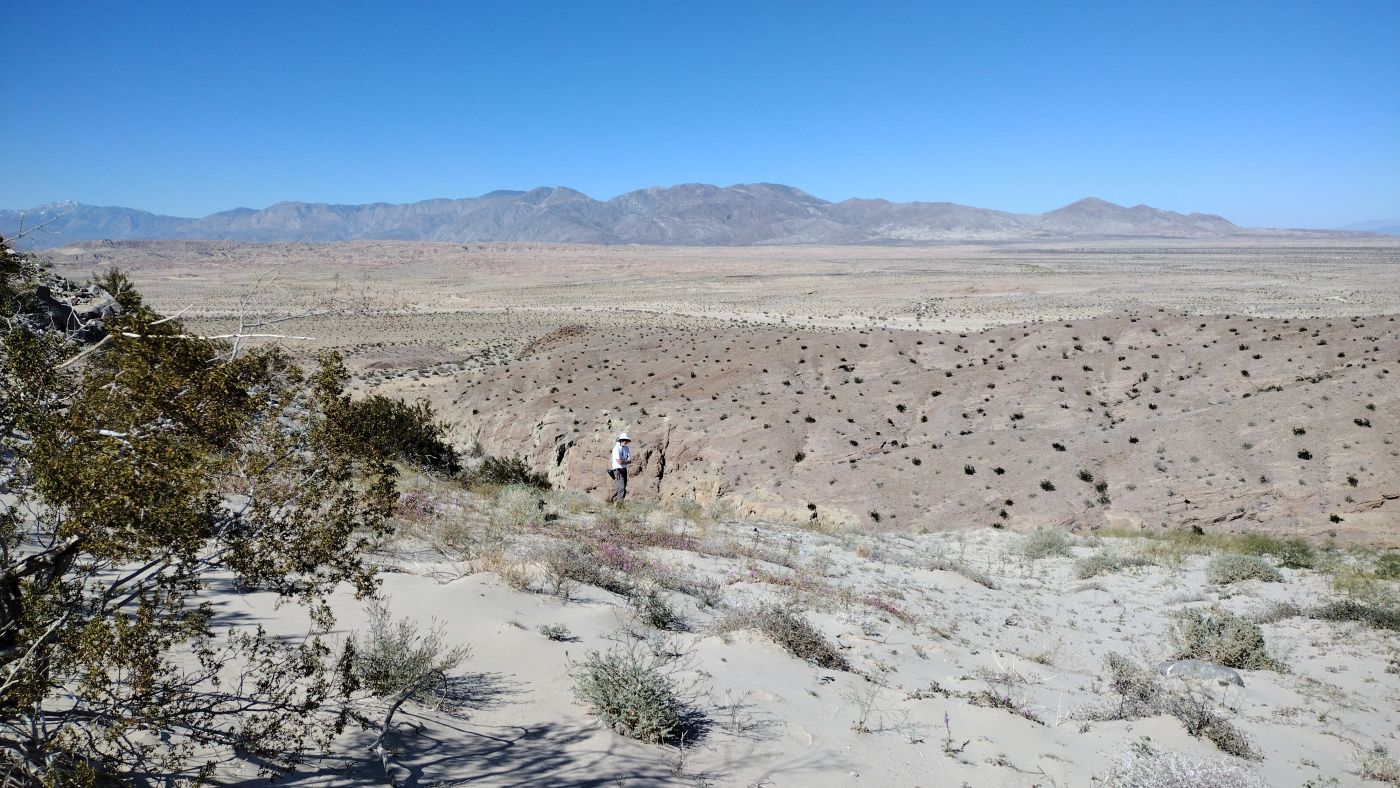
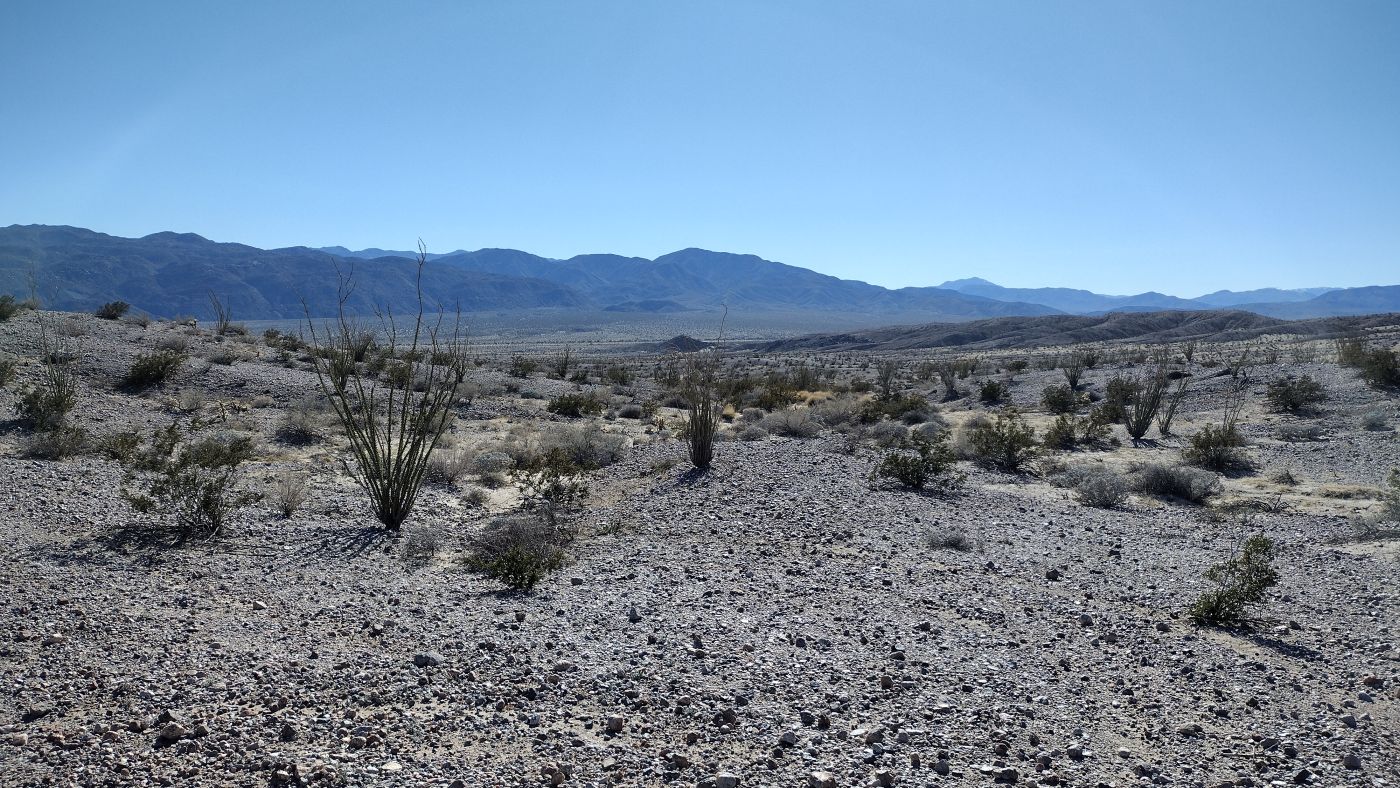
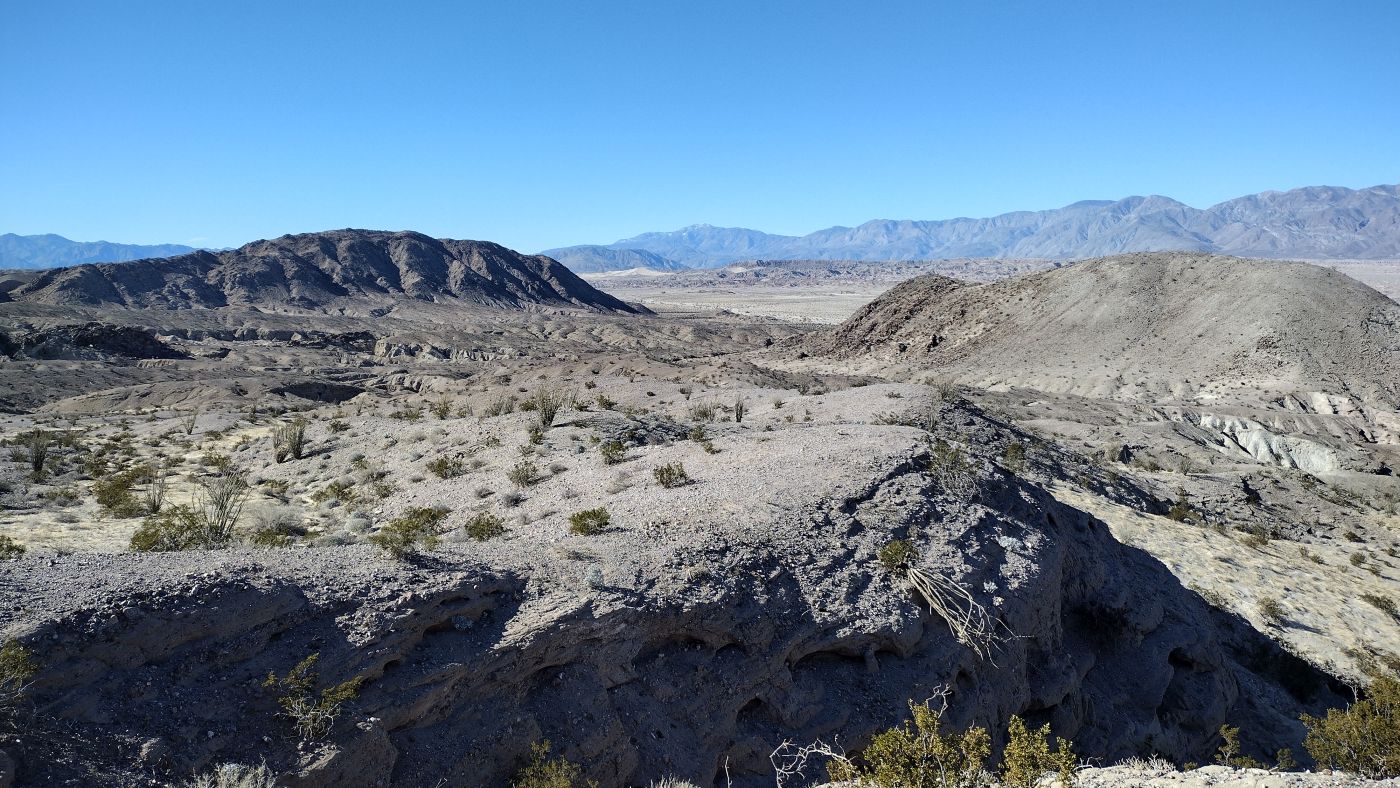
A major
highlight of this trip was the wonderful scenery. The view to
the north is of the Borrego Badlands, with Fonts Point prominent,
with the Santa Rosa Mountains behind them, and the Orocopia /
Chocolate Mountains in the distance beyond the Salton Sea. The
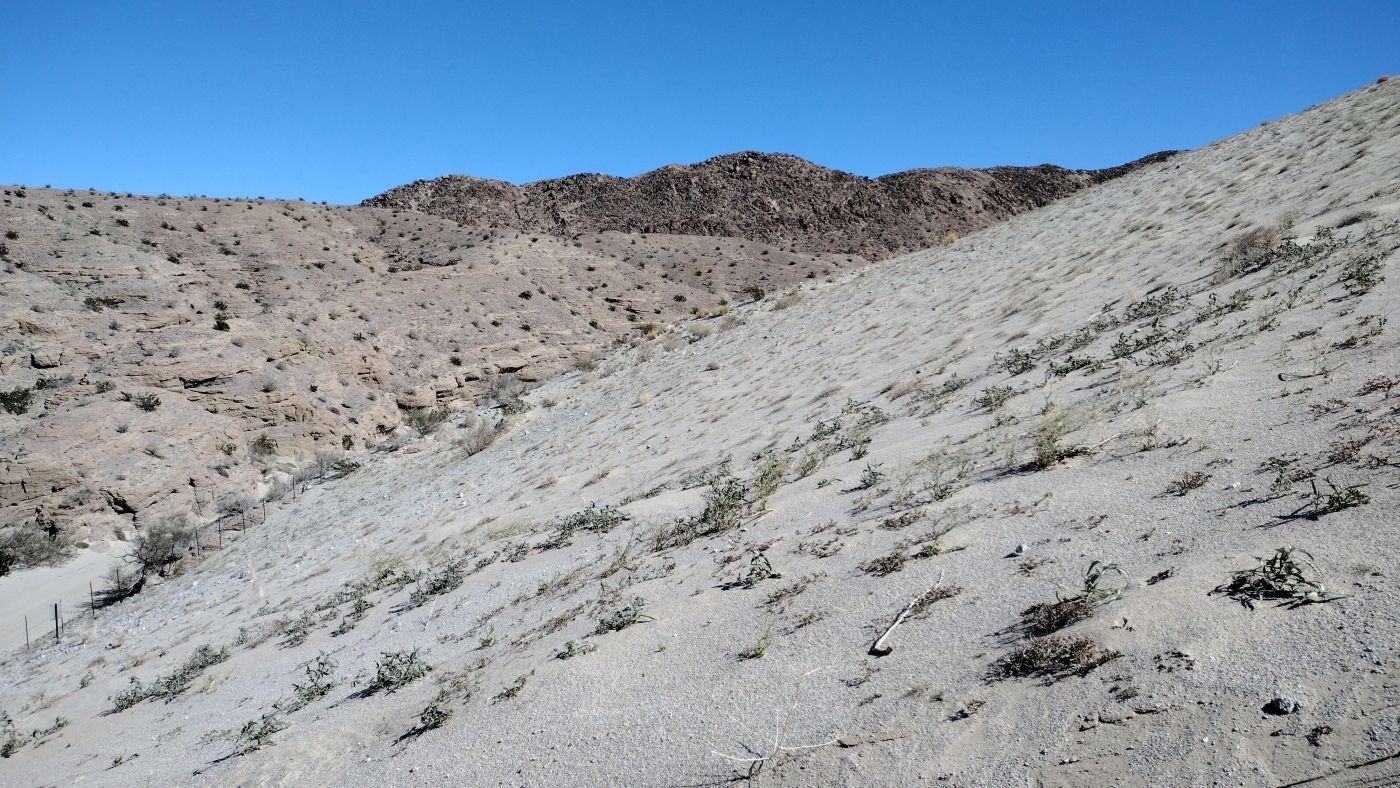
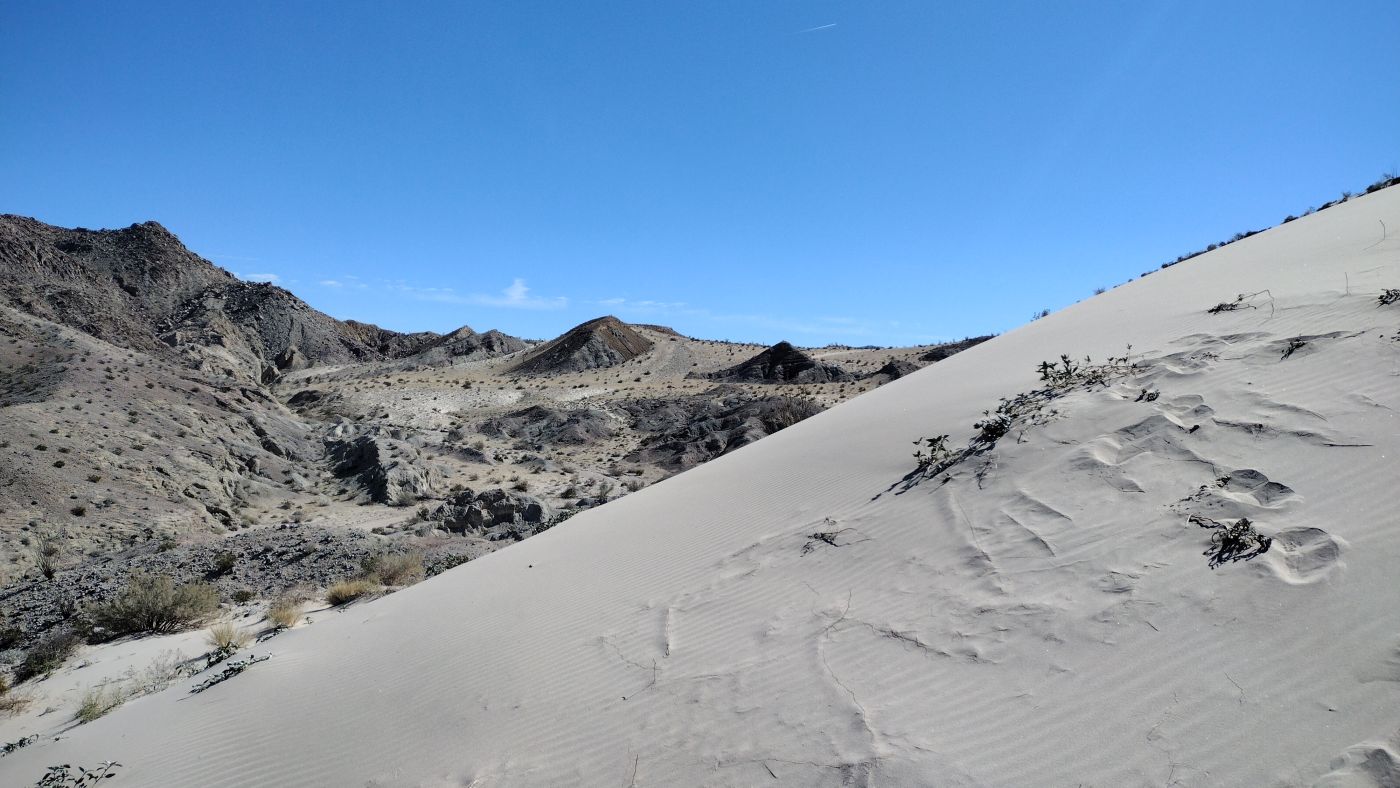
landscape of Borrego Mountain is absolutely beautiful. From the
start, we had great views of the big sand dune in Blow Sand Canyon.
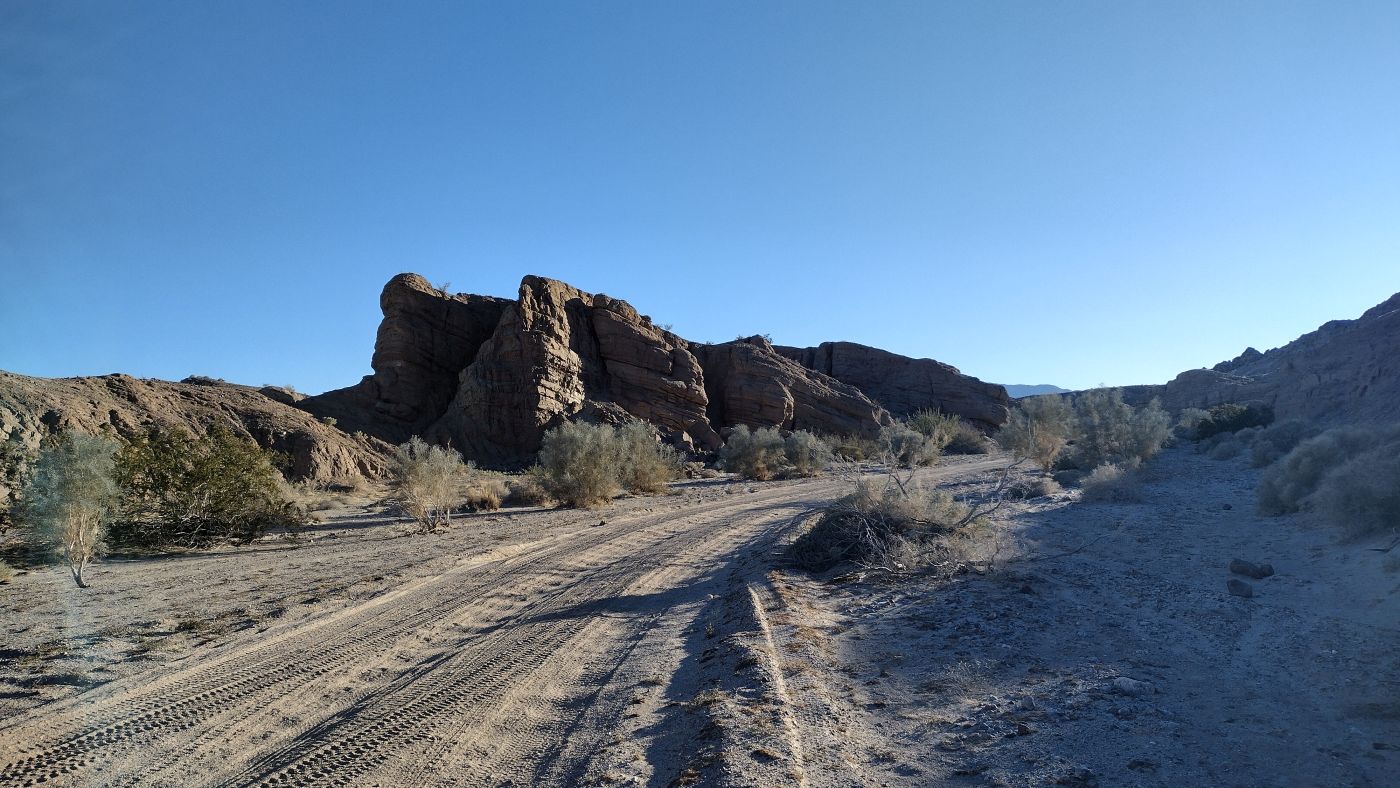
As we hiked, the rocks of Borrego Mountain varied considerably, from
dark black exposures to the red rocks of Hawk Canyon. See the
links below to Don's pix that show some of the great views.
We
found annual species in bloom all along our hike, 50 different
species, but they were mostly very small plants, with few blooms.
This is typical of years in which we get just enough rainfall to
germinate annuals, and little follow-up rainfall to make them grow
big. The list of species in bloom is at the bottom of this
email. We estimated that this area is at peak bloom now.
Don
and I posted 82 obs of 55 species:
https://www.inaturalist.org/observations?on=2023-03-07&place_id=95385&user_id=lagoondon,tchester
Don posted 56 obs of 46 species; I posted 26 obs of 20
species.
Details:
There were still very
few species in bloom along our drive to Borrego.
S2 in
San Felipe Valley had nothing visible from the car, but we stopped to
check on the Prunus fremontii, and it was in full bloom. Don's post:
https://www.inaturalist.org/observations/150616981
The bloom was less visible than normal from the car,
since these plants had leafed out after the September rain, and so
were quite leafy when blooming.
Along SR78, there
were only a few Peritoma in bloom in Sentenac Canyon; a few chuparosa
along SR78, and only a few Encelia farinosa in bloom as we got close
to Buttes Pass Road. Few ocotillo had leaves. Most of the
greenery we saw along the road was Brassica tournefortii, with some
clumps of Bermuda grass. (:-(
It looked very
inauspicious for flowers when we parked the car at the bottom of the
Buttes Pass Road. There were annuals, but they were sparse, and
TINY. Some were quite cute, though, such as this tiny Abronia
with a single flower cluster; my post:
https://www.inaturalist.org/observations/150777639
this tiny Chylismia claviformis; my post:
https://www.inaturalist.org/observations/150777936
and this Rafi with just two flowers; Don's and my
posts:
https://www.inaturalist.org/observations/150617542
https://www.inaturalist.org/observations/150781036
We started hiking just after noon. The
weather was very pleasant, a temp of 65 deg, no breeze, and a warm
sun. I took off my two sweatshirts, and didn't put them back on
the entire day.
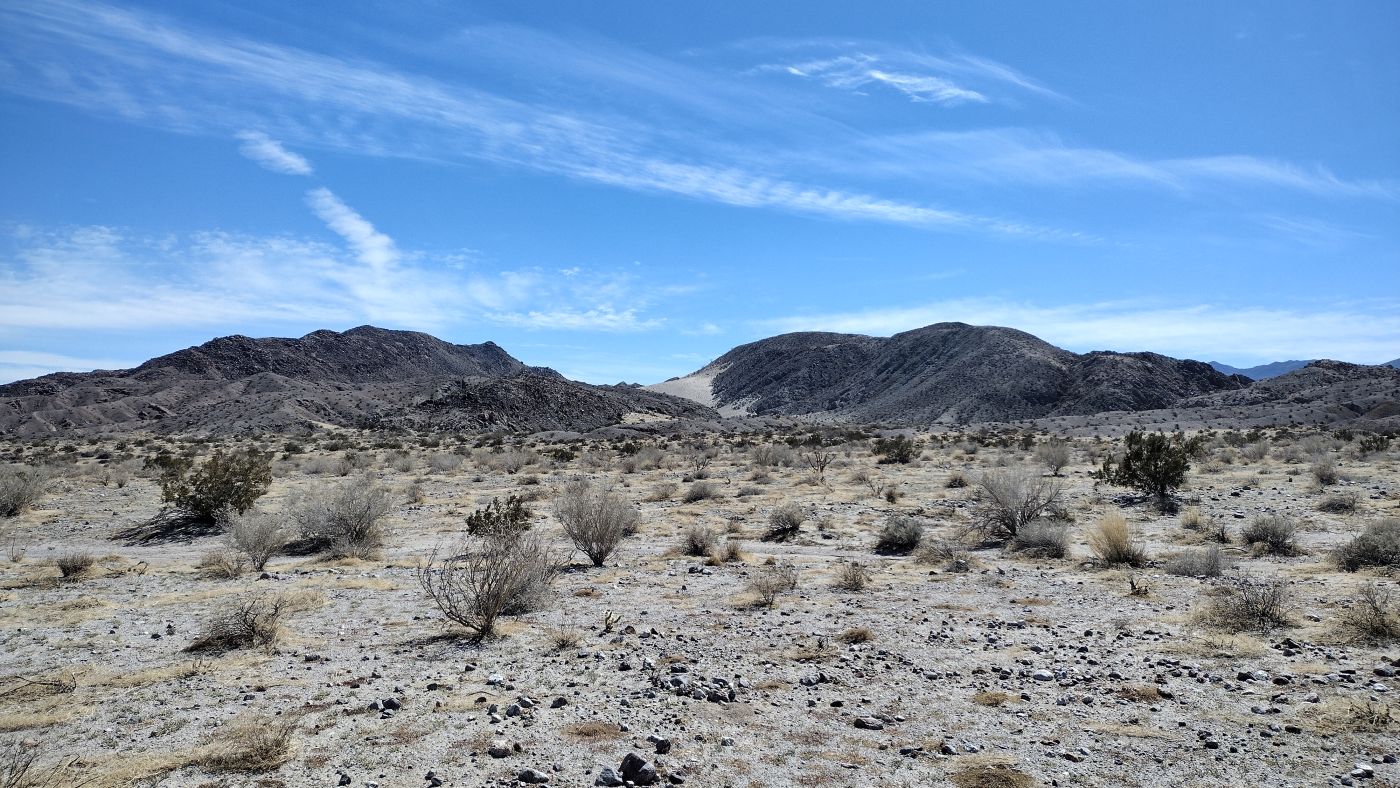
Don's pix of the great view of Blow Sand
Canyon near the start of our hike:
http://tchester.org/temp/230307/rideout/blow_sand_canyon_35.jpg
It looks pretty bleak in this pix for the area where we
were hiking, but there were annuals there that don't show up in the
pix. (:-) The shrubs obviously don't look very happy.
One
surprisingly thing is that all the Palafoxia arida were young, fresh,
and just starting to bloom. Apparently they germinated from
January rain here, not the September rain. Don's post:
https://www.inaturalist.org/observations/150621239
The flowers got a bit better when we entered the
drainage from the canyon immediately west of Blow Sand Canyon, with
bigger Lupinus arizonicus. In Blow Sand Canyon itself, the
plants significantly better. There were about 40 plants of
Eschscholzia minutiflora along the canyon wall in one spot.
Don's post:
https://www.inaturalist.org/observations/150622913
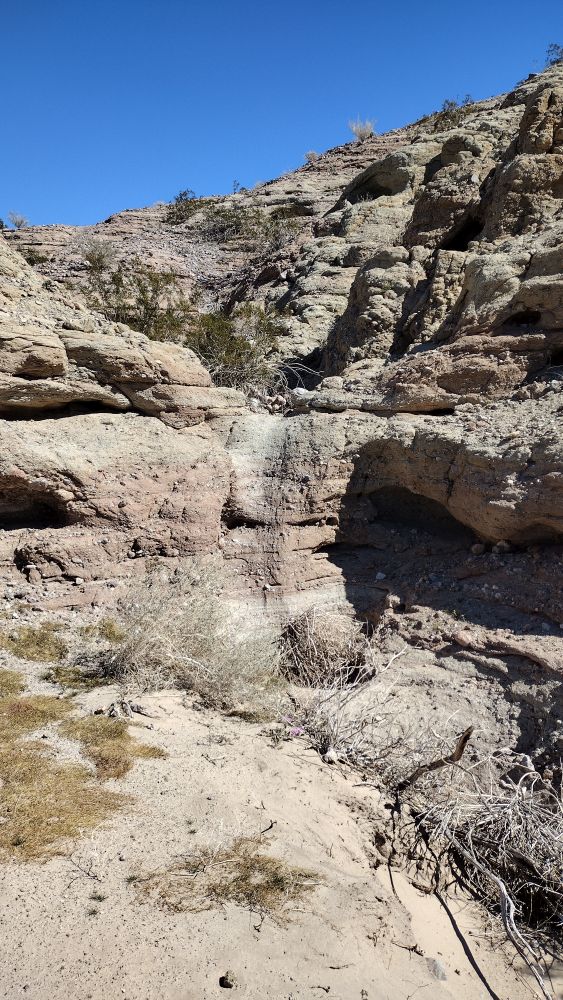
At the top of the mini-dune with the Aristida
californica, there was a side canyon where a dry waterfall was marked
by whiter rocks. Don's pix:
http://tchester.org/temp/230307/rideout/dry_waterfall_side_canyon_25.jpg
The sandy areas all along our route were mostly
untouched by human footprints, and bore a wealth of tracks.
Don's posts of three of them:
https://www.inaturalist.org/observations/150627060
https://www.inaturalist.org/observations/150629168
https://www.inaturalist.org/observations/150629797
Some were like highways, with many tracks on top of each
other.
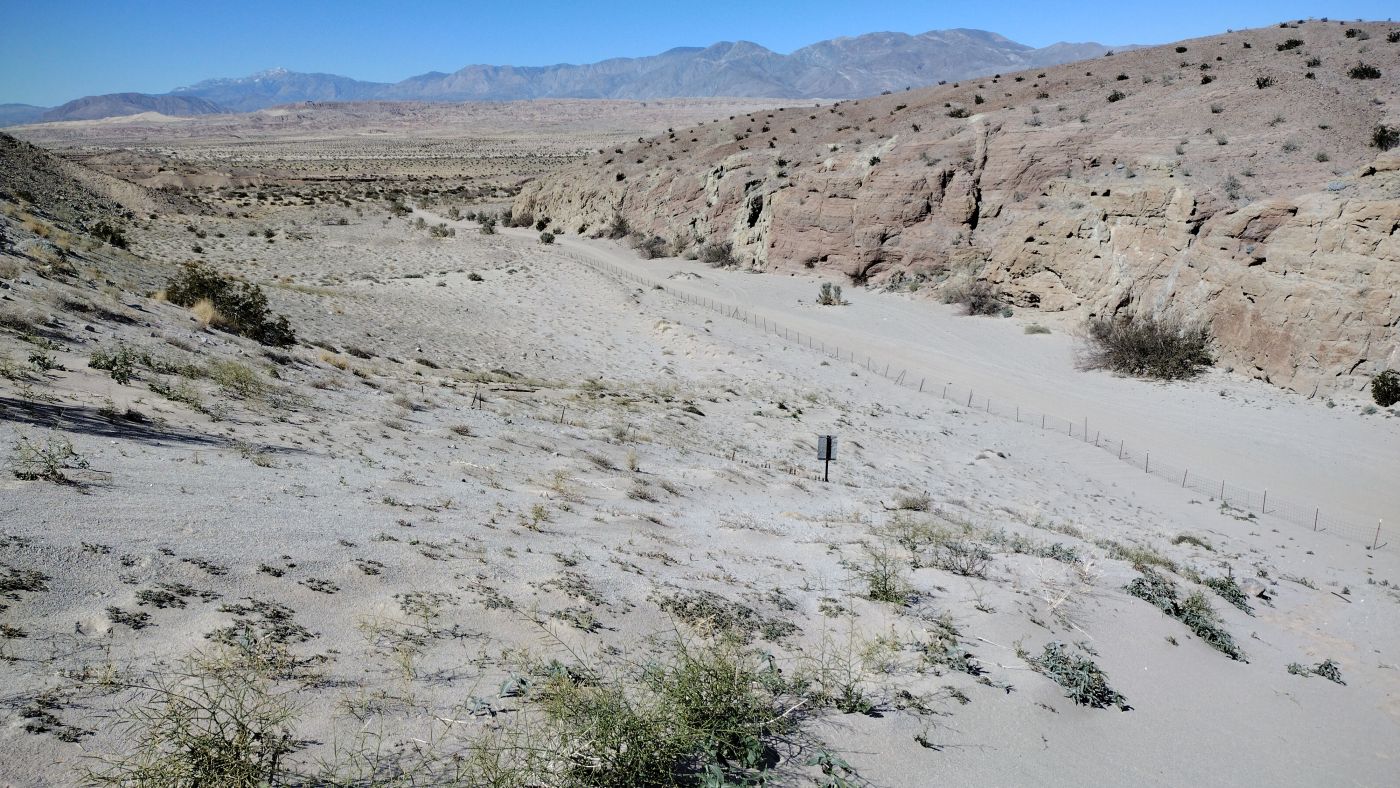
The Big Dune was pretty exciting to see up
close. Don's pix of us approaching it:
http://tchester.org/temp/230307/rideout/approaching_sand_dune_35.jpg
The fence to keep off-roaders off the dune was, of
course, knocked down right at the Dune. But we were surprised
we didn't see any off road tracks on the dune.
The dune
is pretty steep, and I had to stop regularly to catch my breath as we
went to its top.
Don's pix from most of the way up
the dune, looking north:
http://tchester.org/temp/230307/rideout/view_from_sand_dune_to_north_35.jpg
Dicoria is the most common plant seen in the pix, with
mustard along the little channel we were climbing.
At the
top of the pix, "ant hill", Fonts Point, and the Borrego
Badlands are in the middle distance. Coyote Mountain is the
dark feature at extreme top left, with snow-covered Toro Peak just to
its right, and the ridge of the Santa Rosa Mtns in the middle.
Looking south, the (sandstone?) rocks on the other side
of Blow Sand Canyon are at left, with the somber dark granitic rocks
of the East Butte of Borrego Mountain at top:
http://tchester.org/temp/230307/rideout/view_from_sand_dune_to_south_35.jpg
Don took this pix of me looking hard for the
Astragalus, as I was cresting the south top of the Dune:
http://tchester.org/temp/230307/rideout/tom_looking_for_astragalus_35.jpg
Don took this great pix eight minutes later,
showing the Big Dune, and the fantastic view of upper Blow Sand
Canyon:
http://tchester.org/temp/230307/rideout/view_up_blow_sand_canyon_from_dune_35.jpg
Since we went up the Big Dune sans packs, we went
down to the road and looped back to get our packs. We were
pleased looking up that we couldn't see any sign of our tracks
disturbing the dune.
The road up Blow Sand Canyon
connects with the Goat Trail, which travels along the east-west ridge
connecting Blow Sand Canyon with the Buttes Pass Road. There
are great views from the Goat Trail. Don's pix:
The view
south, toward Harper Canyon and the Vallecito Mtns:
http://tchester.org/temp/230307/rideout/view_south_from_goat_trail_35.jpg
The view north is now even better, showing the West Butte
of Borrego Mountain and the drainage we next attempted to go down:
http://tchester.org/temp/230307/rideout/view_north_from_goat_trail_35.jpg
View of us approaching that drainage:
http://tchester.org/temp/230307/rideout/view_canyon_west_of_blow_sand_35.jpg
We got into that canyon with no problem, but it
worried me that the bottom of the canyon was so flat. Since
Blow Sand Canyon had a pretty-even fairly-steep gradient, I suspected
there might be a steep drop ahead to make up for that flatness.
Sure enough, we soon suddenly came across a 10 to 15' waterfall that
did not look easy to descend safely. So we went back to the
Goat Trail, and shortcut it to get into the canyon that Buttes Pass
Road descends.
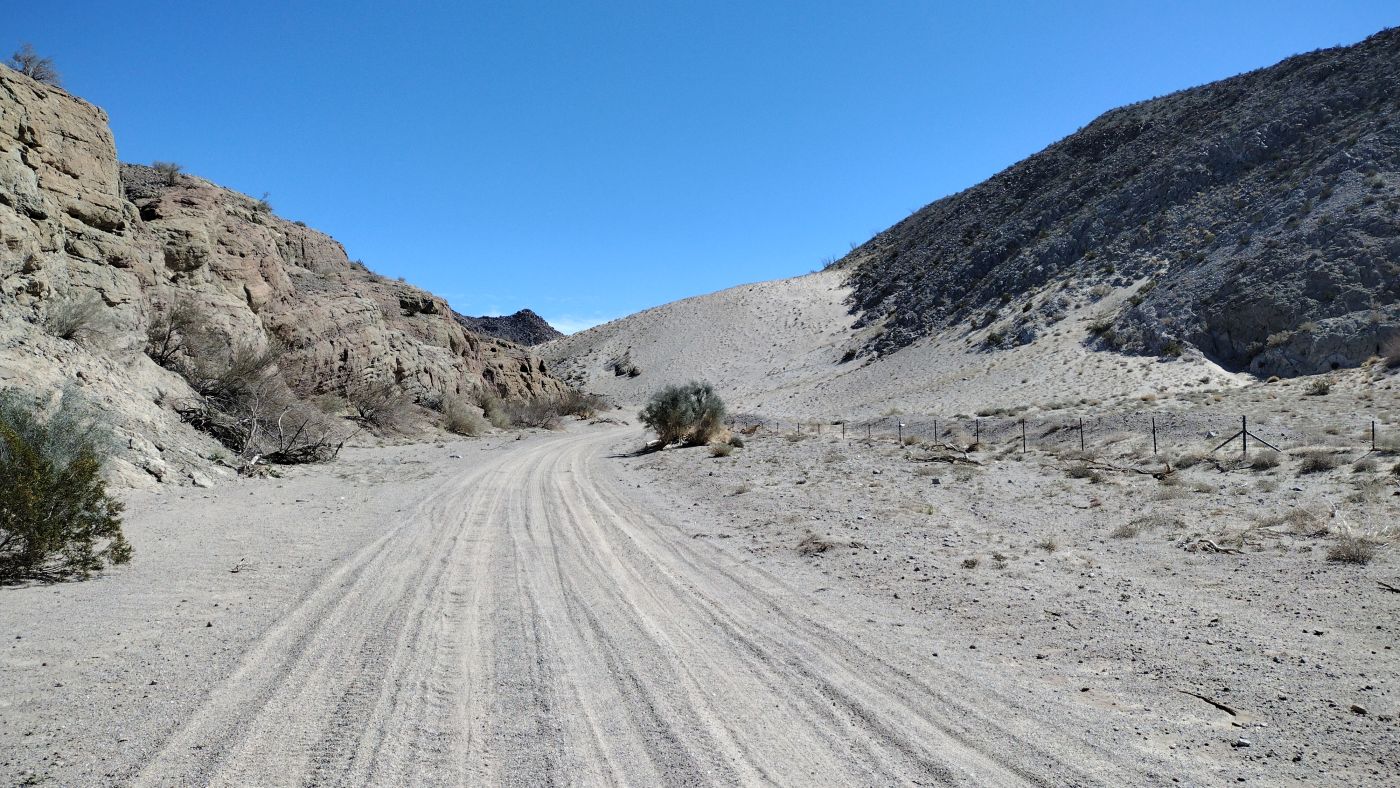
It was delightful descending Buttes Pass
Canyon. At no point did we have to walk on the road itself,
since the wash is very wide. Don took this pix when we were
about to cross from one side of the road to the other side:
http://tchester.org/temp/230307/rideout/view_going_down_buttes_pass_canyon_35.jpg
There were side canyons galore that begged us to
explore them, but we didn't have time to do so on this trip.
It
was interesting that the Buttes Pass Canyon was loaded with Ottleya
strigosa (Lotus strigosus = Acmispon strigosus), which we hadn't seen
in the rest of our hike.
There was one amazing
Eremothera boothii that looked like it was "ready for takeoff".
See the second pix in Don's post:
https://www.inaturalist.org/observations/150634479
We diverted from going straight back to the car in
order to check on a big field of Orobanche cooperi (Aphyllon c.) that
I had seen there a decade or so ago. This year no Aphyllon
plants were seen there at all.
I was very surprised to
see that the Ambrosia dumosa plants there were on big mounds of sand:
https://www.inaturalist.org/observations/150787068
But I had seen this same plant, or a very nearby one,
back on 3 April 2011, when it had an Orobanche growing on it:
https://www.inaturalist.org/observations/150788598
We found our lone Astragalus crotalariae in that
vicinity. Don's post:
https://www.inaturalist.org/observations/150635584
As we were walking back to the car, the wind came
up pretty strongly. It blew Don's mask out of the car, which
quickly became irretrievably lost. We got back to the car at
5:43 p.m.
List of species in bloom.
#Pls
in bloom name
99 Abronia
villosa var. villosa
99 Achyronychia cooperi
99 Acmispon strigosus
99
Aristida adscensionis
99 Brassica
tournefortii
99 Chamaesyce polycarpa
99
Chylismia claviformis ssp. peirsonii
99
Cryptantha angustifolia
99 Geraea canescens
99 Lupinus arizonicus
99
Palafoxia arida var. arida
99 Perityle emoryi
99 Schismus barbatus
50
Eriogonum thomasii
40 Eremothera
boothii ssp. condensata
40 Eschscholzia
minutiflora ssp. minutiflora
40 Phacelia
crenulata var. minutiflora
25 Encelia
farinosa
20 Aliciella latifolia ssp.
latifolia
20 Larrea tridentata
15
Dithyrea californica
10 Dalea
mollissima
10 Eulobus californicus
10
Plantago ovata
5 Bebbia juncea var.
aspera
5 Chaenactis stevioides
5
Ditaxis lanceolata
5 Stillingia spinulosa
4 Rafinesquia neomexicana
3
Encelia frutescens
3 Malacothrix glabrata
2 Eriogonum inflatum
2
Oenothera deltoides ssp. deltoides
2
Peucephyllum schottii
1 Allionia
incarnata var. incarnata
1 Astragalus
crotalariae
1 Chylismia cardiophylla ssp.
cardiophylla
1 Croton californicus
1
Ditaxis neomexicana
1 Gilia stellata
1
Hilaria rigida
1 Krameria bicolor
1
Loeseliastrum matthewsii
1 Mentzelia
albicaulis?
1 Mohavea confertiflora
1
Monoptilon bellioides
1 Nicotiana obtusifolia
1 Phacelia pedicellata
1
Physalis crassifolia
1 Psorothamnus emoryi
--
tom chester