This
was an unusual trip for its planning.
The only day in
this time period with semi-decent weather in Borrego Springs was
Monday, but I had a dryer scheduled to be delivered between 10 a.m.
and noon on Monday. Don and I decided to try to go to Borrego
anyway, so he stood at the ready to leave Encinitas when I called to
say the installers were here in Fallbrook.
It worked
out! They arrived at 10:35 a.m., and Don arrived at my house
just when I was ready to go. I needed to resolve a problem with
the venting, and got it done so that the dryer could be in use
immediately.
The main purpose of our trip was just
to get outside after all the rain, cold and wind we'd had. We
picked Coyote Creek Wash from zeroth crossing to first crossing,
after Fred and Carla reported "We've never seen such a good and
wide bloom at this location". Interestingly, they only
hiked there because their electricity was off on 2/22/23!
Here
are highlights of our hike, which actually was from 0th crossing to
the Horse Camp Road. We diverted from going to first crossing,
due to a cold and a stiff breeze that was coming out of first
crossing.
- There were over 200 plants / clumps of
Orobanche cooperi = Aphyllon c.! We've never seen so many.
The plants were almost entirely confined to the banks of the wash,
where they were parasitic on Ambrosia dumosa, except for one clump on
Ambrosia salsola. Once we left the wash channel, the number of
Orobanche went to zero, even though the Ambrosia was found away from
the wash.
We posted 18 obs of the Aphyllon:
https://www.inaturalist.org/observations?nelat=33.34784842478738&nelng=-116.36077844537795&on=2023-02-27&place_id=any&swlat=33.328631095033465&swlng=-116.39545404352248&view=&taxon_id=802494&page=
We also observed some occasional, but widespread,
surprising wash-downs of plants that normally grow in water at First
Crossing, as well as a sign for Second Crossing that is a long way
from where it was originally stuck in the ground. Don's pix:
http://tchester.org/temp/230227/rideout/second_crossing_sign_post_25.jpg
Putting those facts together, I speculated that a lot of
water had come down this channel in September, which washed those
plants down and deposited a lot of water in the channel, which the
Ambrosia dumosa and Orobanche responded to.
- A
large number of those O. cooperi plants were crested!! My posts
of them:
https://www.inaturalist.org/observations/150083731
https://www.inaturalist.org/observations/150084726
https://www.inaturalist.org/observations/150084727
https://www.inaturalist.org/observations/150087157
https://www.inaturalist.org/observations/150089059
- Despite this being a usual low-diversity area, we
recorded 59 species in bloom! Six of those were non-native
species, but 53 native species is quite good, and more than we
thought we had seen. A
list of the plant in blooms is given at the end of this email.
-
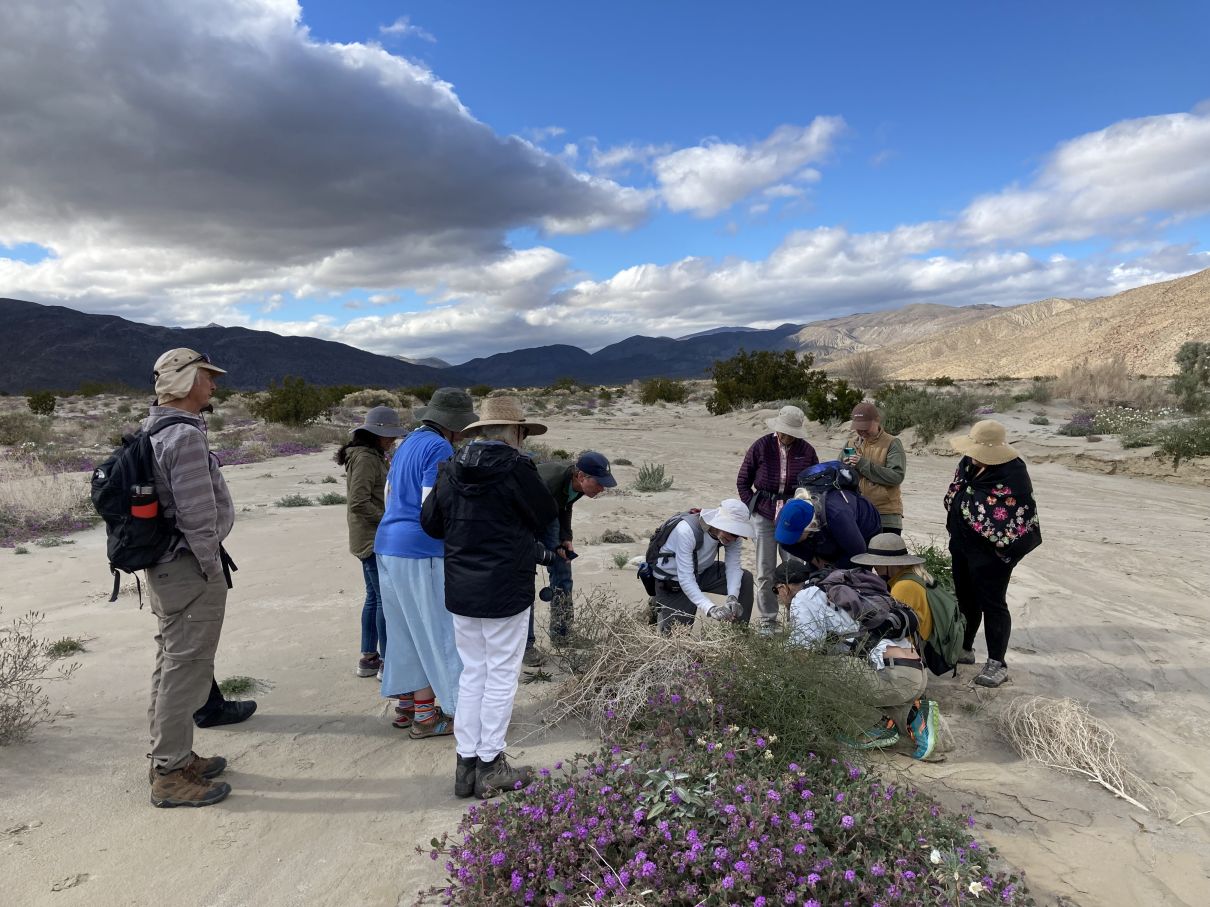
We ran into the ABDSP Botany Training Class in action near the
beginning of our hike! It was fun to meet those people, and we
spent 30 minutes talking to them, and answering some of their plant
questions. One of them found a Cryptantha ganderi! We
only spotted one more C. ganderi on our hike. Posts of those
plants:
Don:
https://www.inaturalist.org/observations/149916778
"marzduffy":
https://www.inaturalist.org/observations/149908638
"dryrunner":
https://www.inaturalist.org/observations/149952750
Don took this pix of me examining a logfia for
them:
http://tchester.org/temp/230227/rideout/class_at_filago_35.jpg
Karyn took this pix of me showing them how to look
at the nutlets of Cryptantha:
http://tchester.org/temp/230227/sauber/IMG_8868_30.jpg
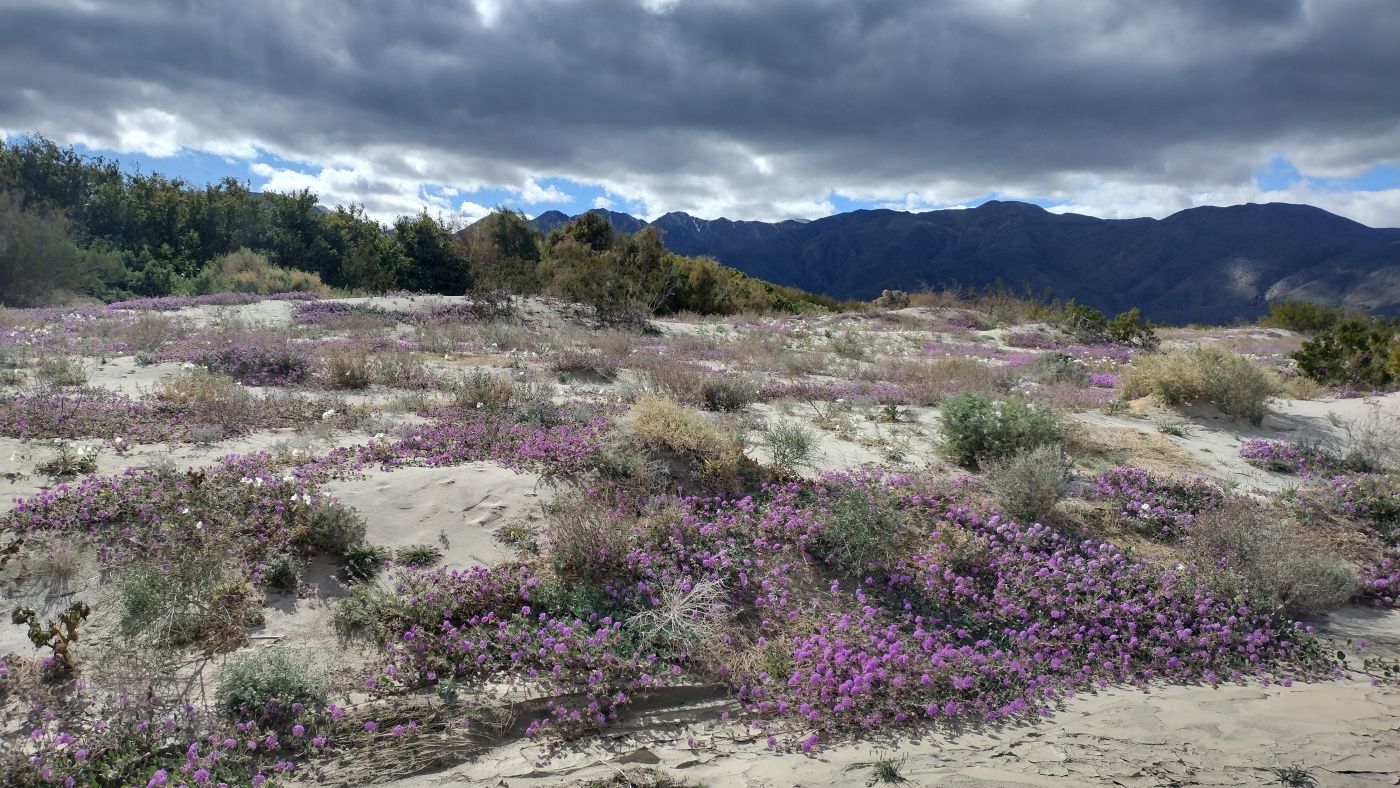
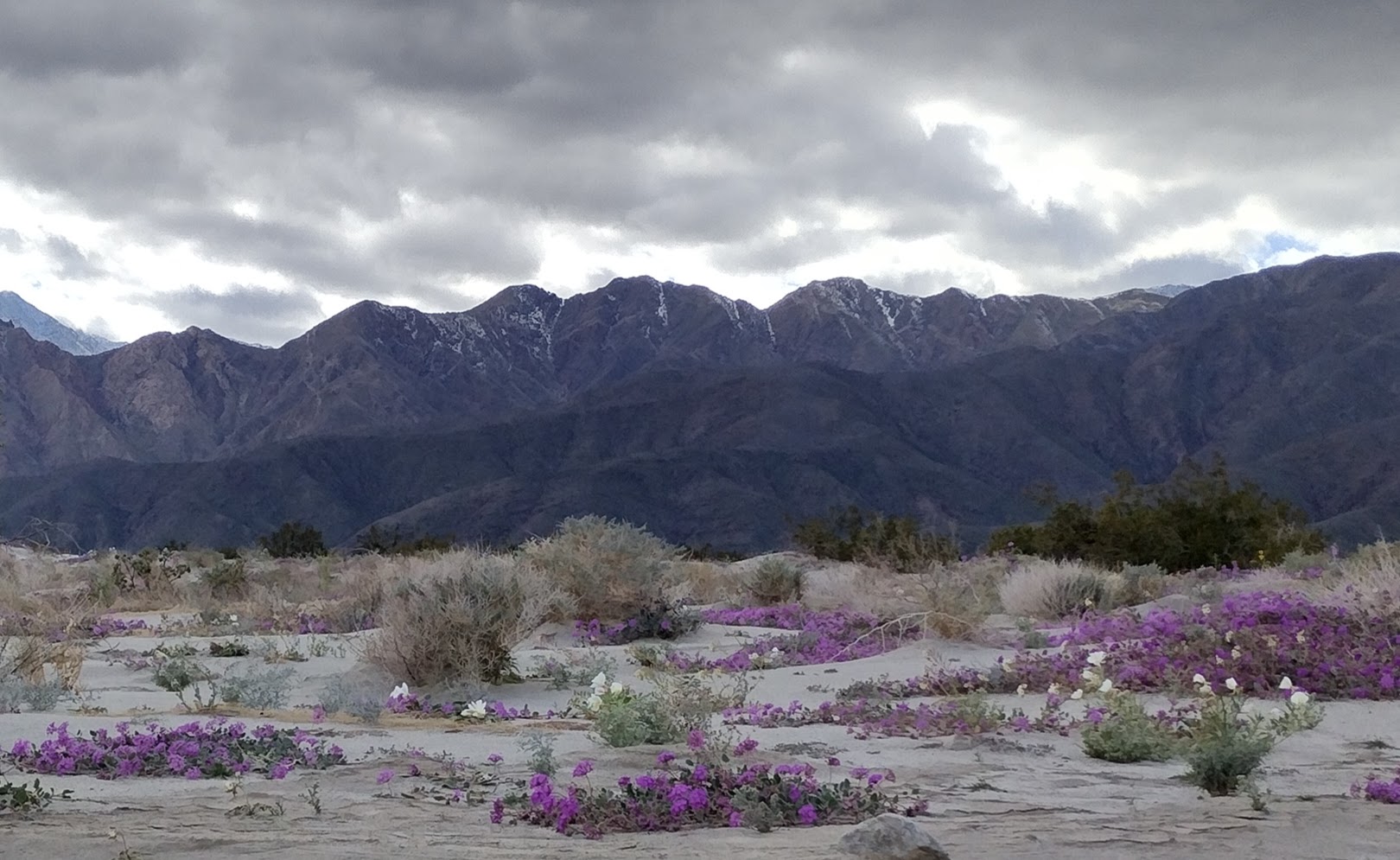
- As always in sandy areas this year, there were
beautiful displays of sand verbena, sometimes accompanied by evening
primrose. Some examples:
Don's pix with the
close-by hills with snow in their drainages:
http://tchester.org/temp/230227/rideout/abronia_oenothera_display_35.jpg
http://tchester.org/temp/230227/rideout/snowy_hills.jpg
My posts:
https://www.inaturalist.org/observations/150070891
https://www.inaturalist.org/observations/150070889
https://www.inaturalist.org/observations/150070890
- Including posts from the people in the
Botany Class and Don, 115 obs of 54 species were posted at iNat from
the area we hiked in:
https://www.inaturalist.org/observations?nelat=33.34784842478738&nelng=-116.36077844537795&on=2023-02-27&place_id=any&swlat=33.328631095033465&swlng=-116.39545404352248
"marzduffy" posted 35 obs of 31 species; Don
posted 20 obs of 14 species; and I posted 19 obs of 5 species.
7 other people posted obs!
The link above doesn't include
the C. ganderi since it is obscured; posts of it were linked above.
Details:
On our drive to Borrego, Don
noticed that the hills west of Pala now had good patches of
California poppies in bloom. The side of Palomar near Pauma
Valley was still in good bloom with them.
On our
drive to the desert, we often follow big trucks filled with mulch or
tree trimmings or green waste that smells like Eucalyptus. On
this trip, we followed a truck with a decomp smell; yikes! I
wasted no time in passing that truck. I wonder if that odor is
due to people now including discarded meat in the green waste....
Ranchita was a wonderland of snow! Roadside
had banks of snow, and some fields were solid snow that looked
untouched.
I immediately noticed that the blooming
Encelia farinosa below Culp Valley had suddenly stopped blooming.
It was clear what happened when we got about halfway down Montezuma
Grade, and the Encelias were suddenly restored to their former
blooming glory. The ones near the top had been hit by frost!
We
stopped at Don's Borrego yard, so I could nab some flowers to count
the number of involucre lobes on a plant whose leaves were the color
of Eriogonum inflatum. They turned out to have only four
lobes. This has upended our understanding of separating plants
of E. trichopes / E. inflatum from the color of the leaves. See
the comments on that plant here:
https://www.inaturalist.org/observations/149174130
Carla and Fred had recently also noticed a similar plant:
https://www.inaturalist.org/observations/149595612
We stopped near the corner of Di Giorgio Road and
Henderson Canyon Road to photograph the sand verbena display, with
its new accompaniments of Chaenactis fremontii and Malacothrix
glabrata:
Don's pix (note the snow on the mountains!):
http://tchester.org/temp/230227/rideout/di%20giorgio%20field_35.jpg
My post:
https://www.inaturalist.org/observations/150069987
There we saw the first evidence of the damage from
the 60 mph (from the NWS report; some anecdotal reports were of 100
mph) winds that area experienced a week ago. Many of the
Abronia plants had half of their stems flipped over! See:
https://www.inaturalist.org/observations/150069988
https://www.inaturalist.org/observations/150069989
https://www.inaturalist.org/observations/150069991
https://www.inaturalist.org/observations/150069993
Some of the Abronia plants didn't look very happy,
either, even if they weren't currently flipped:
https://www.inaturalist.org/observations/150069994
But overall the field still looked great.
On
our hike, we saw additional damage from the winds. We saw one
sand verbena that was shredded into pieces by the winds, with its
parts strewn all around it (no pix), and a Gilia stellata stripped of
its flowers and leaves alongside a Lupinus arizonicus that was killed
by the wind:
https://www.inaturalist.org/observations/150081512
https://www.inaturalist.org/observations/150081513
One sand verbena was almost buried by wind-blown
sand. My post:
https://www.inaturalist.org/observations/150071579
Still, the amount of damage we saw was minimal,
very much less than I would have expected.
Our desert
plants are tough!
Don noticed that there were
plants of the small-flowered Lupinus arizonicus in the Di Giorgio
Road field, and we spotted more of them on our hike. This
significantly increased the area in which these plants are known.
I measured the corolla lengths of all those new area plants, and
nearby large-flowered plants, and put the results in a new figure in
this page:
http://tchester.org/bd/species/fabaceae/lupinus_arizonicus_small_flowered_plants.html
I also added a map showing all the known locations of the
small-flowered plants, and new links to the iNat obs posted from this
trip.
Stimulated by identifying the "Mexican
sprangle-top" for the Botany Class, I finally looked up the
meaning of "sprangle": "to spread out in different
directions".
MANY grasses have "tops" that
spread in different directions, so it isn't exactly distinctive for
this species. But someone decided to apply that common name to
this genus first, so it won that common name. (:-)
On
this hike, as on almost every hike we've done this year in the
desert, we saw no insects at all, and few birds. The plants are
very out of sync with the insects this year so far.
The
hike was OK weather-wise for the first half hour, with a temp of 65
deg when we arrived at 2:00 p.m. But the wind picked up after a
half hour or so, blowing directly at us from the direction of First
Crossing. It became so chilly that I considered aborting the
hike and returning to the car. Fortunately, I stuck with it
after I decided to head to the shelter of the mountains west of the
Horse Camp, and the wind was tolerable there. We then headed
northeast, to make a loop, and the wind was at our back as we hiked
back down the wash. It was 55 deg when we got back to the car
at 5:30 p.m.
Don took this pix at 4:32 p.m. looking back
up Coyote Canyon soon after we re-entered the wash to hike back to
the car:
http://tchester.org/temp/230227/rideout/looking_back_at_432_pm_35.jpg
It rained off and on all the way from the Montezuma
Grade to Fallbrook.
List
of plants in bloom:
#Pls in bloom Name
99 Allionia incarnata var. incarnata
99 Ambrosia salsola var. salsola
99 Bahiopsis parishii
99 Baileya pauciradiata
99 Hyptis emoryi
99 Lepidium lasiocarpum ssp. lasiocarpum
99 Mimulus bigelovii var. bigelovii
50 Mirabilis laevis var. retrorsa
30 Physalis crassifolia
30 Plantago ovata
20 Abronia villosa var. villosa
20 Achyronychia cooperi
15 Chylismia claviformis ssp. peirsonii
10 Cryptantha angustifolia
10 Lupinus arizonicus
10 Oenothera deltoides ssp. deltoides
10 Orobanche cooperi
10 Brassica tournefortii
5 Dithyrea californica
5 Eulobus californicus
5 Eschscholzia parishii
5 Palafoxia arida var. arida
5 Dalea mollis
5 Astragalus lentiginosus var. borreganus
5 Emmenanthe penduliflora var. penduliflora
5 Phacelia distans
5 Sisymbrium irio
5 Sisymbrium orientale
2 Ambrosia dumosa
2 Caulanthus hallii
2 Chaenactis fremontii
2 Cryptantha micrantha var. micrantha
2 Cynodon dactylon
2 Eschscholzia minutiflora ssp. minutiflora
2 Leptochloa fusca ssp. uninervia
2 Malacothrix glabrata
2 Rafinesquia neomexicana
2 Stillingia spinulosa
1 Croton californicus
1 Cryptantha ganderi
1 Descurainia pinnata
1 Encelia frutescens
1 Fagonia laevis
1 Geraea canescens
1 Justicia californica
1 Loeseliastrum matthewsii
1 Nicotiana obtusifolia
1 Psorothamnus schottii
1 Acmispon strigosus
1 Amsinckia tessellata var. tessellata
1 Bebbia juncea var. aspera
1 Camissoniopsis pallida ssp. pallida
1 Chenopodium murale
1 Chylismia cardiophylla ssp. cardiophylla
1 Cryptantha maritima
1 Dalea mollissima
1 Encelia farinosa
1 Eremothera boothii ssp. condensata
1 Eriogonum thomasii
--
tom
chester