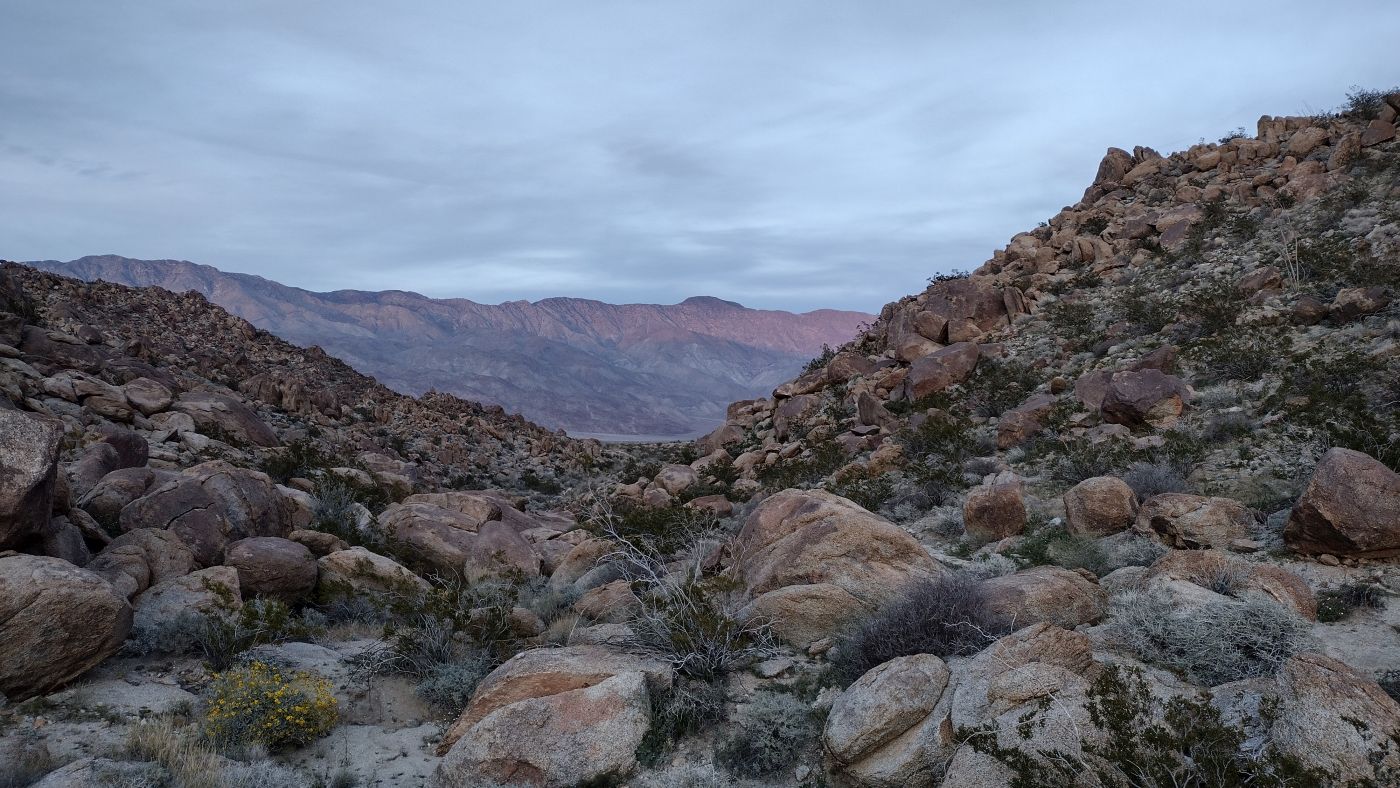
Don
Rideout and I picked this trail to hike to get some good exercise,
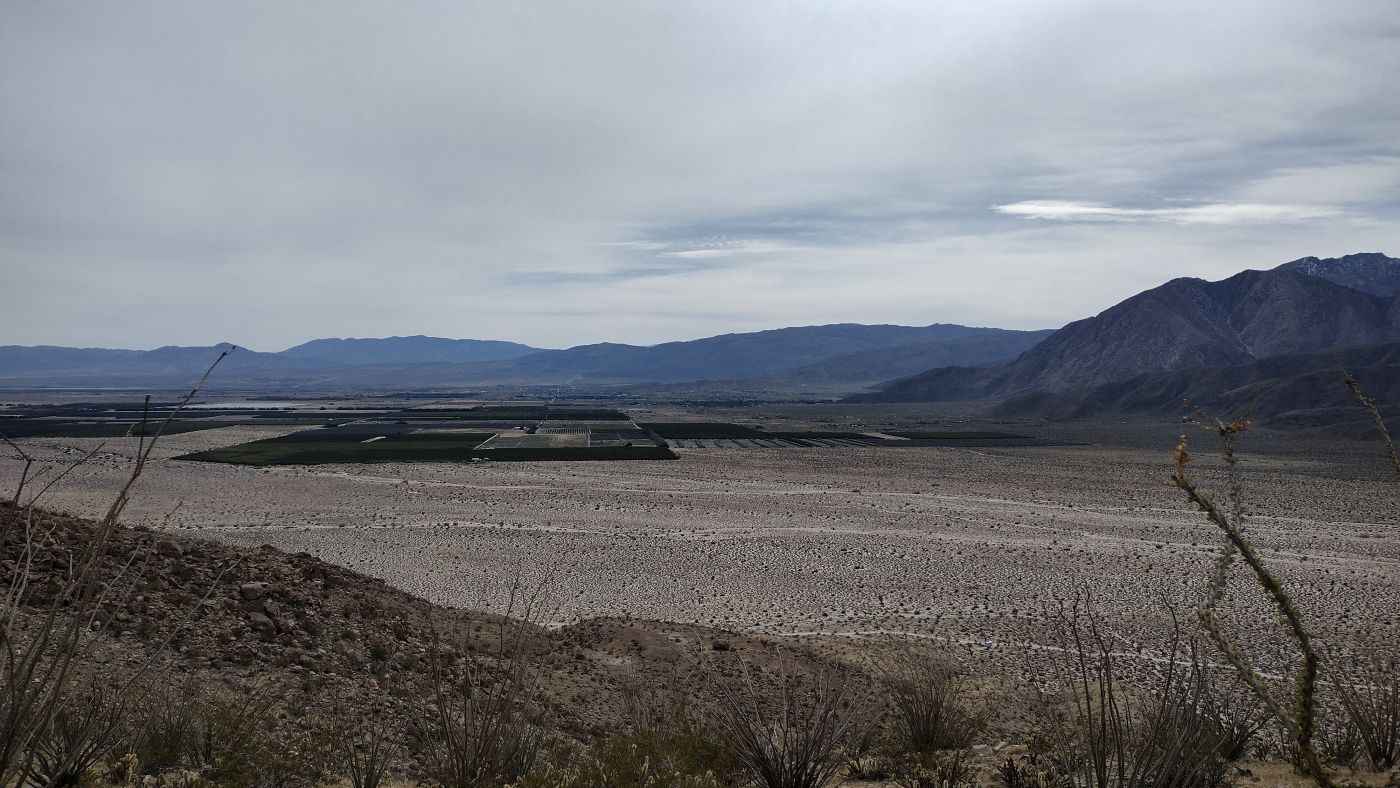
and for Don to see views from this trail into Clark Valley, and where
the trail hits Rockhouse Canyon Road. We've had three trips in
Clark Valley since 1 January, so this hike provided a nice way to put
those trips into the perspective from this trail. I had also
checked iNat, and found that Marley Peifer had posted 34 obs from
this trail on 2/9/23, so I knew there were flowers to be seen there.
The hike did not disappoint. We made it from the
Coyote Canyon Trailhead to Rockhouse Canyon Road and back, getting
back to the car at the last drop of daylight. We enjoyed good
views of Clark Valley, and it gave Don another opportunity to see the
Elephant Trees from another perspective (still from 2.5 miles away,
but with a more "face-on" view to where they live).
We had good flowers essentially all along our route, seeing 64
species in bloom (list appended at end of this email).
The
plant highlight of the day was night-blooming linanthus, L. jonesii,
which was a real delight.
On our hike to Rockhouse Canyon
Road, we were able to find three locations of L. jonesii during
mid-day, even though they only had closed flowers then. Don
said the closed flowers looked like rolled-up newspapers, which is a
good description. It was special to see those plants with open
flowers on our hike back, accompanied by many more from other
locations that we didn't spot until they had open flowers on the way
back.
I was very pleased to relocate the first patch of
plants I previously knew about on the trail, and counted 28 plants in
its small area of just 10 square feet (one square meter) or so.
Looking at my pix, there were additional smaller plants I didn't
count from a standing position.
My post at 1:44 p.m.:
https://www.inaturalist.org/observations/149415120
My post near sunset:
https://www.inaturalist.org/observations/149415123
Don's post at both times of day:
https://www.inaturalist.org/observations/149050737
On the way back, Don and I spotted at least 100
plants with open blooms, all along the trailas we hiked back to the
car in the few hours before sunset!
Here are "before
and after" pix of the plant at the first location I spotted on
the way up to the saddle, on a webpage I put together to show them
side by side:
http://tchester.org/bd/species/polemoniaceae/night_blooming_linanthus.html
I photographed every plant of this species that we
saw on the way back, until the number of plants overwhelmed me.
(:-) That instantly propelled me to being the top observer of
this species at iNat! (:-)
One of the reasons I
took so many pix was in fact because most people never notice this
species, since it is almost invisible until they open their flowers
near sunset.
Don and I posted 36 obs of this species at
iNat:
https://www.inaturalist.org/observations?on=2023-02-17&place_id=95385&taxon_id=77770&user_id=lagoondon,tchester
------------------------
Altogether on
this trip, Don and I posted 106 obs of 42 species:
https://www.inaturalist.org/observations?on=2023-02-17&place_id=95385&subview=table&user_id=lagoondon,tchester&view=species
The link is to the "species view", so you can
more easily see the non-Linanthus jonesii posts. Remember to
click on the "n observations" line at the bottom of each
pix to see our observations, which are not the ones in the pix shown
in this view. Or click on the "observations" tab near
the top to see the individual posts directly.
I posted 64
obs of 26 species. Don posted 42 obs of 30 species.
Details:
On the drive to Borrego, I didn't notice the California
poppies this time on Palomar, perhaps because the flowers were closed
due to cloud cover.
I forgot to mention in the
previous report the large number of Gazanias in bloom along SR76 at
Palomar Mountain between Pauma Valley and Lake Henshaw. I don't
remember seeing this species in bloom here before. The flowers
were mostly closed on this drive due to the cloud cover.
The
surface of Lake Henshaw was very angry, very choppy due to wind-blown
waves.
Both Don and I were surprised to see snow
along the roadside in the Ranchita area. There was no snow
there when Don returned from Borrego on Tuesday morning 2/14/23.
The snow must have come from accumulation on Tuesday night. The
NWS reported 4 inches of snow in Ranchita that night, and it must
have been cold enough there in the next few days for the snow to
persist to Friday. Still, that seems a bit hard to believe the
snow could survive that long, especially since there was one small
patch of snow and/or ice on the road. It is possible that patch
of snow / ice was due to melt and re-freezing of the roadside snow,
since it was in a low spot in the road.
We stopped
at the end of Di Giorgio Road, and Don got introduced to the
small-flowered population of Lupinus arizonicus. (:-) Don's
posts:
small flowers
https://www.inaturalist.org/observations/149013856
large flowers
https://www.inaturalist.org/observations/149014216
I took the time after this trip to write up a
webpage on these plants, something I've been meaning to do since
2010. See:
Small-Flowered Plants of Lupinus arizonicus,
Arizona Lupine
http://tchester.org/bd/species/fabaceae/lupinus_arizonicus_small_flowered_plants.html
The bloom in that area of Coyote Canyon Road was
good, but it certainly wasn't "superbloom" good. (:-)
It was only 60 deg, with a cold breeze, when we
arrived at the Alcoholic Pass Trailhead at noon. I put on a
heavy jacket, over my two sweatshirts, while we briefly looked around
the trailhead area. I reluctantly took it off when we started
hiking, and warmed up a bit going up the steep trail. But
throughout the entire day I was never warm enough to take off any of
my sweatshirts. I was saved from freezing to death on the way
back since we were hiking rapidly uphill back to Alcoholic Pass, and
it was only 0.9 miles to the car from that point.
Once
the Trail leaves the wash at the start, it starts quickly climbing
toward a saddle on the ridgetop of Coyote Mountain. Don took
these pix shortly after we achieved some pretty good elevation in a
short time:
View of Borrego Valley:
http://tchester.org/temp/230217/rideout/view_borrego_valley_from_trail_35.jpg
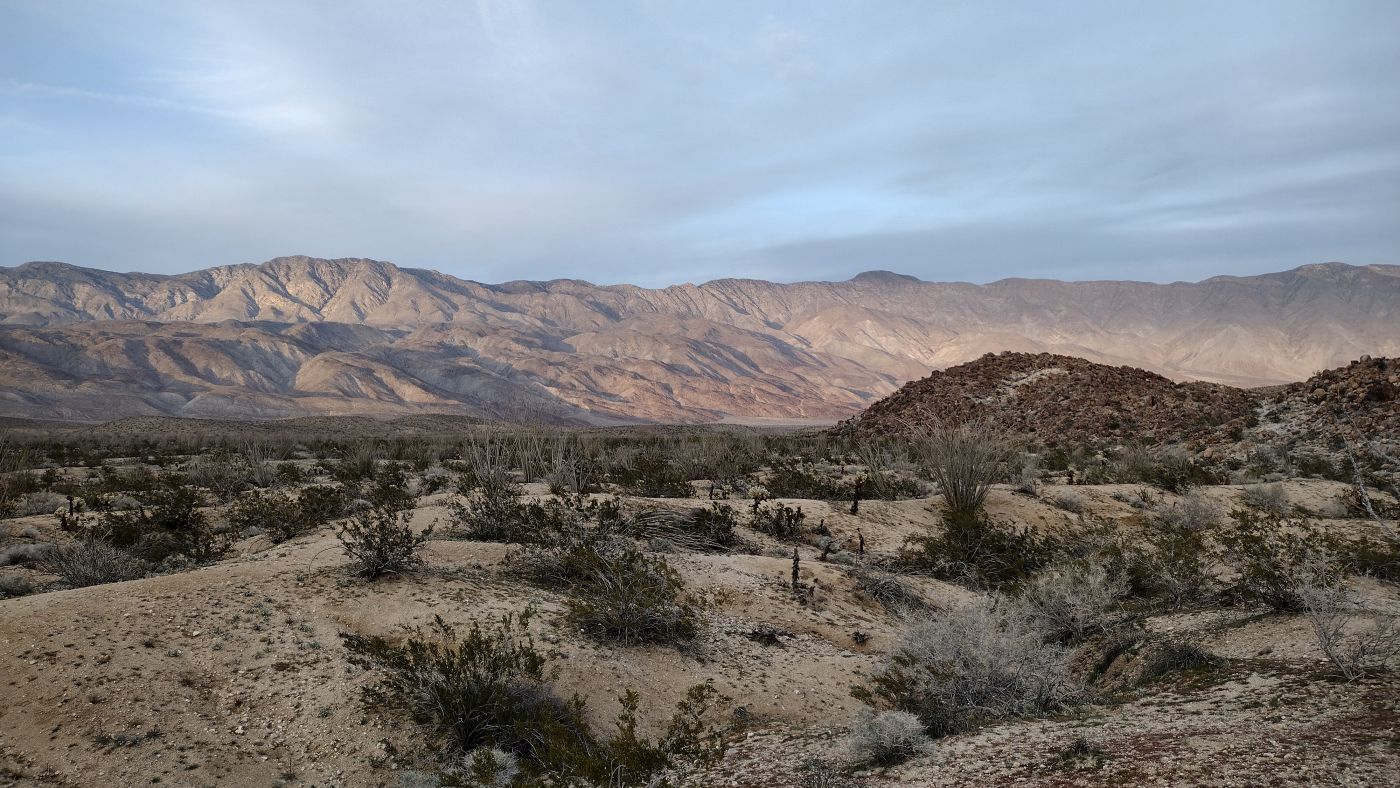
View of Coyote Creek area:
http://tchester.org/temp/230217/rideout/view_coyote_creek_area_from_trail_35.jpg
On our way back to the car, he took this same view of the
Coyote Creek area in the facing light:
http://tchester.org/temp/230217/rideout/view_coyote_creek_area_from_trail_past_sunset_35.jpg
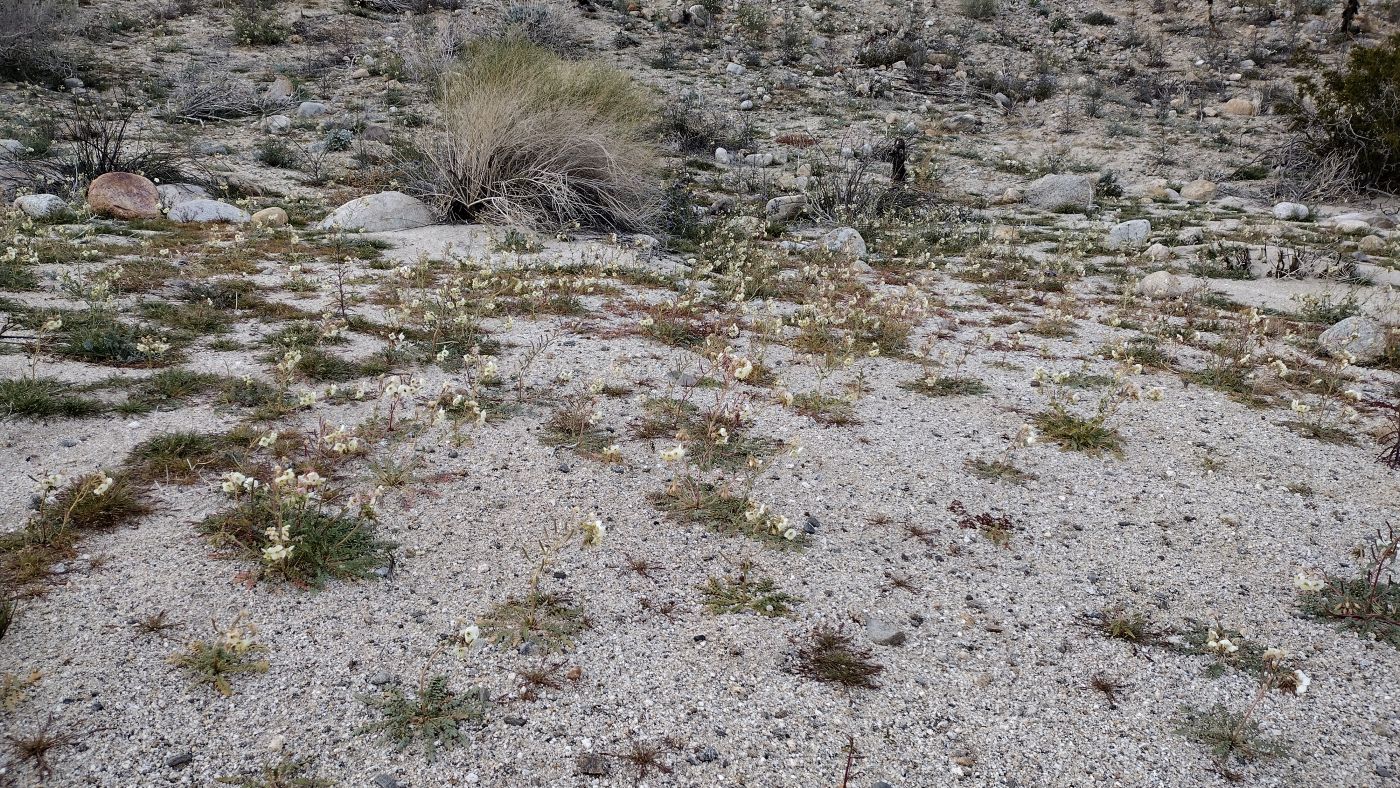
We were very pleased to find that there were good
flowers all along the trail, especially in the flattish places and in
the washes. On the way back, we took a different route out of
the wash, which had few plants in blooms. So we pretty quickly
got back into a good wash.
The flattish part at the
top of the trail was a highlight. That area had some very nice
plants of Langloisia, showing different colors of bloom, and
Monoptilon.
Don's posts of Langloisia:
https://www.inaturalist.org/observations/149017172
https://www.inaturalist.org/observations/149020376
My posts of Monoptilon:
https://www.inaturalist.org/observations/149263534
https://www.inaturalist.org/observations/149262551
Don's post of Monoptilon:
https://www.inaturalist.org/observations/149020123
We saw baby chollas that had to be C. ganderi:
Don's post:
https://www.inaturalist.org/observations/149016983
My post:
https://www.inaturalist.org/observations/149259329
On the hike down to Rockhouse Canyon Road, we
spotted the highest-elevation-in-this-area Mimulus bigelovii. The
plants of this species started out in small numbers, but eventually
became more abundant.
My post:
https://www.inaturalist.org/observations/149271459
Don's post:
https://www.inaturalist.org/observations/149088619
We found no Nama at all.
At the
turn-around point for our hike, Don took this pix looking east from
Rockhouse Canyon Road, looking directly at Villager Peak and the
Elephant Trees on the almost bare slopes at the base of the rocky
part of the SnRsMtns, with Lute Ridge and Clark Dry Lake at middle
right:
http://tchester.org/temp/230217/rideout/view_east_from_rockhouse_canyon_road_35.jpg
Eulobus californica was everywhere in the washes.
This was a very good year for it here.
My post:
https://www.inaturalist.org/observations/149292266
Chylismia claviformis was also very abundant,
forming pretty fields of bloom near sunset. The shoes of both
Don and I had the usual accumulation of its pollen, even though we
never stepped on any plants.
Don's lovely pix of one
patch:
http://tchester.org/temp/230217/rideout/field_chylismia_claviformis_in_bloom_near_sunset_35.jpg
My posts:
Field in bloom near sunset:
https://www.inaturalist.org/observations/149291903
Pollen on shoes:
https://www.inaturalist.org/observations/149291904
As were hiking back to Alcoholic Pass, Don
fortunately looked back and took these pix of the evening light on
the Santa Rosa Mountains:
Toro Peak at left; Rabbit Peak
at right:
http://tchester.org/temp/230217/rideout/light_on_SnRsMtns_1_35.jpg
Closer view:
http://tchester.org/temp/230217/rideout/light_on_SnRsMtns_2_35.jpg
At the Saddle, the canyon points right at Rabbit
Peak, with the pink light of sunset on it:
http://tchester.org/temp/230217/rideout/view_rabbit_peak_from_saddle_35.jpg
List of species in bloom on our hike:
#Pls
in bloom Name
99
Achyronychia cooperi
99 Allionia incarnata
var. incarnata
99 Brassica tournefortii
99 Chylismia claviformis ssp. peirsonii
99 Cryptantha angustifolia
99
Emmenanthe penduliflora var. penduliflora
99
Eschscholzia minutiflora ssp. minutiflora
99
Eschscholzia parishii
99 Eulobus californicus
99 Gilia stellata
99
Hyptis emoryi
99 Linanthus jonesii
99
Mimulus bigelovii var. bigelovii
99 Perityle
emoryi
99 Phacelia distans
99
Plantago ovata
99 Schismus barbatus
50
Lepidium lasiocarpum ssp. lasiocarpum
40
Chaenactis fremontii
40 Phacelia crenulata
var. minutiflora
30 Aristida
adscensionis
30 Eremothera boothii ssp.
condensata
30 Senecio mohavensis
25
Encelia farinosa var. farinosa
25 Fagonia
laevis
25 Lupinus arizonicus
20
Caulanthus lasiophyllus
20 Cryptantha
barbigera var. barbigera
20 Cryptantha
maritima
20 Descurainia pinnata
20
Erodium cicutarium
20 Justicia californica
10 Ditaxis lanceolata
10
Eriogonum thomasii
10 Langloisia setosissima
ssp. setosissima
10 Larrea tridentata
10
Loeseliastrum matthewsii
10 Logfia depressa
10 Monoptilon bellioides
5
Bebbia juncea var. aspera
5 Cryptantha
decipiens
5 Draba cuneifolia
5
Pectocarya recurvata
5 Physalis crassifolia
4 Trixis californica var. californica
2 Euphorbia eriantha
2
Malacothrix glabrata
2 Psorothamnus schottii
2 Rafinesquia neomexicana
2
Salvia columbariae
2 Trichoptilium incisum
1 Abronia villosa var. villosa
1
Acmispon maritimus
1 Camissoniopsis pallida
ssp. pallida
1 Chaenactis carphoclinia var.
carphoclinia
1 Cryptantha cycloptera
1
Dalea mollissima
1 Eriogonum inflatum
1
Erodium texanum
1 Fouquieria splendens ssp.
splendens
1 Geraea canescens
1
Mentzelia involucrata
1 Mirabilis laevis var.
retrorsa
1 Nicotiana obtusifolia
1
Simmondsia chinensis
--
tom
chester