Our
main purpose in returning to Henderson Canyon a month after our 7
January 23 hike there was for Don to photograph Phacelia campanularia
in bloom and post it at iNat, since it was one of the few showy
species he had never posted at iNat. We knew there would be at
least two plants of this species in bloom thanks to Fred and Carla,
and Mark Stevens, posting recent pix of those plants.
I
love Phacelia campanularia, so I was looking forward to seeing it in
bloom, too.
Our trip was very successful for that
species. Don photographed 32 (!!) plants of P. campanularia, of
which at least eight were in bloom. What a lovely flower!
We saw no P. minor at all, so it was highly likely that the
non-blooming plants were all P. campanularia.
Don posted
his 32 P. campanularia plants in ten iNat observations, combining
plants that were near each other:
https://www.inaturalist.org/observations?on=2023-02-12&place_id=95385&taxon_id=50171&user_id=lagoondon
It was also very interesting what had changed in
one month, and what had not:
- Several
Phacelia campanularia went from being just rosettes, with no sign of
producing an infl yet, to being on their last flowers! Some of
the plants set fruit; some did not.
- There
were only a few Emmenanthe plants seen a month ago, as young rosettes
and one just-starting-to-bloom plant, compared to dozens of plants
now, with ten or so blooming.
- Mimulus
(=Diplacus) bigelovii increased by a factor of 10 to 100.
- Ambrosia salsola went from a single plant with its first blooms, to
dozens of plants beginning to fruit.
-
Datura discolor had almost no blooms a month ago, but on this trip
had a revival of bloom, with the young plants we had seen on the last
trip now blooming.
- Abronia, Malacothrix,
Rafi, frostmat were still blooming.
On 1/7/23, we found
51 species in bloom. On this trip we found 68 species in bloom.
The
list of plants in bloom is attached at the end of this email.
Don
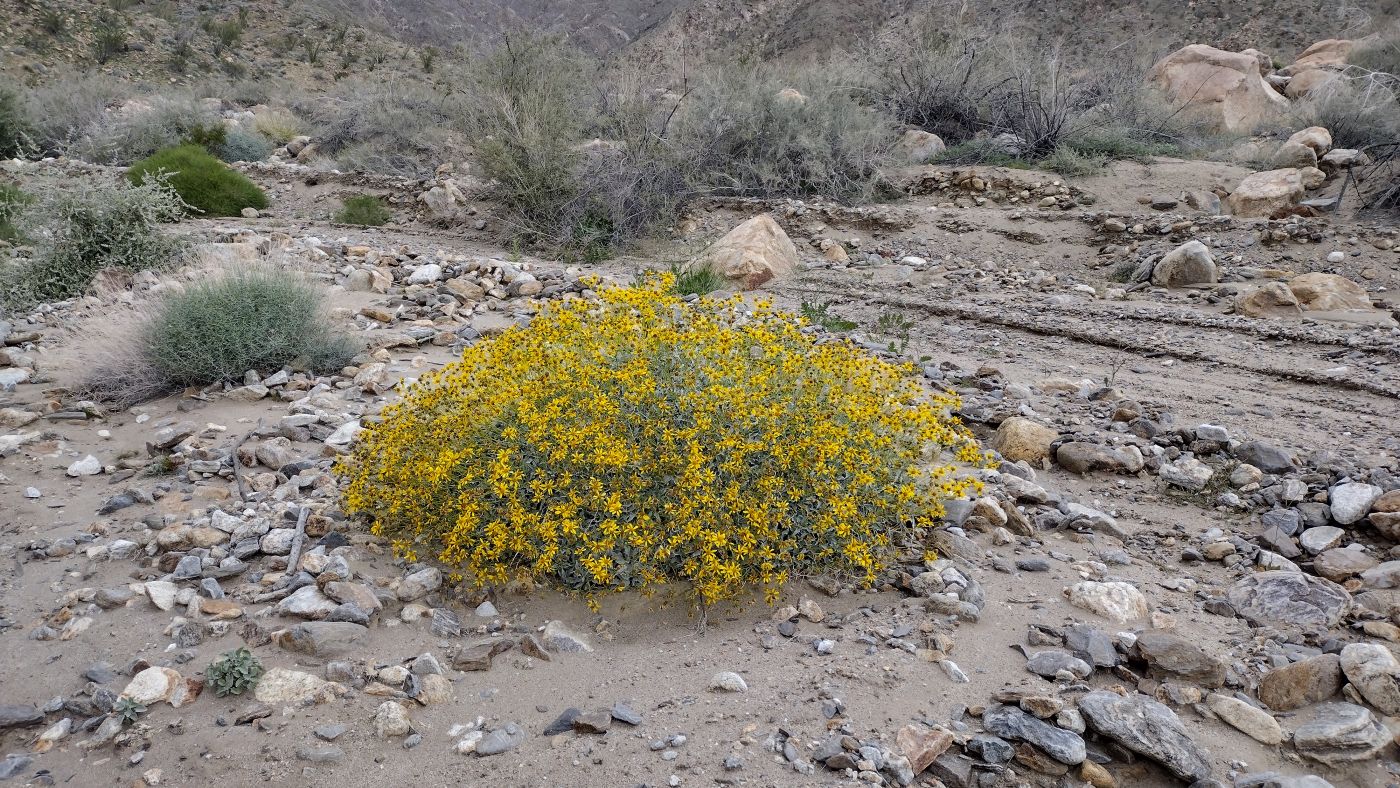
took this pix of an Encelia that was loaded with blooms on this trip:
http://tchester.org/temp/230212/rideout/gorgeous_encelia_35.jpg
Our other goal on this trip was to get as far into
the upper canyon as we could, and post more observations from that
area. Before our trip, there were just 27 iNat obs from the southwest
branch of the upper canyon. We added 38 new obs, more than
doubling the number of obs from that area.
Don and
I posted 101 obs of 71 species from our trip. This link is the
"species view" of our posts; click on the "n
observations" at the bottom of each pix to go to our obs.
Or click on the "observations" tab to see each individual
post directly.
https://www.inaturalist.org/observations?on=2023-02-12&place_id=95385&user_id=lagoondon,tchester&view=species
Don posted 65 obs of 46 species. I posted 36 obs of
27 species, mostly trying to post only species that Don did not post.
Details:
The California poppies were
still blooming on the south slope of Palomar Mountain near Pauma
Valley.
The ocotillos are now mostly leafed out
again on the Montezuma Grade, and the Perityle is looking better as
well.
I stopped at Don's yard to see his young
plants of Eriogonum trichopes, and nab some flowers to check on the
number of invol lobes, which was four, confirming that id.
Don
had previously posted a number of observations of E. trichopes and
first-year E. inflatum from his yard, so I thought it would be
interesting to put pix of leaves from those plants on my webpage for
those two species. See Fig. 5, the bottom figure here:
http://tchester.org/bd/species/polygonaceae/eriogonum_inflatum_and_trichopes.html
As a bonus, I got to see a number of Erodium
texanum in his yard that had actual blooms with five good petals!
The first two miles of our hike contained only
Eschscholzia minutiflora, and no E. parishii. I noticed that
one of the plants had largish petals, and I measured it having 7 to
11 mm petals, beating out the 10 mm petal length I had previously
seen as the largest E.m. petal. Don's post:
https://www.inaturalist.org/observations/148673236
E. parishii was only seen later, with clearly-larger
petals.
I spotted a single Abronia villosa plant
well into Henderson Canyon. We had never seen any Abronia in
Henderson Canyon proper before. My pix:
https://www.inaturalist.org/observations/148852742
We checked for germination on the Phacelia
rotundifolia cliff, but the fresh germination we saw looks like
Perityle:
https://www.inaturalist.org/observations/148852191
There was recently-pulled mustard all along our
route! Don speculated it was the Park volunteers who did that
the day before our hike. It was heartening to see so much
pulled mustard. This canyon needed that work, and more, since
mustard was everywhere. (:-(
We made it about 0.7
miles into the southwestern upper arm of Henderson Canyon, above the
Crossosoma near where the two upper arms merge.
That
upper branch was very different from what I remembered from 2009.
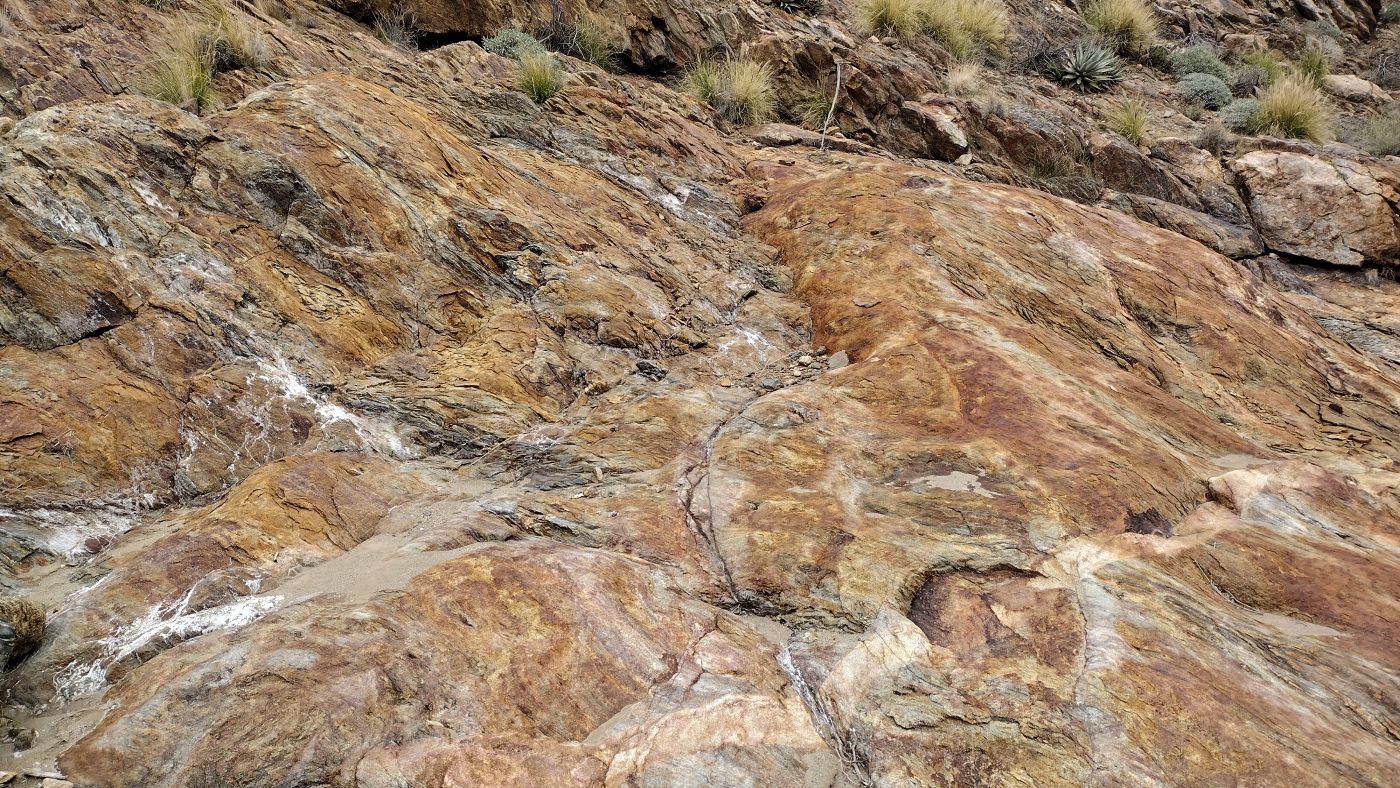
There were about ten waterfalls that we had to scramble over, from
three to eight feet tall, that I hadn't remembered. Some of
those waterfall areas were drop-dead gorgeous. Here's one we
called "Rainbow Rock"; Don's pix:
http://tchester.org/temp/230212/rideout/rainbow_rock_35.jpg
The canyon bottom had been scoured by some recent
flooding event, so it was much rockier now than the sandy bottom I
remembered from 2009.
A year ago, we had turned around
after leaving the dramatic rock gorge area near the start of this
branch, due to it being mostly a non-native annual grass weedpit.
Those grasses were hardly noticeable on this trip, but instead, there
were tons of fountain grass and Sahara mustard, far more than I
remembered from 2009 (but that might be because I mostly ignored it
then).
As an example of how bad the fountain grass was, I
took some pano shots near our turnaround point, for the view, but it
was so filled with fountain grass that I posted those shots at iNat
under fountain grass! (:-( See:
https://www.inaturalist.org/observations/148872586
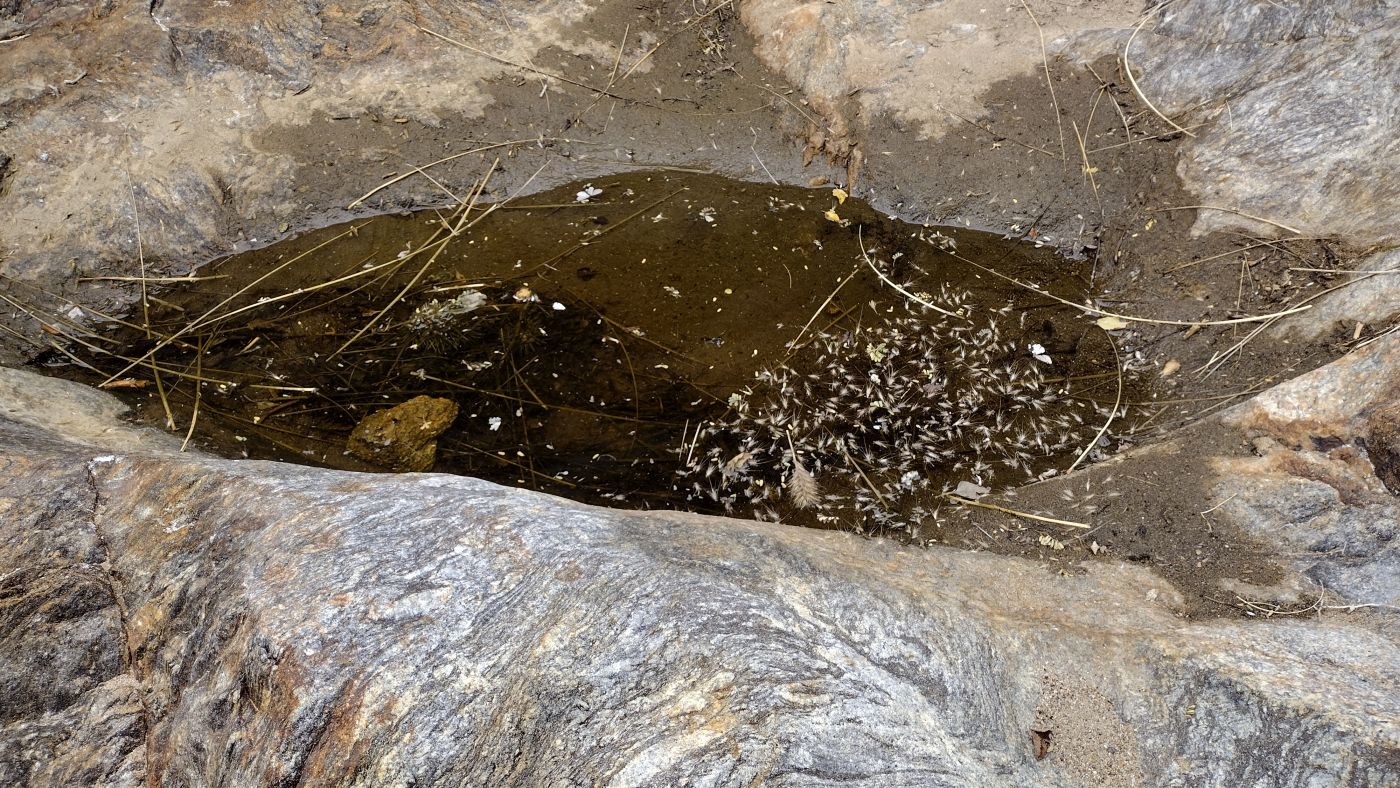
Also, we found a few puddles of water in the rocks.
Don took a pix of one puddle, and it was filled with seeds of
fountain grass:
http://tchester.org/temp/230212/rideout/puddle_with_pennisetum_seeds_35.jpg
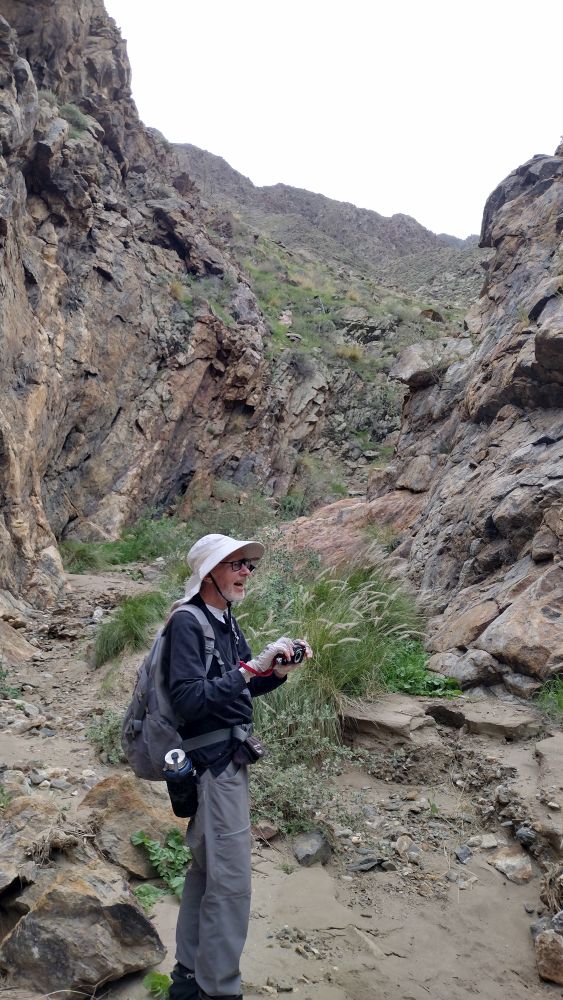
Don took this pix of me taking my pano shots, and somehow
managed to only get a few fountain grass plants in his pix:
http://tchester.org/temp/230212/rideout/tom_at_side_canyon_turnaround_25.jpg
In 2009, I had found a Condea (Hyptis) with 3
leaves per node in this branch, so I was looking for it on this
trip. It was still here! My posts:
2023
https://www.inaturalist.org/observations/148871258
2009
https://www.inaturalist.org/observations/146359293
I don't know for sure this is the same plant, but it
seems highly likely.
We were looking for
Myriopteris (=Cheilanthes) viscida on the way up this upper branch,
since I had found two locations of it in 2009. I didn't bring
GPS points for it, since I figured we would surely find it by just
looking around. I was stunned, though, that we didn't find any
on the way up, despite looking pretty hard for it in likely
locations.
We continued to look for it on the way back
down, and I finally spotted it at one location. Don's post:
https://www.inaturalist.org/observations/148785012
It sprinkled on us at our turn-around point, and
periodically as we hiked the four miles out. It was windy, too,
but mostly the wind was at our backs, so it wasn't as bad.
Don
took this pix shortly after we turned around, showing the beautiful
canyon walls, with the rain clouds above:
http://tchester.org/temp/230212/rideout/tom_descending_upper_canyon_25.jpg
Later, Don took this pix of the rain clouds, and
rain, as we were exiting the canyon proper:
http://tchester.org/temp/230212/rideout/rain_and_dark_clouds_over_borrego_50.jpg
As might have been anticipated from this pix, it
started raining pretty steadily for the last half mile to the car.
Fortunately, I estimated we only got 0.01 to 0.02" on us.
On
my drive home, there was a steady rain going up the Montezuma Grade,
when all of a sudden it turned to snow! The snowflakes were
streaming toward my windshield like I was entering warp speed on Star
Trek!
Fortunately, there was no accumulation on ground.
The air temp was 34 deg, and the ground temp was undoubtedly much
warmer.
It rained all the way to Pala, but was dry from
then on. A lot of road dust got washed off my car from that rain.
(:-)
I looked at the radar map when I got home, and
was surprised to see that there was yellow and red on the radar map
for southwest San Diego County. Flinn Springs was the big
winner at 1.39"!
List of species in bloom:
#Pls in bloom Name
99 Abronia villosa var. villosa
99 Aristida adscensionis
99 Brassica tournefortii
99 Camissoniopsis pallida ssp. pallida
99 Chaenactis fremontii
99 Chamaesyce polycarpa
99 Chylismia claviformis ssp. peirsonii
99 Cryptantha angustifolia
99 Cryptantha micrantha var. micrantha
99 Eschscholzia minutiflora ssp. minutiflora
99 Eulobus californicus
99 Hyptis emoryi
99 Malacothrix glabrata
99 Mimulus bigelovii var. bigelovii
99 Parietaria hespera var. hespera
99 Perityle emoryi
99 Phacelia distans
99 Schismus barbatus
50 Justicia californica
40 Logfia depressa
25 Nama demissa var. demissa
20 Acmispon maritimus var. brevivexillus
20 Chamaesyce arizonica
20 Dithyrea californica
20 Physalis crassifolia
15 Emmenanthe penduliflora var. penduliflora
15 Pholistoma membranaceum
10 Allionia incarnata var. incarnata
10 Amsinckia intermedia
10 Datura discolor
10 Pectocarya recurvata
5 Ambrosia salsola var. salsola
5 Bebbia juncea var. aspera
5 Calyptridium monandrum
5 Cryptantha barbigera var. barbigera
5 Cryptantha maritima
5 Descurainia pinnata
5 Ditaxis lanceolata
5 Encelia farinosa
5 Erodium texanum
5 Eschscholzia parishii
5 Fagonia laevis
5 Lupinus concinnus
5 Mirabilis laevis var. retrorsa
5 Phacelia campanularia ssp. campanularia
5 Rafinesquia neomexicana
5 Salvia columbariae
3 Acmispon strigosus
3 Crossosoma bigelovii
3 Mammillaria dioica
3 Trichoptilium incisum
2 Acmispon rigidus
2 Bahiopsis parishii
2 Eriogonum fasciculatum var. polifolium
2 Eucrypta chrysanthemifolia var. bipinnatifida
2 Gilia stellata
2 Lepidium lasiocarpum ssp. lasiocarpum
1 Adenophyllum porophylloides
1 Cryptantha decipiens
1 Eriogonum inflatum
1 Erodium cicutarium
1 Lupinus arizonicus
1 Nicotiana obtusifolia
1 Pectocarya platycarpa
1 Phacelia cicutaria var. hispida
1 Pleurocoronis pluriseta
1 Psorothamnus schottii
1 Trixis californica var. californica
--
tom
chester