Don
Rideout and I had a fabulous time botanizing the Rockhouse Canyon
Road area on Saturday 2/4/23.
Our main goal was to see
the "monster desert lily", aka "Lilyzilla", that
was posted on Facebook by Paulette Donnellon:
https://www.facebook.com/search/top?q=paulette%20donnellon%20monster%20desert%20lily
Paulette kindly sent a GPS point to Don, so that was our
first order of business when we parked the car at the junction of
Rockhouse Canyon Road and Butler Canyon.
We were STUNNED
when we got to her GPS point; there were HUNDREDS of lilies in bloom
there! I've never seen anything like this display.
Don
has three pix of the "field of lilies" in this post; be
sure to clickat least once on each pix (after selecting each of the
three pix in turn) to see a larger photo (clicking twice presents it
in full resolution):
https://www.inaturalist.org/observations/148080218
Unfortunately, her monster lily was not at the GPS
point she sent. This was the biggest inflorescence we found
near her point:
https://www.inaturalist.org/observations/148079632
In the field, we thought this was her lily, but alas, it
doesn't match her pix, since there is no carpet of frost mat below
it.
Oh, well, this is still a darn good desert lily.
(:-)
Btw, Paulette calls this the "Valley of
the Desert Lilies", which is a great name:
https://www.facebook.com/profile.php?id=100064514180423
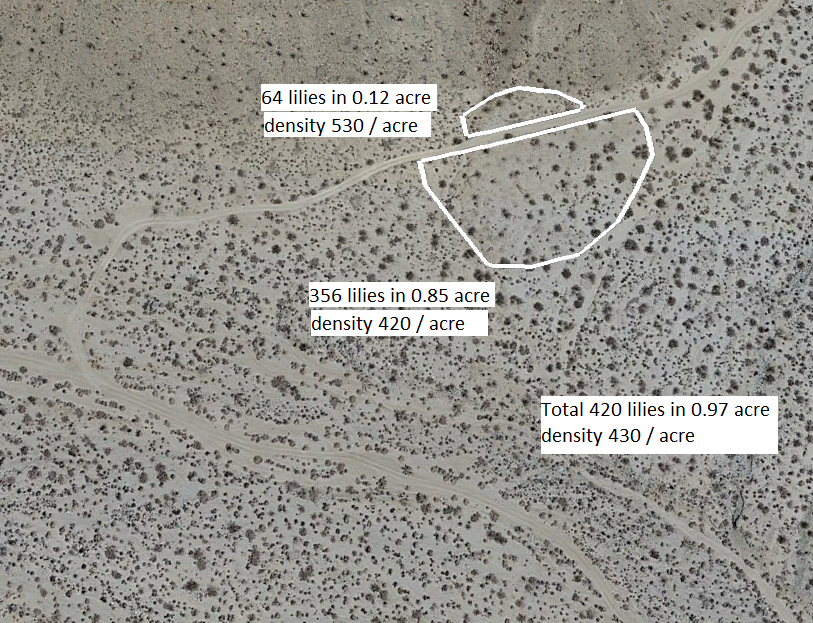
We took the time to count the lilies here, and
measure the area. We counted a total of 420 lilies (!!!!) in an
area of just under 1 acre, giving a density of 430 per acre.
See:
http://tchester.org/temp/230204/hesperocallis/desert_lily_area_label.PNG
As far as we know, this is the record desert lily field,
slightly more dense than the lilies in Don's yard.
The
density might be somewhat higher in the larger area of the two in
this spot, since I used my GPS points from our wandering around to
define it, and it turned out to be larger than what I had stepped
off. I.e., some of those GPS points may have been slightly
outside the desert lily area.
Amazingly, in our 5
mile hike, we saw not a single other desert lily. But we did
see 68 species in bloom. The list of blooming plants is at the
end of this email.
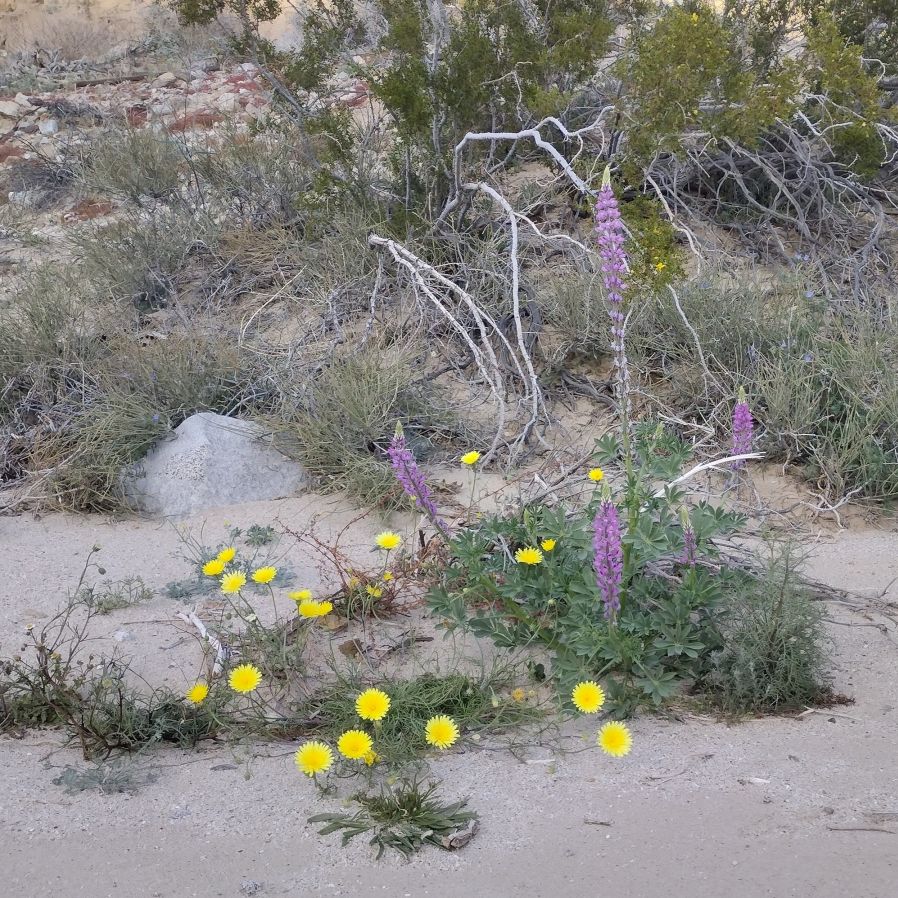
Don took this pix of some nice flowers
at one point:
http://tchester.org/temp/230204/rideout/flower_display_45.jpg
By far the best plants we saw in bloom were two
plants of night-blooming Linanthus, both spotted by Don on our hike
back to the car. The first had partly-open flowers; the second
had fully-open flowers. They both had a faint smell that was
hard to describe; "spicy" is the closest word Don came up
with. Don's posts:
https://www.inaturalist.org/observations/148159825
https://www.inaturalist.org/observations/148160486
Don posted 75 obs of 61 species from our drive
along Rockhouse Canyon Road and our hike:
https://www.inaturalist.org/observations?on=2023-02-04&place_id=95385&user_id=lagoondon
Details:
On my drive to Borrego
Springs, I was very surprised to see hillsides of orange from
California poppies in bloom on the southern slopes of Palomar
Mountain near Pauma Valley!
I forgot to mention in
the last botreport that some agency had mowed the dense stands of
Brassica tournefortii (and everything else) on the roadside from
someplace past the Ranchita park entrance to the Culp Valley
Campground. That was good work, really cutting down the number
of seeds from this weed, since those plants (from the September rain)
essentially were confined to the roadside. On this trip, they
had mowed a bit farther past the campground entrance.
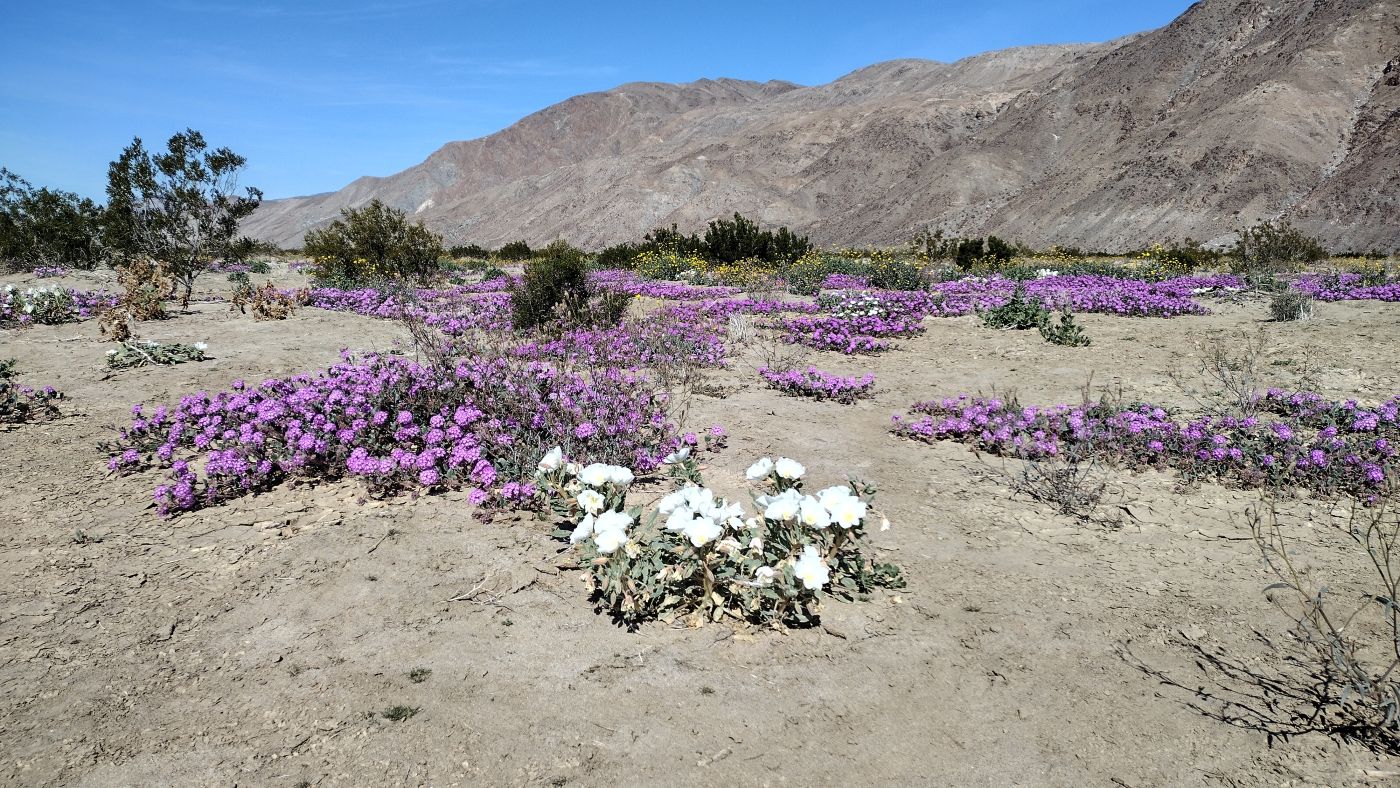
We
stopped at Henderson Canyon Road since the Abronia villosa patch
there was simply stunning. Don's pix:
http://tchester.org/temp/230204/rideout/abronia_field_35.jpg
Clark Valley was very dry, with essentially nothing
in bloom, until we got to the sandy area near the wash that comes
from the saddle where the Alcoholic Pass Trail ends.
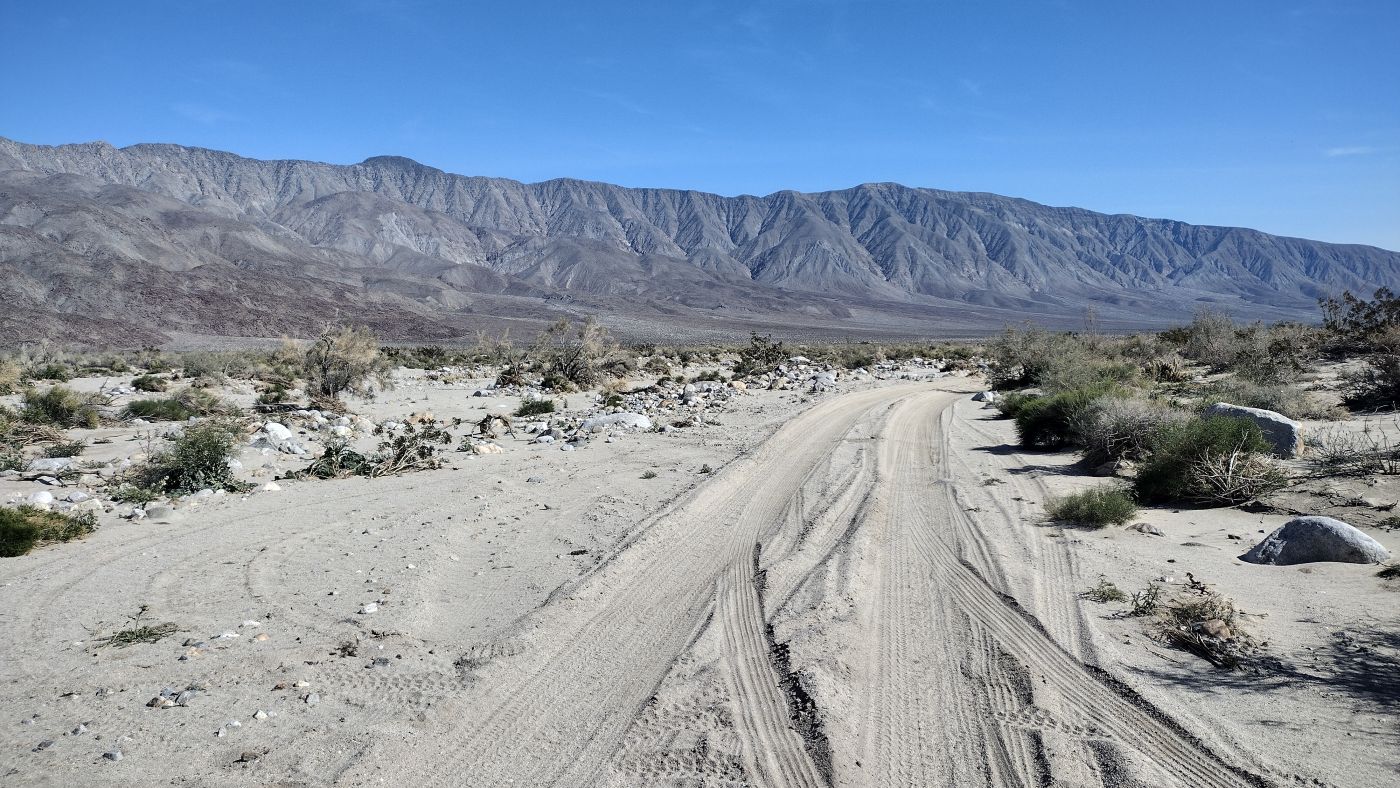
Don
took this pix looking east, back into the drier area, at our first
stop where there were plants in bloom:
http://tchester.org/temp/230204/rideout/rockhouse_canyon_road_1213_35.jpg
We had a bit of excitement at that stop, since we
saw plants that were clearly Eschscholzia minutiflora, with petal
lengths of 6 to 8 mm; plants that were clearly E. parishii, with
petal lengths of 25 mm; and one plant with petal lengths of 8 to 10
mm. I've only seen a single plant with 10 mm petals before; E.
minutiflora seems to have a hard cutoff of 8.0 mm for its longest
petal lengths. So it was tempting to call this a hybrid between
the two species.
Alas, apparently our two species can't
easily hybridize, since they have different chromosome numbers.
Instead, apparently E. minutiflora just very rarely has petals of 10
mm.
See the discussion in Don's post:
https://www.inaturalist.org/observations/148074033
It was 71 deg at the start of our hike just before
1:00 p.m., and 55 deg at the end, just after sunset.
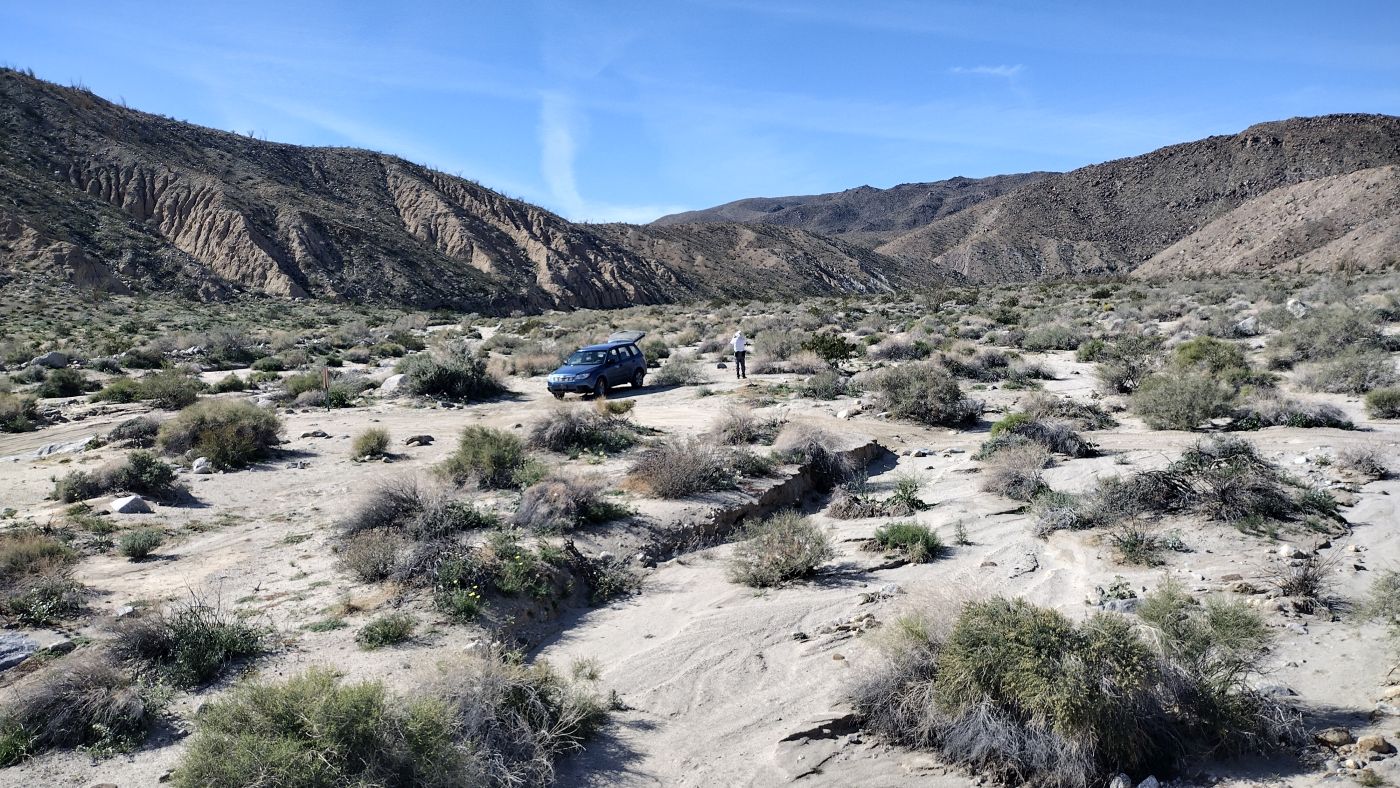
Don
took this pix of where we parked, looking west into Butler Canyon:
http://tchester.org/temp/230204/rideout/parking_area_35.jpg
We measured two more young ocotillos, one of which
was the oldest we've measured so far, an estimated 15 years old, with
the other being six years old. See the plots in Figs. 2 and 3
here:
http://tchester.org/bd/species/fouquieriaceae/recruitment.html
Don's posts:
6 year old
https://www.inaturalist.org/observations/148156912
15 years old
https://www.inaturalist.org/observations/148139254
It also appears this one is growing a new stem segment,
the first new growth we've seen after their summer growth this year.
We mostly hiked up the Rockhouse Canyon Road area,
generally staying next to the hills to the west. Don took this
pix at 2:13 p.m. of me just off the road:
http://tchester.org/temp/230204/rideout/1413_35.jpg
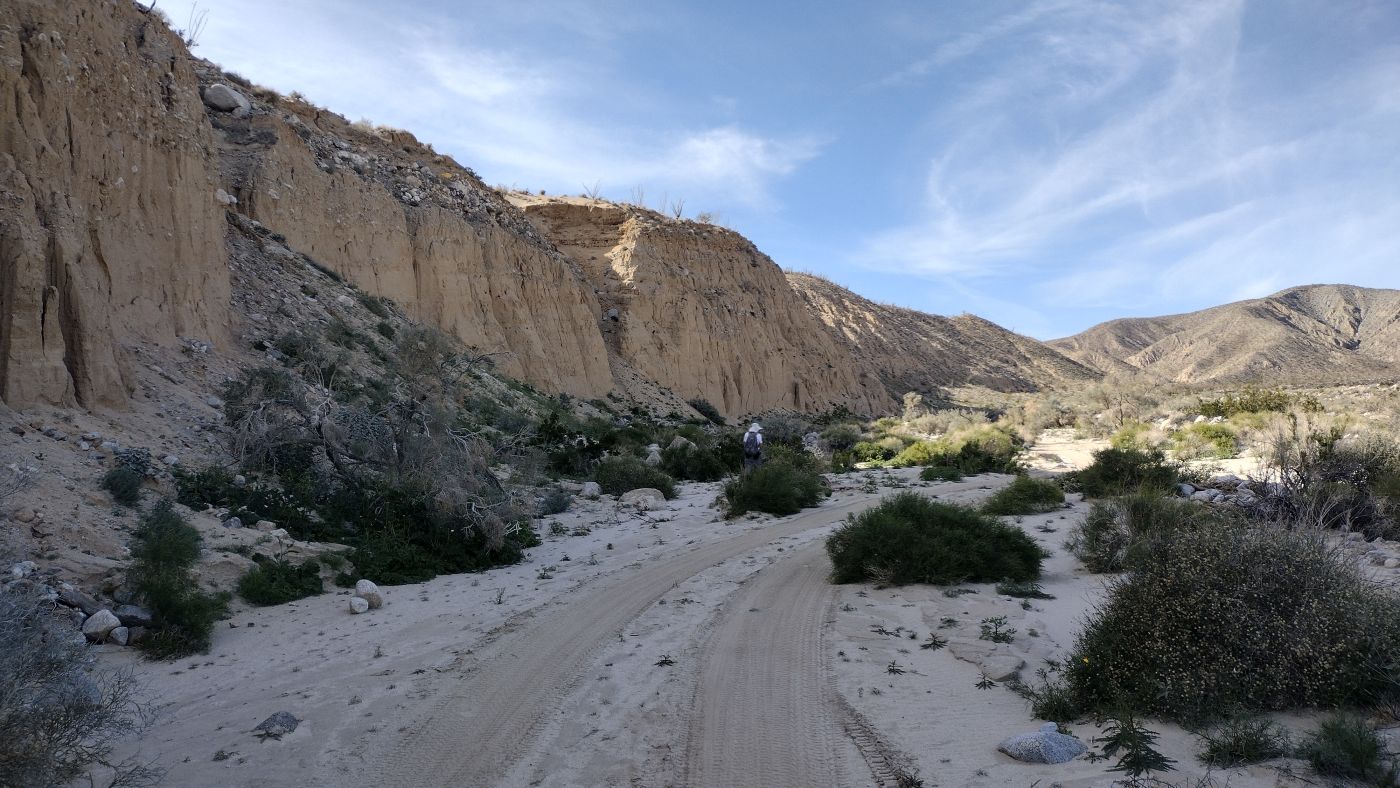
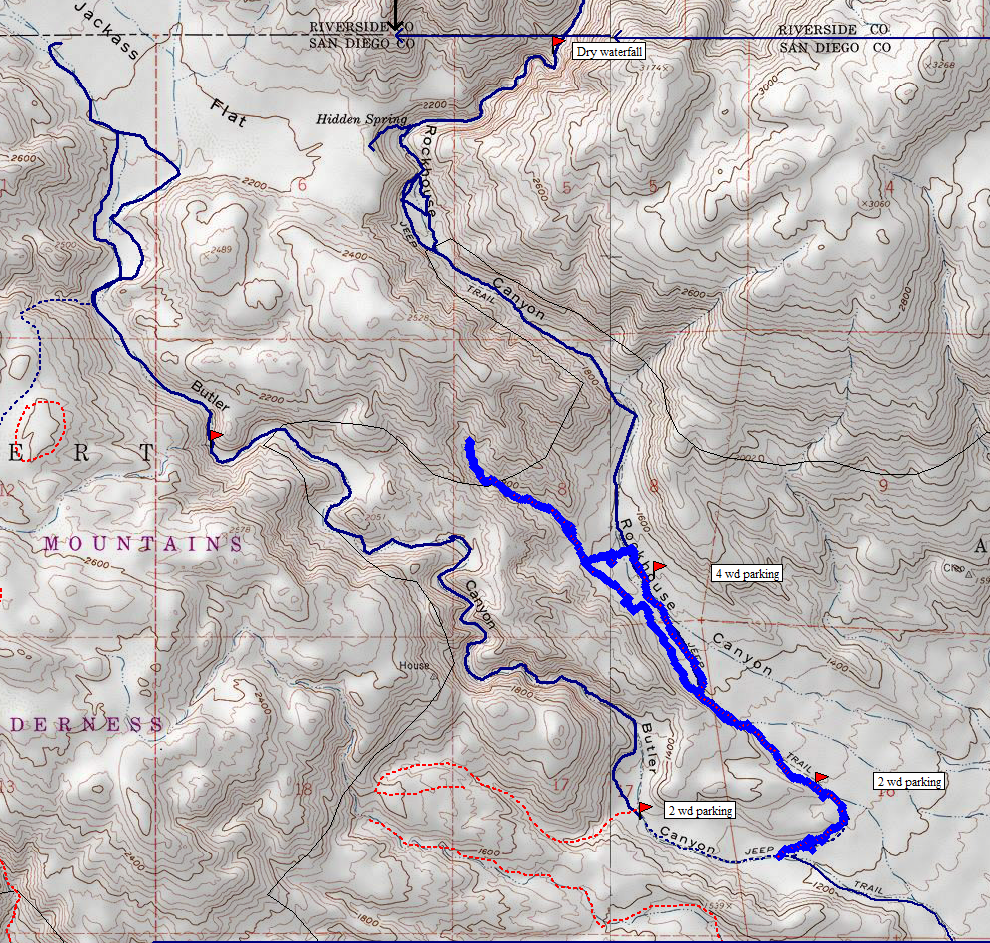
Although we were aiming for Rockhouse Canyon
itself, we ended up in a tributary canyon that was halfway in between
Butler Canyon and Rockhouse Canyon. We were following the dirt
road there, and I didn't know there was a branch off Rockhouse Canyon
Road that led to this small canyon. But that worked out even
better, since there were only a few previous iNat obs from this
little canyon. See the map here for our route:
http://tchester.org/temp/230204/route_230204.PNG
Here's Don's pix as we approached the small canyon:
http://tchester.org/temp/230204/rideout/not_rockhouse_canyon_35.jpg
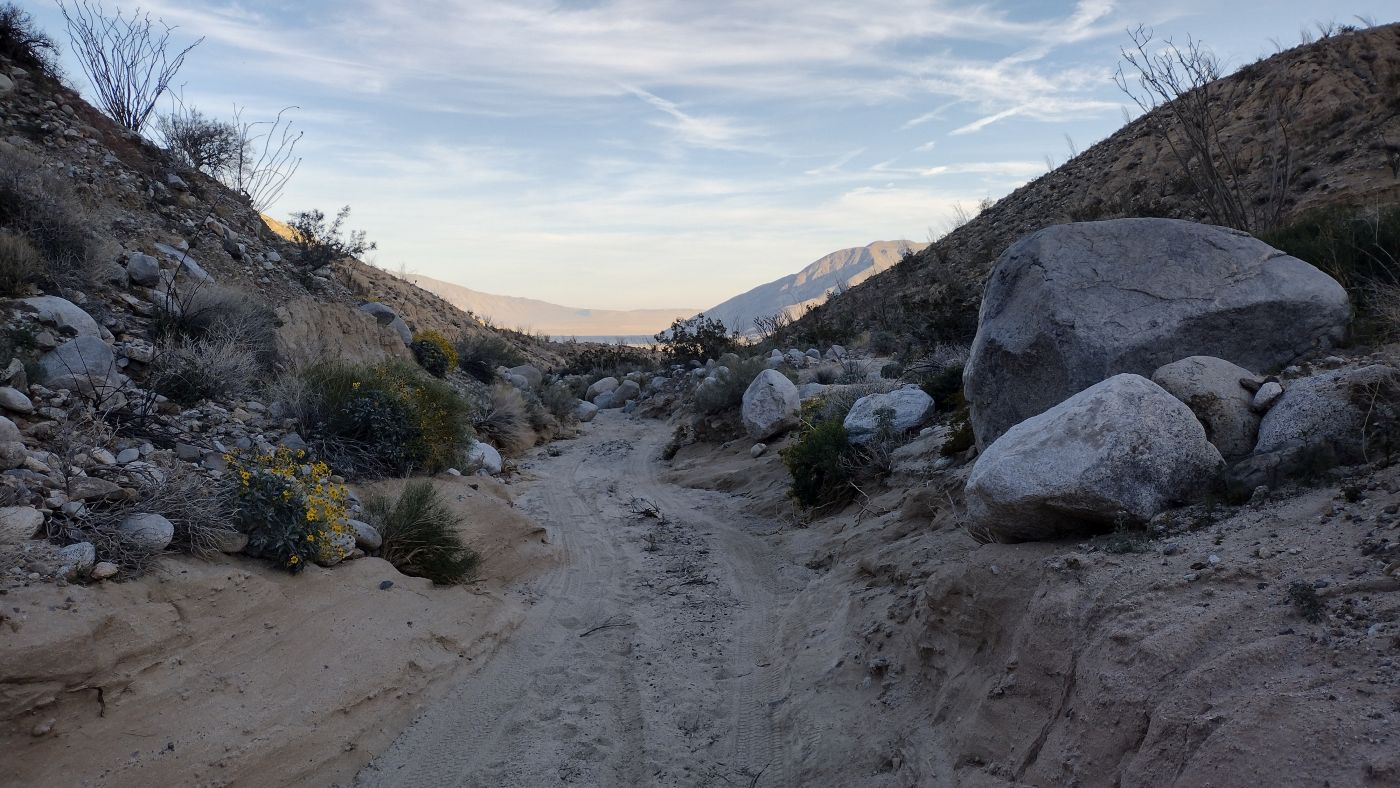
and Don's pix when we were hiking back down that canyon:
http://tchester.org/temp/230204/rideout/coming_back_small_canyon_35.jpg
We weren't anywhere near as far from our intended
destination as were the people in two monster trucks that passed us
on the road. They had intended to go to "that place with
water flowing in it" (Coyote Canyon)! (:-)
Don's
pix of the monster vehicles:
http://tchester.org/temp/230204/rideout/the_monster_vehicles_35.jpg
As we were hiking back a half hour or so before
sunset, I suddenly noticed an incredibly-strong beautiful smell,
similar to the fragrance of blooming Phoradendron californicum.
It turned out to be Eremothera boothii!!!
https://www.inaturalist.org/observations/148158888
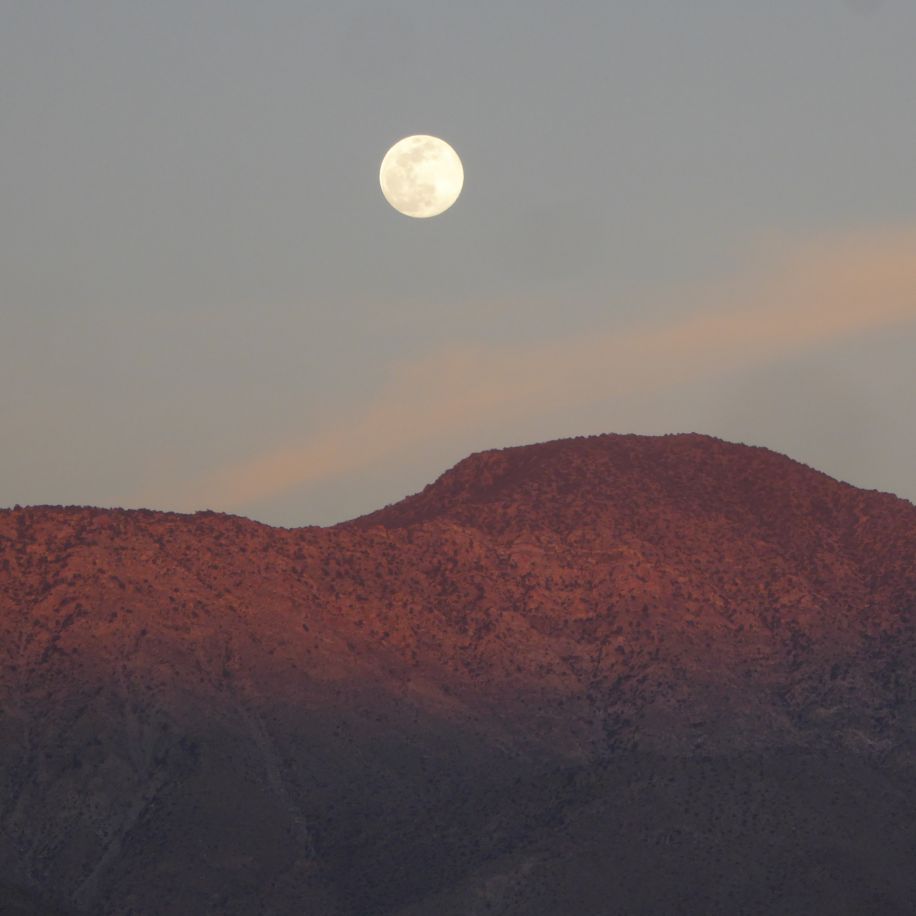
We got back to the car just as it was getting
dark. Don's pix of the moon rise:
http://tchester.org/temp/230204/rideout/moonrise_over_coyote_mtn_25.jpg
Our our drive back, we wondered what the "fenced
station with a satellite dish" was. It is just north of
Clark Dry Lake. If anyone knows what this is, please tell us. I
don't think it is a GPS station, since it doesn't have the little
dome those have.
At Clark Dry Lake, the "Peace
House" was ablaze with lights, with a campfire.
List
of plants in bloom:
99 Achyronychia
cooperi
99 Brassica tournefortii
99
Chylismia claviformis peirsonii
99 Condea
emoryi
99 Cryptantha angustifolia
99
Encelia farinosa
99 Eschscholzia minutiflora
99 Eschscholzia parishii
99
Hesperocallis undulata
99 Lupinus arizonicus
99 Perityle emoryi
99
Phacelia distans
50 Eulobus
californicus
50 Logfia depressa
50
Malacothrix glabrata
50 Palafoxia arida arida
50 Phacelia crenulata minutiflora
40
Loeseliastrum matthewsii
30 Chaenactis
fremontii
30 Eriogonum thomasii
30
Monoptilon bellioides
25 Eremothera
boothii condensata
20 Justicia
californica
20 Rafinesquia neomexicana
10 Caulanthus hallii
10
Cryptantha barbigera barbigera
10 Cryptantha
maritima
10 Cryptantha micrantha micrantha
10 Emmenanthe penduliflora penduliflora
10 Mimulus bigelovii bigelovii
10
Nama demissa demissa
10 Peritoma arborea
angustata
6 Larrea tridentata
5
Ambrosia salsola salsola
5 Camissoniopsis
pallida pallida
5 Mirabilis laevis retrorsa
5 Psorothamnus schottii
5
Senecio mohavensis
3 Eriogonum inflatum
3 Lepidium lasiocarpum lasiocarpum
3
Marina parryi
3 Pectocarya recurvata
3
Physalis crassifolia
2 Abronia villosa
villosa
2 Bebbia juncea aspera
2
Cryptantha nevadensis
2 Eucrypta micrantha
2 Fagonia laevis
2
Linanthus jonesii
2 Nemacladus glanduliferus
2 Salvia columbariae
2
Thamnosma montana
1 Adenophyllum
porophylloides
1 Allionia incarnata incarnata
1 Caulanthus lasiophyllus
1
Cryptantha pterocarya
1 Descurainia pinnata
1 Dithyrea californica
1
Eriogonum fasciculatum polifolium
1 Euphorbia
eriantha
1 Gilia stellata
1
Hibiscus denudatus
1 Mammillaria dioica
1
Pectis papposa papposa
1 Pleurocoronis
pluriseta
1 Tiquilia palmeri
1
Tomostima cuneifolia
1 Trixis californica
californica
--
tom
chester