Don
Rideout and I had one main goal for this trip, to see the Deep Canyon
Snapdragon population discovered by Sanjiv Nanda, Mark and Rebecca
Stevens on an ABDNHA hike in Palo Verde Canyon on 1/22/23, and to
survey for more plants of that species. Carla Hoegen also asked
us to follow-up on a baby Peucephyllum she and Fred had photographed
in November.
To do that survey, we really wanted to get
to the end of Palo Verde Canyon, a 7 mile roundtrip hike. And
we did it, arriving back at the car exactly at last light!
We
began hiking at S22 / Palo Verde at 11:38 a.m., where the temp was a
somewhat chilly 63 deg, with a somewhat-cool breeze. Fortunately, the
breeze was at our backs as we were hiking up the wash, so it
essentially disappeared.
The beginning of the hike was
pretty non-floriferous. The main plant species in bloom was
Phacelia crenulata. Some of the blooms were small enough that
we had to spend some time looking at plants for a while to decide
whether it was var. minutiflora or the larger-flowered var. ambigua.
But that was only because it had been a while since we had seen
either in bloom.
Here's the first plant we saw, from
Don's obs:
https://www.inaturalist.org/observations/147590036
and here's one of the next few plants, which had pretty
small flowers:
https://www.inaturalist.org/observations/147590663
My page showing the two varieties next to each
other made it clear that all of our plants were ssp. ambigua:
http://tchester.org/bd/species/boraginaceae/phacelia_crenulata.html
My usual test to discriminate the varieties is
whether I feel sorry for a (minutiflora) plant with such small
blooms, and I never felt sorry on this trip. (:-) Don
decided the best test was that if you could see the flowers from some
distance away, it was ambigua. Both tests worked.
We
mostly hiked up the wash, and were making almost 2.0 mph until we
started to slow down a bit due to finding more happy plants in bloom
the farther we went up the canyon. We found Carla's baby
Peucephyllum right away, and found it had grown quite a lot in just
six weeks.
Don's post:
https://www.inaturalist.org/observations/147592562
My post:
https://www.inaturalist.org/observations/147745361
Fred and Carla's post from six weeks earlier:
https://www.inaturalist.org/observations/144113815
We soon found that there were HUNDREDS of
Peucephyllum babies farther up, one of which had a single bloom!
My posts:
https://www.inaturalist.org/observations/147746250
https://www.inaturalist.org/observations/147746251
While looking at something else, I spotted a
Nemacladus glanduliferus IN BLOOM, our first Nemacladus of the year!
Don's post:
https://www.inaturalist.org/observations/147594241
My post:
https://www.inaturalist.org/observations/147779557
Don spotted the first Deep Canyon Snapdragon a bit
later:
https://www.inaturalist.org/observations/147595108
There were three plants total there, all presumably
wash-downs from the population found by Sanjiv's group.
By
then, we were pretty excited, from the DC snapdragon, Peucephyllum
babies, and the number of flowers we were seeing. There were a number
of Eschscholzia parishii in bloom, including some pretty good
displays.
Don's first post:
https://www.inaturalist.org/observations/147593936
Don's pix of one of the displays:
http://tchester.org/temp/230128/rideout/Eschscholzia_parishii_field_35.jpg
An hour after spotting the three wash-down
snapdragon plants, our breath was taken away by a large number of
plants of the DC Snapdragon, including some pretty big ones. We
quickly started counting them, and found a total of 63 plants in this
area.
We thought at first we had found a new population,
because I didn't think we were at Sanjiv's location yet, and so I
hadn't been consulting my GPS. But when we finally recovered from all
the excitement of seeing this large number of easily-accessible DC
Snapdragon plants, I checked Sanjiv's GPS point, and it was bang-on
this location.
Don and I surveyed all the way to
the top of the canyon, and only found those three probable wash-down
plants outside of Sanjiv's location.
Don and I were both
very surprised that we didn't find additional plants, since there is
quite a bit of suitable habitat for it, both in the wash and on the
rocky slopes. The "Ajo Peak To Tinajas Altas: A Flora Of
Southwestern Arizona "gives its habitat as "washes,
bajadas, canyons, and slopes; widespread across the region but seldom
common".
It is really quite a mystery as to why it
is found in so few areas, despite so much suitable habitat for it.
But that apparently is par for the course for this species even in
Arizona. And we are at the edge of its range, so it may find
our area marginal for its success.
The canyon floor
got rockier as we got near the top. It seems like perfect
habitat for the DC Snapdragon, but none were found.
Don
took this pix of me near the top:
http://tchester.org/temp/230128/rideout/tom_near_canyon_top_25.jpg
The uppermost part of the canyon was dense with
Chylismia cardiophylla. Don's post:
https://www.inaturalist.org/observations/147642727
https://www.inaturalist.org/observations/147641365
There was even a small amount of water at the very
top flowing in the canyon floor.
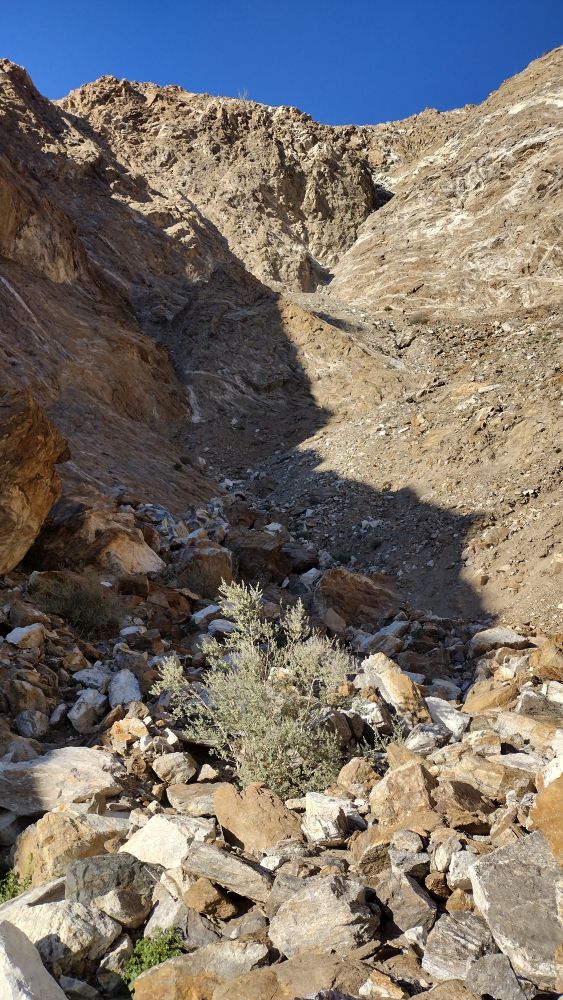
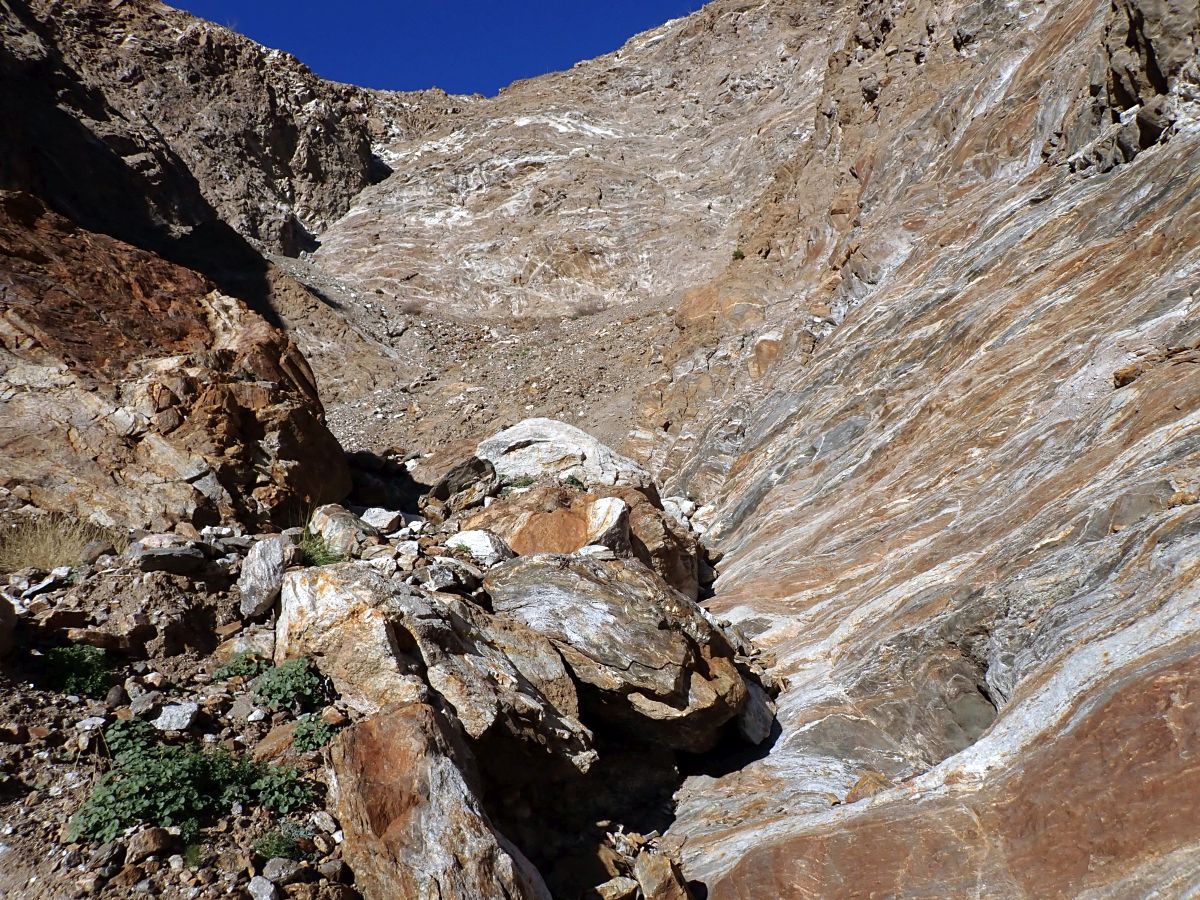
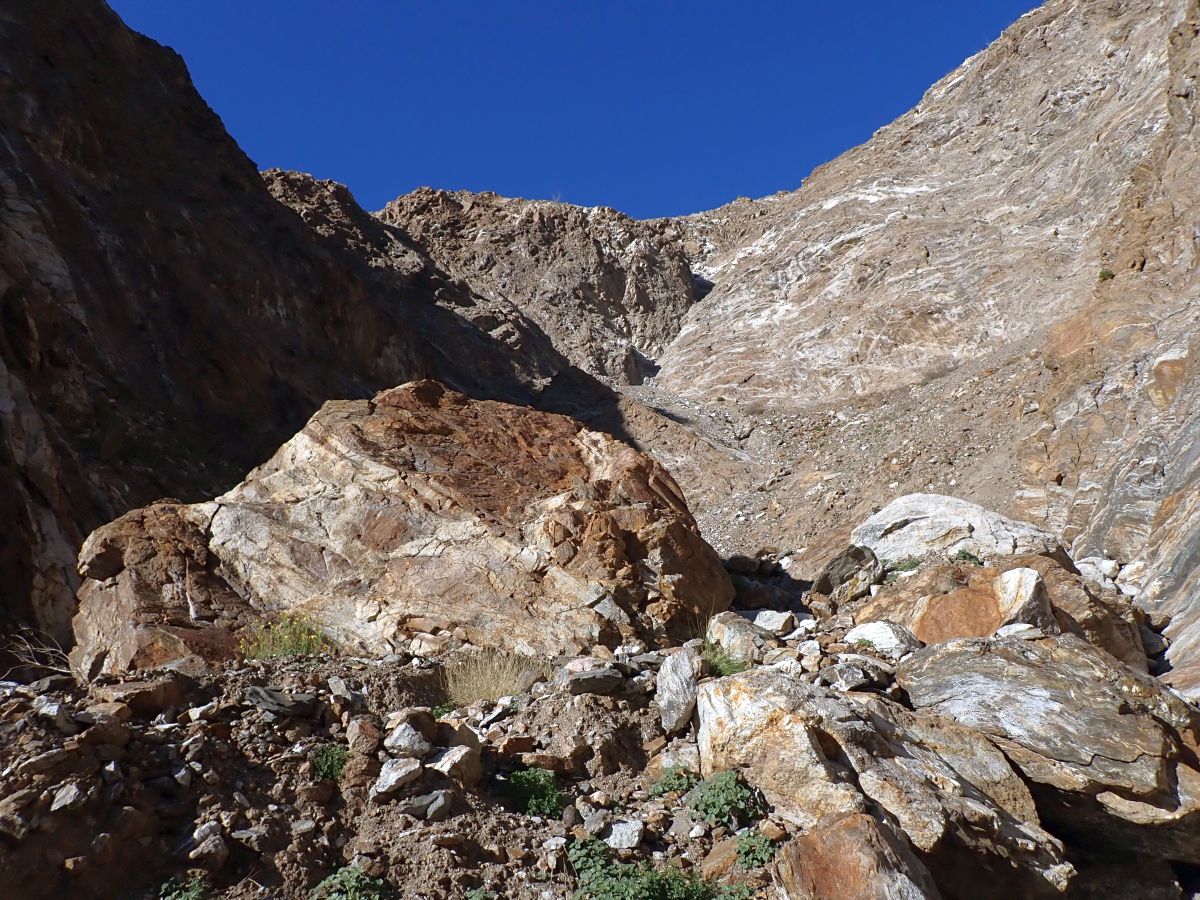
We really enjoyed
reaching the top of the canyon, where it ends in a big bowl.
Don's
pix:
http://tchester.org/temp/230128/rideout/canyon_top_25.jpg
My pix:
http://tchester.org/temp/230128/top_palo_verde_canyon_05_30.jpg
http://tchester.org/temp/230128/top_palo_verde_canyon_07_30.jpg
However, there was a price to be paid for reaching
the top of the canyon while doing botanizing on the way up. We
were about a half hour past a good turn-around time to get back to
the car without flashlight hiking. That of course was fine with
us, to make sure there were no DC Snapdragon plants farther up.
And
it worked out well. We really hustled down the canyon, and
arrived back at the car exactly at last light!
Don
and I posted a total of 90 obs of 45 species:
https://www.inaturalist.org/observations?on=2023-01-28&place_id=95385&user_id=tchester,lagoondon
I posted 56 obs of 28 species; Don posted 34 obs of 26
species.
We noted 45 species in bloom. The bloom
list is given at the end of this email.
Other
highlights:
There were THREE sets of bighorn sheep bones
in the upper canyon. Don speculated that was due to the Rock tanks
that hold water, with mountain lions picking off sheep at the water
hole. One set of bones was just a lamb. Don's pix:
https://www.inaturalist.org/observations/147643139
We tried to follow up the Lupinus concinnus baby
found by Cathy Wiley on our previous trip here on 25 November 2022,
but they had scraped the entire surface clean. (:-(
Amazingly, though, a new baby Lupinus concinnus had sprouted here!
My pix:
https://www.inaturalist.org/observations/147746901
We found a total of EIGHT Pectis plants still in
decent bloom! My pix of one of them:
https://www.inaturalist.org/observations/147747010
On the way up, we had tried, but failed, to locate
a baby Ferocactus that Don had found on the previous trip, despite
having a GPS point for it. On the way down, we tried again, and
once again failed to find it at the GPS point. The GPS point
was on a hillside, where we both also thought was the location, from
memory. But after giving up, while having a snack, I remembered
it was actually in the wash. As soon as I said that, Don spotted it.
(:-)
The plant had not changed at all in two months!
Don's pix from this trip:
https://www.inaturalist.org/observations/147643641
Don's pix from two months earlier:
https://www.inaturalist.org/observations/142980714
On the way down, I spotted a number of Eschscholzia
parishii petals lying on the ground, apparently from finished
blooms. My post:
https://www.inaturalist.org/observations/147805979
We noticed considerable frost damage to some
plants, especially on Mentzelia involucrata. My posts:
https://www.inaturalist.org/observations/147747404
https://www.inaturalist.org/observations/147747405
https://www.inaturalist.org/observations/147747406
https://www.inaturalist.org/observations/147747407
https://www.inaturalist.org/observations/147747408
Don photographed a Mohavea plant in bloom on the
way up, and I thought it had opened another bloom on our way down.
It turned out it was a different plant, but my pix captured an insect
inside one flower:
https://www.inaturalist.org/observations/147805396
We noticed a young ocotillo on the way down, and
that finally stimulated me to start the page on ocotillo recruitment
that Don and I have been accumulating data for.
The 5 to
six year old ocotillo on this hike:
https://www.inaturalist.org/observations/147806718
The start of our page on ocotillo recruitment:
http://tchester.org/bd/species/fouquieriaceae/recruitment.html
The temp was a chilly 55 deg when we got back
to the car, but it didn't bother us at all. We were warmed
internally by the good feelings we had from this trip! (:-)
List of species in bloom
#Pls in bloom
Species Name
99 Cryptantha angustifolia
99 Eschscholzia parishii
99
Perityle emoryi
99 Phacelia crenulata var.
ambigua
50 Chamaesyce polycarpa
50
Eschscholzia minutiflora ssp. minutiflora
50
Pseudorontium cyathiferum
30 Mentzelia
involucrata
20 Achyronychia cooperi
20 Hyptis emoryi
20
Trichoptilium incisum
15 Cryptantha
maritima
10 Encelia farinosa var.
farinosa
10 Lupinus arizonicus
10
Physalis crassifolia
8 Pectis papposa
var. papposa
5 Acmispon strigosus
5
Chylismia cardiophylla ssp. cardiophylla
5
Dalea mollissima
5 Eriogonum inflatum
5
Eriogonum thomasii
3 Larrea tridentata
3 Marina parryi
3
Palafoxia arida var. arida
3 Senecio
mohavensis
2 Abronia villosa var.
villosa
2 Allionia incarnata var. incarnata
2 Chylismia claviformis ssp. peirsonii
2
Eremothera boothii ssp. condensata
2 Mohavea
confertiflora
2 Nicotiana obtusifolia
2
Peucephyllum schottii
2 Plantago ovata
2
Sisymbrium orientale
1 Aliciella
latifolia ssp. latifolia
1 Bebbia juncea var.
aspera
1 Brassica tournefortii
1
Chenopodium murale
1 Ditaxis lanceolata
1
Draba cuneifolia
1 Fagonia pachyacantha
1
Geraea canescens
1 Lepidium lasiocarpum ssp.
lasiocarpum
1 Nemacladus glanduliferus
1
Psorothamnus schottii
--
tom
chester