Bloom Reports from the Anza-Borrego Desert: 2024-2025
Table of Contents
Latest Summary of Bloom Status
Bloom Reports from Individual Hikes This Season
Links to Other Webpages on Anza-Borrego Desert State Park Blooms
Background Information for Bloom Reports from the Anza-Borrego Desert
Older Bloom Reports from 2009 to present

| 
|
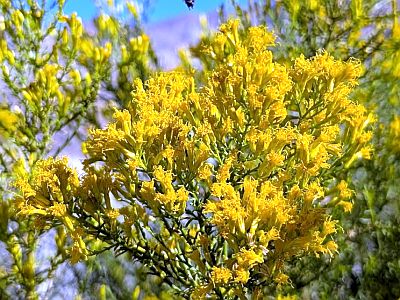
| Fig. 1. Left: Encelia farinosa, brittlebush, observed by Tom Chester on 14 December 2024 in Hellhole Canyon. Right: Ericameria paniculata, black-banded rabbitbrush, observed by Fred Melgert and Carla Hoegen on 7 December 2024 in the drainage from Ash Canyon, just east of Ocotillo Flat, in lower Coyote Canyon.
Click on the pix to go to the iNat obs of each, showing exactly where those photos were taken. | |
Latest Summary of Bloom Status
Summary as of 20 December 2024
Most of the Borrego Desert is dry, dry, dry.
Borrego Springs, as measured at the official weather site used by the National Weather Service, has received no measurable rainfall at all since 6 April 2024. As of 20 December 2024, this streak is 258 days and counting, 8.5 months. This is the second longest dry period on record at that station. The longest dry period was 284 days from 18 February to 28 November 2009, according to NWS Forecaster Miguel Miller.
It is also the second longest dry period, if one discounts daily rain totals of 0.10 inches or less. A daily rain of 0.10 inches or less is not very useful to plants in the desert since it evaporates quickly in the desert heat and low humidity. Ignoring daily rain of 0.10" or less, our streak is at 280 days and counting, over nine months, beginning on 16 March 2016. This is very close to the record streak of 284 days from 18 February through 28 November 2009.
Worse, Borrego Springs probably had its hottest summer on record. There were about 50 days in the summer with high temperatures of 110 to 121 degrees, far hotter than it used to be in the summer. The minimum temperatures at night often did not go below 90 degrees, giving the plants little or no recovery time from the daytime heat. So it is no surprise that in most places, the plants look to be near death. The Encelia farinosa, brittlebush, in Fig. 1 is typical of the vast majority of plants of that species.
But in some areas, especially in washes with deep sand that stores water, there are blooming plants that look good! Since 1 December 2024, there have been 186 iNat posts of 44 species in bloom. The numbers may be higher if you click on that link after 20 December. The most commonly posted species in bloom are Ericameria paniculata, black-banded rabbitbrush (see Fig. 1); and Asclepias subulata, rush milkweed. If you go to the places where those two species live, you'll see a good number of blooms.
However, in most areas, you are likely to see only a handful of plants in bloom, of just a few species. If you are lucky, you might see 10 to 20 species in bloom.
The southern parts of the Borrego Desert, and the areas to the west of the desert floor, are in better shape. Although the monsoon season was nearly a total bust this year in the entire Southwestern U.S., we had one day, 10 August 2024, with fairly widespread thunderstorms. Good rainfall extended from the Ranchita area on the north, with 1.43 inches, to Agua Caliente on the south, with 0.85 inches. The town of Anza, to the north of Ranchita, received only 0.19 inches, so the rainfall did not extend much to the north of Ranchita.
One of the best areas for happy plants in that area is Rainbow Wash and the nearby Blair Valley area. The 11 August 2024 thunderstorm dropped a lot of rain there, that was not measured by any rain gauge since there are no rain gauges in the vicinity. The rain from that thunderstorm caused significant flow in the washes, with high water levels that ranged from a few inches to one foot deep, judging from the debris on plants in the washes. The plants looked happy on our 5 November 2024 trip there, and have continued to look good into December.
An even better spot with deep sand is between Diablo Canyon and Fish Creek Wash, but everything there is fading fast, and it requires 40 minutes of driving on a wash road to get there.
You can explore the state of the bloom yourself from the comfort of home with the iNat 774 observations of 198 species, mostly non-blooming, posted at iNat since 1 December 2024 (numbers are as of 20 December 2024; your numbers will be greater as more obs are added from later dates). Click on "Filters" in the upper right to change the date range if you want to see only very recent observations.
Click on the "Map" tab at the link and you can zoom into the map to see where the reports are. Once you zoom into a given area, click on the "Redo search in map", or use the rectangular or circular area tool to circumscribe your area, to find out how many flower observations there are in your desired area. Each observation gives the date and time of observation, and the latitude and longitude for each observation, which is plotted on a map so you can see where it was observed (rare species have obscured coordinates, which have a different symbol on the map and wildly-inaccurate coordinates from the obscuration).
See also previous versions of this page.
Bloom Reports from Individual Hikes This Season
The latest bloom reports are given first (i.e., the reports are in inverse order of time). As detailed immediately above, you can see a map of where the hikes were from any linked iNat post of the species in bloom.
For many more bloom reports, see Anza-Borrego Wildflowers Bloom Report by Fred Melgert and Carla Hoegen.
Bloom Reports not yet added to this page
Links to Other Webpages on Anza-Borrego Desert State Park Blooms
Anza-Borrego Wildflowers Bloom Report by Fred Melgert and Carla Hoegen, often with daily wildflower updates.
All iNaturalist observations in the Borrego Desert since 1 December 2024, 774 observations of 198 species (numbers are as of 20 October 2024 (click on "Filters" to change the dates).
Wildflower Updates from the Anza-Borrego Desert Natural History Association.
Anza-Borrego Desert State Park official site, with wildflower information on it. When they start producing current wildflower reports, click on the link near the top with the word Update, which might be updated weekly.
DesertUSA Anza-Borrego Desert State Park Wildflower Reports
Anza-Borrego Foundation and Institute Wildflowers and their Anza-Borrego Desert State Park Wildflower Hotline: (760)767-4684. "Information on this recording is updated regularly."
Theodore Payne Wildflower Hotline (Reports begin the first Friday in March)