Bloom Reports from the Anza-Borrego Desert: 2023-2024
Table of Contents
Latest Summary of Bloom Status
Bloom Reports from Individual Hikes This Season
Links to Other Webpages on Anza-Borrego Desert State Park Blooms
Background Information for Bloom Reports from the Anza-Borrego Desert
Older Bloom Reports from 2009 to present
| 
|
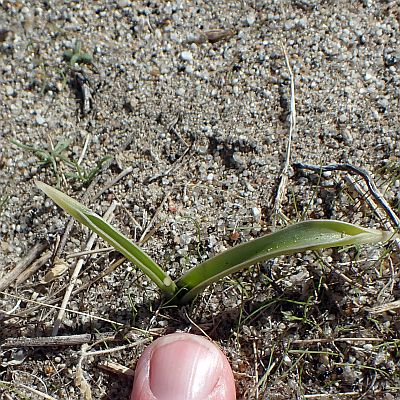
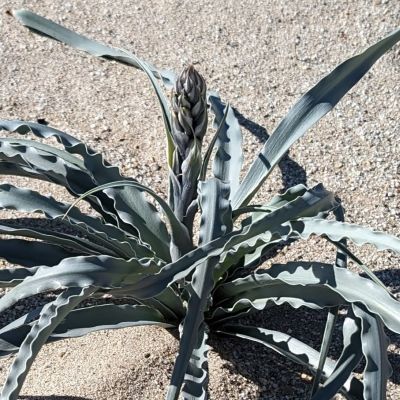
| Fig. 1. Two Hesperocallis undulata, desert lily, plants photographed on 10 January 2024.
Left: very young small plant near the pavement end of Di Giorgio Road that probably emerged from the December 2023 rain, by Tom Chester. Right: A very large plant with a robust bud stalk just north of Henderson Canyon Road a bit west of the PegLeg Monument, that emerged from the August rain, by Don Rideout. Low numbers of desert lilies that came up after the August rain have been observed over a fairly widespread area. The young plant shown at left may be the first ones coming up from the December rain. No desert lilies have come up yet in Don's Borrego Springs yard as of 9 January 2024. Click on the pix to go to the iNat obs of each by Don Rideout. | |
Latest Summary of Bloom Status
Summary as of 10 January 2024
The exciting news is that we have seen annual germination in the Borrego Springs area, and in canyons west of Borrego Springs. We have even seen three young desert lilies emerging from their slumber, and one very large desert lily that is about to bloom with many blooms! See Fig. 1.
We are in the usual winter lull in blooming plants. Fig. 2 shows a plot of the number of species seen in bloom on each desert trip so far this year, with a comparison to three other previous years.
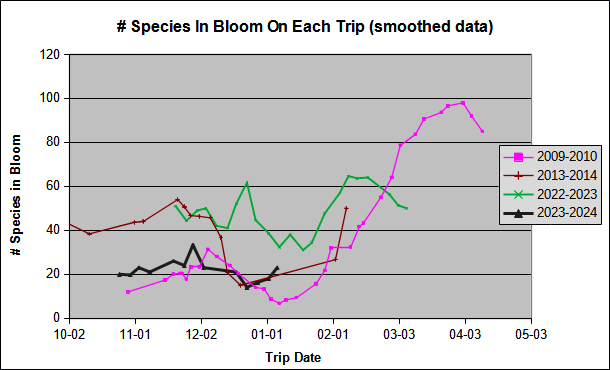
Fig. 2. Plot of the number of species seen in bloom on each desert trip so far this year (heavy black line), with a comparison to three other previous years. The data have been smoothed by averaging each trip with the previous trip and the subsequent trip. We are well below the number of species seen in bloom a year ago, but are very close to what was seen in the other two years shown.
The number of species seen in bloom on each trip has been remarkably consistent on most hikes since late October 2023, at about 20 to 30 species. Typically, most of those species have only one or a few plants in bloom. This is very representative of most years in the desert. Blooms don't usually start to become abundant until mid-February or March.
A notable exception with more species in bloom is Coyote Creek from the Second Crossing area to the gate closure at Third Crossing, which has water flowing to Second Crossing. It has the record for the most species seen in bloom, 63. But many of those plants are non-native weeds.
This is the third year in a row with good monsoonal rain in the Borrego Desert, which makes this yet another year in which the desert blooms consist of two very different components.
The first component is from plants that responded to monsoonal rains, specifically the unusually-good rain from the remnants of Tropical Storm Hilary on 19-20 August 2023. Hilary dumped seven inches on both Ranchita and Mt. Laguna, and the desert floor received a widespread two inches.
That rain resulted in widespread appearance of monsoonal species on the desert floor, especially Pectis papposa, chinchweed; Kallstroemia californica, California caltrop; Palafoxia arida, Spanish needles; and Allionia incarnata, trailing four o'clock. Those plants were probably in full bloom from mid-September through mid-October, but their bloom quickly declined after that, which is usually the case. Last year, their bloom hung on much later, since the rain that year came a month later.
As of 10 January 2024, the Kallstroemia plants were essentially all finished fruiting and dead, as were most of the Pectis and Palafoxia plants except for scattered individuals. Most Allionia plants on the desert floor were dead and finished, but increasing numbers of them are still alive as one heads into the hills west of Borrego Springs.
That August rain also germinated a very small number, in most places, of our usual spring plants in the sandiest areas of the desert, such as Abronia villosa, desert sand verbena; Perityle emoryi, Emory's rock daisy; and Geraea canescens, desert sunflower. There are many fewer plants of those species this year than came from the September rain in the previous summer. For example, last year there were spectacular carpets of sand verbena from October through March. This year, there are only isolated plants of those species in most areas. Those plants began blooming in October, and are still going strong as of 10 January 2024. See a map of those species, plus Palafoxia, observed since 1 December 2023, showing where those sandy areas are.
The best display from those plants are Geraea plants in a small part of the area north of Henderson Canyon Road, at 1.5 miles east of Borrego Canyon Road. Some scattered Badland canyon areas are filled with Perityle plants, such as at Blackwood basin wash and Diablo Dieguenos Loop.
There is also a good display of flowers from Malacothamnus enigmaticus in the Salt Creek area of Mason Valley, southwest of the Butterfield Mobile Home Park. There are hundreds of plants in bloom there, many covered with flowers. See the 19 iNat posts tagged as having flowers since 20 December 2023. This species is a fire-follower, and most of those plants will be dead in a few years.
As is typical, many plants of Xylorhiza orcuttii, Orcutt's aster, are in bloom in the Badlands.
The second component comes from the usual late winter / early spring bloomers. It is a bit too early to predict what will happen from the fall / winter rainfall, since we are still in the window where more rain can make a big difference. So far, we have had enough rain to germinate native annuals at higher elevations west of the desert floor, but probably not enough rain to germinate native annuals on the desert floor east of Borrego Springs. We have observed fairly good germination of Phacelia distans, common phacelia, in canyons west of Borrego Springs. We have observed limited germination in the Borrego Springs area itself.
A few tenths of an inch of rain fell on 13-14 November 2023, and a half to 3/4 of an inch fell on 21-22 December 2024, with both rains widespread on the desert floor. Higher amounts of rainfall occurred west of Borrego Springs. To have a good desert season on the desert floor, we need to receive another inch or so before about 1 February 2024.
In the last three weeks, from 20 December 2023 to 12 January 2024, there were 326 iNat obs of 87 species tagged as being in bloom. The most-frequently posted species are Malacothamnus enigmaticus (19 posts); Abronia villosa, sand verbena (15 posts); Perityle emoryi, Emory's rock daisy (15 posts); and Palafoxia arida, Spanish needles (14 posts).
You can explore the state of the bloom yourself from the comfort of home with the iNat 1,984 observations of 272 species posted at iNat since 20 December 2023 (numbers are as of 12 January 2024; your numbers will be more as more obs are added from later dates). Click on "Filters" in the upper right to change the date range if you want to see only very recent observations.
Note that some of the species in bloom with only a few observations may be represented by only a single individual, or a small number of individuals. Also, how many and which species you see in bloom on your hike is largely determined by where you hike and how far you hike. Many species are restricted to a certain elevation range, or certain locations.
Click on the "Map" tab at the link and you can zoom into the map to see where the reports are. Once you zoom into a given area, click on the "Redo search in map", or use the rectangular or circular area tool to circumscribe your area, to find out how many flower observations there are in your desired area. Each observation gives the date and time of observation, and the latitude and longitude for each observation, which is plotted on a map so you can see where it was observed (rare species have obscured coordinates, which have a different symbol on the map and wildly-inaccurate coordinates from the obscuration).
See also previous versions of this page, and detailed reports from each hike below for locations and lists of the species in bloom, which also report the number of plants observed in bloom.
Bloom Reports from Individual Hikes This Season
The latest bloom reports are given first (i.e., the reports are in inverse order of time). As detailed immediately above, you can see a map of where the hikes were from any linked iNat post of the species in bloom.
For many more bloom reports, see Anza-Borrego Wildflowers Bloom Report by Fred Melgert and Carla Hoegen.
Bloom Reports not yet added to this page
10 January 2024.
For many more bloom reports, see Anza-Borrego Wildflowers Bloom Report by Fred Melgert and Carla Hoegen.
Links to Other Webpages on Anza-Borrego Desert State Park Blooms
Anza-Borrego Wildflowers Bloom Report by Fred Melgert and Carla Hoegen, often with daily wildflower updates.
All iNaturalist observations in the Borrego Desert since 20 December 2023 (click on "Filters" to change the dates; there were 1,984 observations of 272 species posted at iNat as of 12 January 2024)
Wildflower Updates from the Anza-Borrego Desert Natural History Association.
Anza-Borrego Desert State Park official site, with wildflower information on it. When they start producing current wildflower reports, click on the link near the top with the word Update, which might be updated weekly.
DesertUSA Anza-Borrego Desert State Park Wildflower Reports
Anza-Borrego Foundation and Institute Wildflowers and their Anza-Borrego Desert State Park Wildflower Hotline: (760)767-4684. "Information on this recording is updated regularly."
Theodore Payne Wildflower Hotline (Reports begin the first Friday in March)